The Ultimate Guide to Choosing a Custom Gun Holster for Your Carry Style
Pick a holster that fits your exact gun, holds it securely, and stays comfortable all day. For most daily carriers, a custom Kydex holster with adjustable retention and an appendix (AIWB) setup is the best mix of speed, safety, and comfort. Choose leather if you want a softer feel and a classic look. Match every option to your gun, your body, and your daily routine.
How to Choose a Custom Gun Holster: The Quick Answer
Follow these five steps:
- Pick your carry position. Where the gun sits on your body decides almost everything else.
- Pick your material. Kydex or leather (or a hybrid).
- List your gun’s add-ons. Red dot, weapon light, threaded barrel, or extended magazine.
- Choose your attachments. Clips, claws, wings, or loops.
- Set your adjustments. Ride height, cant, and retention.
If you do these five things in order, you will avoid most of the mistakes that lead to a holster sitting in a drawer.
Why Go Custom Instead of Off-the-Shelf?
Production holsters are made to fit many guns loosely. A custom holster is made for one gun setup. That difference matters.
What you gain with a custom fit
- Better retention. The holster grips your gun’s exact shape, so it holds tight without being hard to draw.
- Room for your add-ons. Optics, lights, and suppressor-height sights need specific cuts.
- Better comfort. You choose the size, shape, and hardware for your body.
- Cleaner concealment. A slim, well-placed holster prints less under a shirt.
What to watch out for
- Custom orders take longer than buying off the shelf.
- You must know your exact gun model, slide, and accessories before you order.
- Cheap “custom” work with poor molding can be worse than a good production holster.
Step 1: Pick Your Carry Position
Your carry position shapes how you draw, sit, drive, and bend. Here are the common options.
| Position | Where It Sits | Best For | Main Trade-Off |
|---|---|---|---|
| AIWB (Appendix Inside the Waistband) | Front of the body, near the belt buckle | Fast draw, easy to hide | Can dig in when you sit or bend |
| IWB at 3-4 o’clock | Side of the hip, inside the pants | All-day comfort, easy to learn | Harder to conceal on slim builds |
| Strong-side OWB (Outside the Waistband) | Outside the pants at the hip | Range, competition, duty | Needs a cover garment |
| Front pocket | Small guns, quick errands | Slower draw, small guns only |
Best AIWB Holsters for Concealment
Appendix carry is popular for good reasons. The gun stays close to your body and under your hands. Your shirt hangs naturally over it. And it is hard for someone to reach from behind.
A good AIWB setup usually has these traits:
- A slim profile. Less bulk means less printing.
- A claw or wing. This small piece pushes the grip toward your body so the gun does not tilt out.
- A soft or rounded edge where the holster meets your stomach.
- Full trigger guard coverage. This is a must-have safety feature. Never carry a gun in a holster that leaves the trigger open.
Safety note: Appendix carry points the muzzle toward your front. Practice with an unloaded gun first. Take a class from a qualified instructor before you carry daily this way. Always re-holster slowly and keep clothing and straps clear of the trigger.
Step 2: Kydex vs. Leather
This is the biggest choice for most buyers. Both work well. Each has strengths.
Custom Kydex Holsters vs. Leather at a Glance
| Feature | Kydex | Leather |
|---|---|---|
| Material | Hard thermoplastic | Cured animal hide |
| Retention | Clear “click,” stays the same | Softens over time, may loosen |
| Break-in time | None | Days to weeks |
| Water and sweat | Not affected | Can absorb moisture |
| Re-holstering | Mouth stays open | Mouth may collapse when empty (unless reinforced) |
| Comfort against skin | Harder feel | Softer feel |
| Weight and thickness | Thin and light | Usually thicker |
| Looks | Modern, tactical | Classic, traditional |
| Care | Wipe clean | Needs conditioning |
| Price | Usually mid-range | Often higher for hand-finished work |
When Kydex Is the Better Pick
- You want a fixed, reliable click.
- You carry in hot or humid weather.
- You want a thin holster.
- You need precise cuts for optics or lights.
- You train a lot and re-holster often.
When Leather Is the Better Pick
- You want a softer feel on your body.
- You like the look and feel of traditional gear.
- You carry mostly in cooler weather.
- You don’t mind a break-in period.
What About Hybrids?
A hybrid mixes a leather backer with a Kydex shell. You get a soft surface on your skin and a firm shell around the gun. The downside is that hybrids are often wider and thicker. They can print more under thin shirts.
Step 3: Match the Holster to Your Gun Setup
This is where custom really pays off. Tell the maker about every part of your gun before you order.
Optic-Cut Custom Holsters
Many people now carry pistols with red dots. A standard holster may not fit a slide with an optic on top. An optic-cut holster has extra space so the dot clears the shell and the gun seats fully.
Check these details:
- Your exact optic footprint. Common examples include the Trijicon RMR, Holosun 507C, and Shield RMSc. They all differ in size.
- Your sight height. Suppressor-height sights need more clearance.
- Your mounting plate. Plates change the total height.
- Your slide model. Cuts differ between a stock slide and an aftermarket slide.
If the optic touches the holster, it can rub, get scratched, or lose zero over time. A good cut keeps the optic clear.
Custom Holsters for Weapon-Mounted Lights (WML)
A light changes the shape of the front of your gun. A holster made for a bare pistol will not fit a light.
- Choose a holster molded for your exact light model, such as a Streamlight TLR-7 or SureFire XSC.
- Confirm your gun’s rail type. Not every light fits every rail.
- Make sure the trigger guard is fully covered.
- Check that the light’s switch does not get pressed by the holster.
Remember: a holster made for a TLR-7 will not fit a TLR-7 Sub. Small size differences matter.
Step 4: Choose Attachments for Comfort and Concealment
Attachments decide how the holster sits on your belt and how it feels at 6 p.m. after a long day.
Common Attachment Types
| Attachment | How It Works | Best For |
|---|---|---|
| Belt clip | Snaps over the belt | Easy on and off |
| Hook or loop | Wraps around the belt | Extra stability |
| Claw or wing | Pushes the grip in toward the body | Reducing grip print |
| Soft loops | Fabric or rubber straps | Quiet, secure fit |
| Belt slots (OWB) | Belt passes through the holster | Solid, steady carry |
Claw and Wing Attachments Explained
A claw or wing is a small shape on the outside of the holster. It presses against the belt and pivots the gun. The top of the grip tucks in toward your body. The result is less print and a more comfortable feel.
Tips:
- Try one first if your grip prints through your shirt.
- Choose the right size for your belt width.
- Do not expect it to fix a holster that is too big for you.
Don’t Forget the Belt
A great holster on a weak belt will sag. Get a stiff gun belt made for carrying. It keeps your holster steady and your gun where you expect it.
Step 5: Adjust Ride Height, Cant, and Retention
Custom holsters often let you fine-tune the fit. Small changes make a big difference.
Adjustable Ride Height
Ride height is how high or low the gun sits.
- Higher ride: Easier to conceal, but the grip may be harder to reach.
- Lower ride: Easier to grab, but the grip may print more.
Most people find the best spot after a few weeks of wearing the holster.
Cant (Angle)
Cant is the tilt of the gun.
- Neutral cant: The gun sits straight up and down. Good for OWB and easy for new shooters.
- Forward cant: The grip tilts back toward your body. Popular for AIWB and strong-side carry.
Move the angle a little at a time. Test each change with an empty, cleared gun.
Retention Adjustment
Retention is how firmly the holster holds the gun.
- Too loose: The gun can move, tip out, or fall.
- Too tight: The draw is slow or hard.
Many Kydex holsters have a screw that lets you tune retention. A good rule is to turn the gun upside down, with the gun unloaded, and shake gently. The gun should stay put. Then check that you can draw smoothly with one hand.
Real-World Examples
Example 1: The office worker
Sam sits at a desk for eight hours. He picks a slim Kydex AIWB holster with a wing and sets a slightly higher ride height so the grip does not push into his lap. He wears it with a stiff belt and a loose button-up shirt.
Example 2: The competitive shooter
Maya shoots weekend matches. She wants a fast draw and a secure hold. She picks an OWB Kydex holster with a neutral cant and an optic cut for her red dot. Retention is set a bit firmer for running drills.
Example 3: The night-shift officer
Jordan carries a pistol with a weapon light. He needs a light-specific holster with full trigger guard coverage. He picks a durable Kydex model and tests it in his car seat before wearing it on shift.
Common Mistakes to Avoid
- Ordering before you check your gun’s exact setup. Write down model, optic, light, and slide type.
- Choosing looks over safety. The trigger guard must be covered.
- Skipping the belt. A weak belt ruins a good holster.
- Changing many things at once. Change one setting at a time.
- Not practicing. Dry-fire and draw practice with an unloaded gun builds smooth habits.
- Ignoring local laws. Carry laws vary by state and country. Learn the rules where you live.
Quick Buyer’s Checklist
Before you place an order, confirm:
- Exact gun make, model, and slide
- Optic model and mounting plate
- Weapon light model
- Carry position
- Dominant hand (left or right)
- Belt width
- Attachment type
- Cant and ride height range
- Retention adjustment method
- Return and remake policy
How to Choose a Custom Gun Holster
Follow 5 steps in order
Kydex vs. leather
Pick your carry position
Fine-tune the fit
Where Hash Tactical Fits In
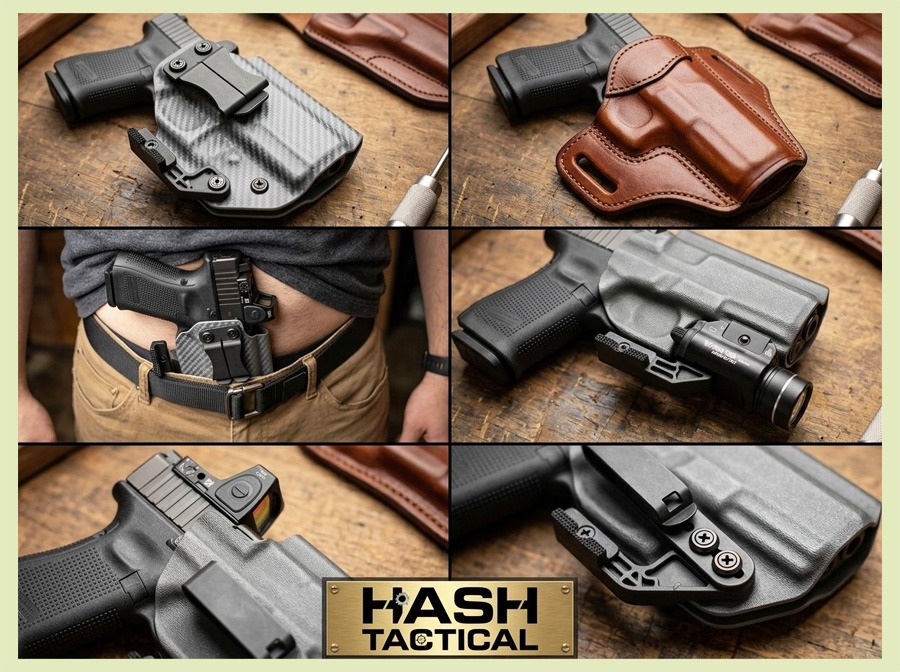
If you want a fit built around your gun, Hash Tactical offers custom holsters shaped around specific firearm models, optic cuts, and light setups. Their customized tactical gun holster category lets you compare options and choose the details that match your carry style. Whether you are upgrading from a generic holster or building your first everyday setup, Hash Tactical can help you narrow down the details before you order.
Frequently Asked Questions
Kydex is the top pick for most daily carriers. It is thin, strong, and consistent. Leather is a good choice if you want a softer feel and don’t mind a break-in period.
It can be safe with the right gear and training. Use a holster that fully covers the trigger guard, a stiff belt, and slow, careful re-holstering. Take a class before carrying this way.
Often, yes. A standard holster may not clear the optic. An optic-cut holster gives the right space and keeps the gun seated properly.
Not with a true custom fit. Each gun and accessory setup needs its own mold.
A well-made Kydex holster can last for years. Leather can also last many years with proper care.
Cant is the angle of the gun. It changes how the grip sits against your body and how easy the draw feels.
It pushes the top of the grip closer to your body. This helps reduce printing and keeps the holster steady.
Tight enough that the gun stays put when you move, but loose enough for a smooth one-handed draw.
Final Thoughts
The right holster feels almost invisible. It holds your gun safely, sits in the same place every day, and lets you draw with confidence. Start with your carry position, choose Kydex or leather, match your optic and light, and fine-tune the fit. Take your time. A few good choices now save money and trouble later.
Ready to build a precision fit for your everyday carry? Explore our custom mold configurator to select your firearm model, optic cuts, and retention preferences today.
👉 Explore custom tactical gun holsters at Hash Tactical
If you have any questions before making purchase, contact our expert team today!
Disclaimer: This guide is for general education. Follow all local laws, get proper training, and follow your firearm maker’s safety rules.