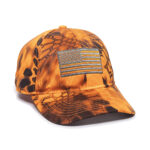
Why a Custom Tactical Gun Holster is Worth Every Penny
A custom tactical gun holster is not a luxury. It is a force multiplier and fits your body. It fits your firearm and your mission. Generic holsters are a gamble with your life. Custom-built, precision-crafted holsters are the standard that operators, law enforcement, and serious civilian carriers should demand — no exceptions.
The Moment I Understood What a Holster Really Means
Let me take you back to 2004. Fallujah. The streets smelled like cordite and dust. My squad was clearing a building — room by room, stack by stack. In the chaos, the Marine to my left went for his sidearm. His generic-issue holster had shifted. Retention snaps had loosened. He lost two seconds.
In a gunfight, two seconds is an eternity.
He recovered. We all made it out. But that moment burned itself into my brain like a brand. A holster is not a carrying accessory. It is the last line of interface between you and your weapon when everything goes sideways. It has to work. Every. Single. Time.
That is why custom tactical holsters exist, and they matter. That is why every serious operator I know swears by them.
Chapter 1: What Makes a Holster “Tactical”?
The Word Gets Thrown Around Too Much
Walk into any sporting goods store. You’ll see the word “tactical” plastered on everything from flashlights to socks. The term has been diluted. So let’s define it on our terms.
A tactical holster is one engineered for active use in high-stress, dynamic environments. It is not decorative or casual. It is purpose-built for:
- Speed — Draw time measured in fractions of a second
- Retention — The weapon stays put until you decide otherwise
- Durability — Survives heat, cold, mud, water, and hard use
- Accessibility — Compatible with body armor, plate carriers, and duty belts
- Concealment or accessibility — Depending on mission parameters
A tactical holster must function perfectly whether you’re sprinting across a parking lot, crawling through brush, or seated in a vehicle.
The Tactical Spectrum
Not all tactical holsters are built for the same role. Understanding the spectrum matters:
| Role | Holster Type | Priority |
|---|---|---|
| Military Operator | Drop-leg / MOLLE-attached | Retention + Access |
| Law Enforcement | Duty holster (Level II/III) | Security + Speed |
| Plain-clothes Agent | IWB / Appendix Carry | Concealment + Draw Speed |
| Civilian CCW | OWB / IWB | Comfort + Concealment |
| Competition Shooter | Open-top race holster | Max Speed |
| Security Personnel | Duty belt holster | Retention + Visibility |
Each role has different needs. A one-size-fits-all holster serves none of them well.
Chapter 2: The Problem with Off-the-Shelf Holsters
Mass Production = Mass Compromise
Here’s the cold truth. When a manufacturer builds a holster for 100,000 units, they’re not building it for you. They’re building it for a statistical average and cutting material costs. They’re standardizing parts and designing for the widest possible customer base.
That means compromises. Many of them.
Common failures of generic holsters:
- Poor weapon fit — Designed for a model, not a specific variant. A Glock 19 with a red-dot and light won’t fit a holster built for a standard Glock 19.
- Weak retention — Passive retention that loosens with wear. Weapons shift. In dynamic movement, they can fall out entirely.
- Wrong ride height — Too high, your draw is awkward. Too low, it snags on gear and furniture.
- Incompatible cant — Standard cant doesn’t work for every body type or carry position.
- Material degradation — Cheap Kydex cracks. Cheap leather stretches. Neither holds up in the field.
- No light or optic compatibility — Your weapon has a WML (weapon-mounted light) and a red dot. Good luck finding an off-the-shelf holster that fits it.
The Real Cost of “Cheap”
You spend $900 on a Glock 19 MOS and add a $300 Streamlight TLR-1. You mount a $350 Trijicon RMR. Then you jam it into a $35 nylon holster from a big-box store.
That’s $1,550 worth of weapon system held in place by $35 worth of material and two screws.
The math doesn’t work. The logic doesn’t work. And in the field — it definitely doesn’t work.
Chapter 3: The Anatomy of a Custom Tactical Holster
Every Component Has a Job
A custom tactical holster is an engineered system. Each element serves a specific function. Understanding those elements helps you demand the right product.
1. The Shell
The outer body of the holster. This is what most people see and what gives the holster its shape.
Premium materials used in custom builds:
- Boltaron — Military-grade thermoplastic. Tougher than standard Kydex. More impact resistant. Holds precise tolerances.
- Kydex — Industry standard. Lightweight, waterproof, durable. Excellent for most applications.
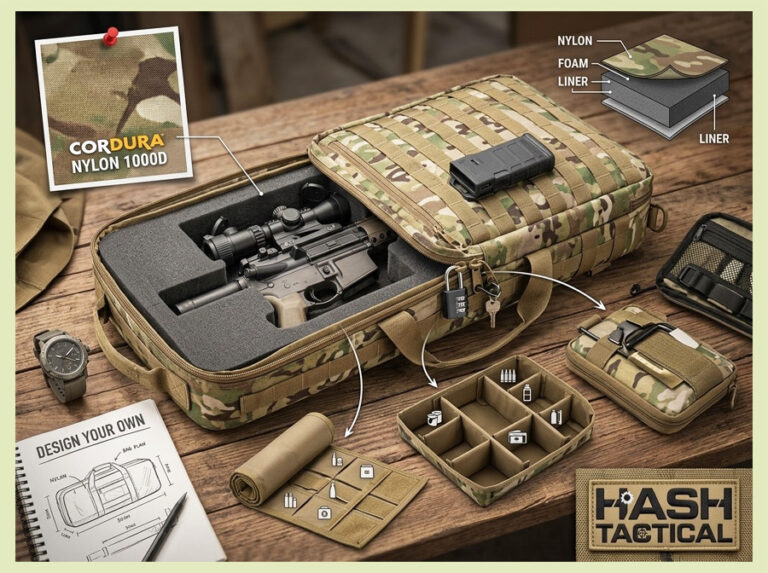
- Cordura Nylon (1000D) — Fabric-based construction. Excellent for soft goods, MOLLE compatibility, and weight reduction.
- Leather — Premium full-grain leather for traditional duty builds. Molds to the weapon over time. Unmatched feel.
In a custom build using sublimation or cut-and-sew manufacturing — like what the team at Hash Tactical specializes in — you can combine materials for optimal performance. Hard shell for weapon security. Soft backing for body comfort. Reinforced stitching at stress points.
2. Retention System
This is the mechanism that keeps your weapon in the holster until you draw it.
Three levels of retention:
- Level I (Passive): Friction only. Fast draw. Less secure. Appropriate for range use or concealed carry where weapon access is not at risk.
- Level II (Active + Passive): One deliberate motion to release (thumb break, hood guard). Standard for uniformed law enforcement.
- Level III (Dual Active + Passive): Two deliberate release steps before draw. Used by military and high-risk environments. Virtually impossible to defeat in a weapon grab.
Custom builds allow you to specify the exact retention level for your mission. Off-the-shelf gives you a single option.
3. Attachment System
How the holster connects to your body or gear platform.
| Attachment Type | Best For |
|---|---|
| Belt loop / Paddle | OWB civilian and duty carry |
| Drop-leg platform | Military, tactical operators |
| MOLLE/PALS loops | Plate carrier or vest integration |
| Chest mount | Vehicle operators, mountainous terrain |
| Ankle rig | Secondary/backup weapon |
| IWB clip system | Concealed carry, plain-clothes |
A custom holster can be built with modular attachment points. One holster, multiple carry positions. That is mission flexibility.
4. The Sweat Guard
Often overlooked. Almost always important. The sweat guard rises above the pistol grip to shield the firearm from body moisture. In hot climates or high-exertion environments, sweat causes rust, corrosion, and reduced reliability. A proper sweat guard extends the life of your weapon significantly.
5. Cant and Ride Height
Cant is the angle of the weapon relative to the vertical. Ride height is how high or low the holster positions the weapon.
These two factors dramatically affect:
- Draw speed
- Ergonomics for your specific body type
- Concealment
- Compatibility with body armor or a duty belt
In a custom build, both are dialed in to your specifications. Not the manufacturer’s assumption about what should work.
Chapter 4: Sublimation and Cut & Sew — The Manufacturing Edge
What Sets Elite Holster Makers Apart
Most consumers don’t know how their gear is made. They just know if it works or doesn’t. But understanding the manufacturing process explains why custom gear performs at a different level.
There are two dominant construction methods for soft-goods tactical holsters and holster accessories:
Sublimation Manufacturing
Sublimation is a process where dye is infused directly into the fabric at a molecular level using heat and pressure. The result is not ink sitting on top of the fabric — it is part of the fabric.
Why it matters for tactical gear:
- Color permanence — Patterns don’t fade, crack, or peel in sun, rain, or repeated washing
- Precision patterns — Camouflage patterns, unit markings, and custom designs rendered with photo-level detail
- No added weight — Unlike screen printing or embroidery, sublimation adds zero additional material
- Breathability maintained — The fabric weave is not blocked by surface coatings
For any soft component of a holster — backing panels, retention straps, MOLLE webbing covers — sublimation produces a result that holds up through hard field use and looks sharp doing it.
Cut & Sew Manufacturing
Cut and sew is exactly what it sounds like. Panels of material are precision cut — either by laser, die, or CNC — and then sewn together with industrial stitching.
The difference between consumer and professional cut & sew:
| Factor | Consumer Grade | Professional Grade |
|---|---|---|
| Thread | Single-stitch nylon | Double or triple-stitch Mil-Spec bonded nylon |
| Seam type | Flat seam | Reinforced box stitch or bartack |
| Material cut | Hand-guided | CNC/laser precision cut |
| Hardware | Plastic buckles | UTX or Duraflex polymer / metal |
| Tolerances | Loose | Tight — critical for retention and fit |
Hash Tactical builds using professional-grade cut-and-sew manufacturing. That means every stitch is intentional. Every seam bears load. Every bartack is placed where stress concentration occurs. The result is a holster that doesn’t fall apart under the weight of real-world use.
Chapter 5: Customization Options — Building Your Holster
This Is Where the Real Power Lives
A custom holster is not just better built. It is built for you. Here is what you can specify in a proper custom order:
Firearm-Specific Fitment
Every configuration gets its own mold:
- Base pistol model (e.g., Glock 17, SIG P320, Beretta M9)
- Generation variant (Gen 3 vs Gen 5 — different dimensions)
- Aftermarket components (threaded barrel extending muzzle, compensators)
- Weapon-mounted lights (WML) — Streamlight, Surefire, Inforce
- Optics cut (RMR, Holosun, DeltaPoint Pro)
- Suppressor-height sights
A holster built for your exact weapon configuration eliminates indexing issues and guarantees a consistent draw stroke.
Body-Specific Fitment
Human bodies are not standard. A holster that fits a 180-pound Marine with a 32-inch waist does not fit a 240-pound security contractor. Custom options include:
- Ride height adjustment
- Cant angle (0° to 15° forward, FBI cant available)
- Body panel contouring for flush carry against the hip
- Torso length accommodation
Color and Pattern
For civilian carriers, concealment may dictate neutral tones. For military and law enforcement, unit colors, camouflage patterns, and high-visibility markings may be required.
With sublimation, the options are nearly unlimited:
- MultiCam, A-TACS, Kryptek, OCP, M81
- Solid colors — FDE, OD Green, Black, Coyote Brown
- Custom unit insignia or logo integration
- High-visibility accents for search-and-rescue applications
Modular Accessories
A truly custom system grows with the operator:
- Mag pouches integrated into the platform
- Tourniquet holders
- Radio/comms loops
- Knife retention
- IFAK quick-access pouches
Chapter 6: Who Needs a Custom Tactical Holster?
Stop Asking If You Need One. Start Asking Why You Don’t Have One Yet.
Let’s be direct. Custom tactical holsters are not just for Navy SEALs and Delta operators. Here is the full spectrum of users who should be running custom:
Law Enforcement Officers
You carry that weapon every day. Eight to twelve hours. Sometimes sixteen. You draw from vehicles, pursue suspects on foot, and restrain combative subjects. That holster is worked harder than almost any gear you own. A Level III retention custom holster fitted to your specific duty weapon — with your TLR and your RMR — is not optional. It’s necessary.
Military Personnel
Standard issue is a starting point. It is rarely the endpoint for serious operators. Custom holsters fitted to specific firearm configurations and body armor setups provide the retention and access speed that standard issue cannot match. When you transition from primary to sidearm in a stressful environment, fumbling is not acceptable.
Armed Security Professionals
You are the visible deterrent. You may be working the same post for ten-hour shifts. Comfort matters as much as retention. A custom holster fitted to your specific weapon and build reduces fatigue and keeps the weapon secure without constant adjustment.
Civilian Concealed Carriers
You’ve made the decision to carry. Now carry the right way. A custom IWB or appendix holster fitted to your specific weapon with your preferred cant eliminates printing, improves comfort, and ensures consistent draw stroke — the foundation of defensive competency.
Competitive Shooters
Every millisecond counts. A custom race holster fitted to your exact gun — with your exact trigger guard geometry — shaves fractions of seconds off your draw time. Fractions matter when the top five shooters are separated by tenths of a second.
Chapter 7: The Ergonomics of a Perfect Draw
Muscle Memory Requires Consistency
Here is something most people don’t talk about enough: the relationship between a holster and training.
Your draw stroke is built on muscle memory. You train it thousands of times. Your hand moves to the same position, contacts the same grip angle, sweeps the same retention release, and presents the weapon on target. This only works if the holster is in the exact same position. Every time.
A generic holster that shifts, loosens, or varies in position between sessions destroys muscle memory. Your body is training to an inconsistent reference point. Under stress — when fine motor skills degrade and the brain goes into survival mode — inconsistent training kills people.
A custom holster solves this problem:
- It is built to your exact body geometry
- It locks into a consistent position on your belt or rig
- Retention is calibrated — not too tight, not too loose
- Draw stroke is smooth and consistent from the first rep to the ten-thousandth
That consistency is not comfort. It is a combat advantage.
Chapter 8: Real-World Durability Testing
How a Holster Earns Its Reputation
Words on a product page are easy. The truth comes out in testing. Here is how serious tactical manufacturers validate their holsters:
Environmental Testing
| Test | Condition | Pass Standard |
|---|---|---|
| Temperature Cycling | -40°F to 160°F | No deformation, retention maintained |
| Water Immersion | 30 min at 3 feet depth | Full function, no delamination |
| UV Exposure | 500+ hours | Color stable, no material degradation |
| Mud / Sand | Full immersion, immediate draw | Draw functions without clearing |
| Drop Test | Weapon-loaded, 6-foot drop | No unintentional weapon release |
Wear Testing
- 10,000 draw cycles with no measurable change in retention
- Stitching pull test: minimum 50 lbs before seam failure
- Hardware stress test: buckles and loops rated to minimum 300 lbs tensile strength
- Sweat/chemical exposure: resistance to CLP, Hoppes, hand sanitizer, sunscreen
Operator Field Testing
No lab test replaces operator feedback. Serious manufacturers work with active duty military, law enforcement, and professional trainers to validate designs in real-world conditions before they ship.
Chapter 9: Cost vs. Value — The Real Calculation
Stop Looking at Price. Start Looking at Value.
A custom tactical holster costs more than a generic one. This is not a secret. A quality custom build runs anywhere from $75 to $250 depending on complexity. A generic holster might cost $25 to $60.
Here is the real math:
Scenario A — Generic Holster
- Cost: $40
- Weapon held: $1,200 Glock 19 with light and optic
- Retention failure: 1 incident in field
- Consequence: Lost weapon. Potential liability. Potential casualties.
- Real cost: Incalculable.
Scenario B — Custom Holster
- Cost: $150
- Weapon held: Same $1,200 Glock 19 with light and optic
- Retention failure: Zero incidents in 5 years of hard use
- Replacement frequency: Zero (properly maintained custom holsters last years)
- Real cost per day: $0.08
The math isn’t close. The conversation shouldn’t be close.
What you’re actually paying for in a custom holster:
- Precision fit that generic manufacturing cannot achieve
- Mil-Spec materials with documented performance standards
- Construction methods validated under field conditions
- A product built for your weapon, your body, and your mission
Chapter 10: Maintenance — Protecting Your Investment
A Holster That Works Must Be Maintained
Even the best custom holster requires basic maintenance. Here is what a competent operator does:
Weekly (For Daily Carriers)
- Visual inspection of stitching and hardware
- Check retention tension — ensure it hasn’t loosened
- Remove debris from interior (carbon fouling, lint, sand)
- Wipe exterior with damp cloth
Monthly
- Deep clean interior with soft brush
- Inspect all attachment points for wear
- Re-tension retention screws if applicable (Kydex builds)
- Condition leather components (if applicable) with approved leather conditioner
Annually
- Full disassembly of platform if modular
- Hardware replacement if showing fatigue
- Consider professional inspection if used in high-intensity environments
What to Avoid
- Leaving weapon holstered for extended periods in extreme heat (warps Kydex)
- Petroleum-based solvents on leather
- Forcing a weapon into a holster that doesn’t fit (damages retention geometry)
- Ignoring wear on stitching — a single seam failure can cascade quickly
Chapter 11: The Future of Tactical Holster Technology
Where the Industry Is Heading
Tactical gear doesn’t stand still. The manufacturers setting the pace are integrating new technologies into holster design:
Smart Retention Systems
Electronic retention systems that can detect unauthorized draws. Used by some law enforcement agencies. Biometric variants are in development that only release to enrolled fingerprints.
3D-Printed Mold Masters
Custom manufacturers are now using 3D scanning and printing to create mold masters from actual firearms rather than manufacturer specifications. This accounts for real-world tolerances and individual weapon variation.
Advanced Composite Materials
Carbon fiber hybrid shells. Ceramic-infused laminates. Anti-corrosive coatings applied at the molecular level. These materials offer weight reduction without sacrificing structural integrity.
Integrated Electronics
Holsters with built-in draw sensors that log draw data for training analysis. Some military programs are testing holsters with GPS integration for weapon tracking in large-scale operations.
Modular System Platforms
The direction the industry is moving is toward fully modular platforms — one base system that accepts interchangeable shells for different weapons. Change out the shell, keep the platform. This is cost-efficient and tactically flexible.
Hash Tactical is operating at the cutting edge of sublimation and cut-and-sew construction, positioning their products to integrate with these emerging platform architectures.
Chapter 12: How to Order a Custom Tactical Holster — What You Need to Know
Don’t Walk In Blind
Ordering a custom holster requires information. Have this ready:
Firearm Information
- Make, model, and caliber
- Generation (if applicable)
- Barrel length (standard or extended)
- Any aftermarket modifications: threaded barrel, compensator, extended slide release
- Weapon-mounted light (make and model)
- Optic (make and model, if direct-milled or via optic cut plate)
- Suppressor-height sights? Yes or No
Carry Configuration
- Primary carry position: OWB, IWB, AIWB, chest, drop-leg, MOLLE
- Dominant hand
- Ride height preference: high, standard, low
- Cant preference: neutral, FBI cant, forward cant
Retention Level
- Level I (passive only)
- Level II (one active release)
- Level III (two active releases)
Materials and Aesthetics
- Shell material: Kydex, Boltaron, leather
- Backing: hard, soft padded, none
- Color / pattern
- Any special markings or insignia
Operational Environment
- Primary environment: urban, rural, desert, jungle, maritime, arctic
- Temperature extremes expected?
- Water exposure expected?
A reputable manufacturer will walk you through these options. Any company that doesn’t ask these questions is not actually building you a custom holster — they’re selling you an off-the-shelf product at a custom price.
Frequently Asked Questions (FAQ)
A: Both are thermoplastics used in holster manufacturing. Boltaron is a higher-grade formulation with greater impact resistance, better temperature stability, and tighter tolerances. It is the preferred material for professional and military applications. Kydex remains an excellent and cost-effective choice for most civilian and law enforcement applications.
A: Lead times vary by manufacturer. Standard custom builds run 2–6 weeks depending on complexity and current order volume. Rush builds may be available at additional cost. If a manufacturer claims same-day turnaround on a truly custom holster, ask questions — it may not be as custom as advertised.
A: A properly fitted custom holster improves draw speed by providing a consistent, repeatable presentation. The weapon is always in the same position. Retention release requires the same motion every time. This consistency is what allows muscle memory to function optimally.
A: Not optimally. A holster with a light cut is engineered around the additional bulk of the WML. Without the light, the weapon may be loose. If you regularly carry with and without a WML, order two holsters — one for each configuration.
A: Replace your holster when: retention tension cannot be adjusted back to specification, stitching is fraying or pulling, shell material shows cracks or deformation, attachment hardware is cracking or failing, or the holster no longer maintains consistent position on your body. When in doubt, replace it. A holster is not the place to gamble.
Final Word: From the Field to Your Holster
Seventeen years of wearing a uniform taught me one thing above all else about gear: the equipment you trust your life to must earn that trust before you need it.
A holster is not background equipment. It is not an afterthought. It is the single piece of gear that sits between you and your weapon at the moment you need it most.
Every operator I’ve known who went through a weapons retention failure came out the other side with one conclusion: they would never run unvetted gear again. The ones who weren’t as fortunate didn’t get the chance to reach that conclusion.
Custom tactical holsters exist because generic gear cannot meet the standard. They cost more because they are worth more. They require more thought to order because they are built for you — not a statistical average, not a mass-market customer profile, not a budget constraint.
When the seconds count and the draw has to happen — you will be glad you invested in the right equipment.
Get the custom holster. Do it right the first time.
Built for those who don’t compromise. Engineered for those who can’t afford to.
👉 For more information before purchasing your desired custom tactical gear, feel free to contact our support team for guidance!