Direct-to-Factory Tactical Gear Manufacturing: The Strategic Guide to OEM/ODM Supply Chains, Modular Designs, and Cost Optimization
Buying tactical gear direct from the factory usually cuts cost, shortens lead time, and gives you control over design and quality. You skip the trading company, the agent, and often the distributor, so every extra markup disappears.
It is not a free win, though. You take on more work: tech packs, sample checks, compliance, and shipping. This guide shows when factory-direct is the right move, how OEM and ODM differ, and how to avoid the common mistakes.
Quick answers:
- Best for: brands, agencies, security firms, and wholesalers that order the same styles on a regular basis.
- Typical savings: you remove one to three middlemen, so margins improve. The exact amount depends on volume and product.
- Biggest risks: weak specs, poor sample approval, and unclear compliance rules.
- Best first step: a rapid prototype, then a small pilot order, then bulk.
What “Direct-to-Factory” Really Means
Direct-to-factory means you deal with the people who cut, sew, and pack your product. You do not buy through a trader who buys from someone else.
A simple chain looks like this:
Traditional chain: Brand → Importer → Trading company → Agent → Factory
Factory-direct chain: Brand → Factory
Each link adds a fee. Each link also adds delay. A message that passes through three people can get changed, and in gear making, a small change can cause a big problem. A strap that is 5 mm too short might break a fit test.
How to Spot a Real Factory
Many sellers claim to be factories. Check these signs before you trust them:
- They show the cutting, sewing, and QC floor on a live video call.
- They list their machines, such as bar-tack, lockstitch, and heavy-duty walking-foot machines.
- Their business license names manufacturing, not only trading.
- They can name their in-house patternmakers and engineers.
- They let you visit or send a third-party auditor.
If they dodge these requests, treat that as a red flag.
OEM vs. ODM: Which Model Fits You?
OEM means the factory builds your design. ODM means the factory builds from its own design, and you brand it. Both can work. The right choice depends on your budget, your timeline, and how unique your product must be.
| Feature | OEM (Original Equipment Manufacturer) | ODM (Original Design Manufacturer) |
|---|---|---|
| Who designs it | You | The factory |
| Who owns the design | You | Usually the factory, unless agreed otherwise |
| Speed to market | Slower | Faster |
| Upfront cost | Higher (patterns, samples) | Lower |
| Uniqueness | High | Medium to low |
| Best for | Agencies, brands with a clear spec | Wholesalers, new brands testing a market |
A Simple Example
Say you run a private security firm. You need a plate carrier with a specific cummerbund, a radio pouch on the left, and your logo patch panel. That is an OEM job. You hand over the spec, and the factory builds it.
Now say you are a wholesaler who wants a solid, ready-made chest rig to sell under your label. That is an ODM job. You pick a proven design, change the color, add your tag, and go.
The Hybrid Path
Many buyers mix both. They start with an ODM base and then ask for changes. This is often called “ODM plus.” It saves pattern costs while still giving you a product that feels like your own.
Why Brands Choose Factory-Direct Sourcing
There are five main reasons. Each one ties back to money, time, or control.
1. Lower Cost per Unit
Middlemen add a margin. Cutting them lets you either keep more profit or offer a lower price. You also see the true cost breakdown: fabric, hardware, labor, and overhead.
2. Faster Communication
You talk to the engineer who makes the call. Questions that took a week now take a day. Time zones still matter, but fewer people in the loop means fewer delays.
3. Real Customization
A trader can only offer what the factory has already agreed to. A factory can change webbing placement, add a pocket, switch a buckle, or rebuild a pattern from scratch.
4. Better Quality Control
You can set your own inspection points. You can ask for in-line checks, not just a final check. When a problem shows up, the factory fixes it at the source.
5. Intellectual Property Control
When fewer parties see your design, fewer parties can copy it. You still need a signed agreement, but a short chain lowers your risk.
Modular Design: The Heart of Modern Tactical Gear
Modular gear lets one base product do many jobs. Users add or remove pouches, panels, and attachments depending on the mission. This design also helps buyers, because one base platform covers many customers.
The MOLLE/PALS System
Most modular gear uses PALS webbing. That is rows of nylon webbing sewn onto a panel. The common spacing is a 1-inch strap with about 1.5 inches between rows. Pouches have matching straps that weave through the grid and snap shut.
Because the spacing is standard, pouches from different makers can fit the same carrier. That is why modular design is so popular with agencies and contractors.
Modular Plate Carrier Production
A modular plate carrier is a vest built to hold hard armor plates and mission gear. A good factory should be able to handle these features:
- Quick-release system: lets the wearer drop the carrier fast in an emergency.
- Adjustable cummerbund: fits different body sizes.
- Removable panels: swap front, back, or side parts.
- Plate bag sizing: options for small, medium, large, and “shooter’s cut” plates.
- Soft armor pockets: space for inserts if the customer supplies them.
Important: A gear factory makes the carrier, not the armor. Ballistic plates and soft armor panels must be tested to a recognized standard, such as the NIJ 0101.06 standard in the United States. Buy certified armor from a licensed armor maker, and have your carrier fit that armor.
Why Modular Helps Your Supply Chain
Modular design cuts the number of products you must stock. Instead of ten different vests, you carry one base carrier and a set of add-ons. That means:
- Smaller inventory
- Lower minimum order quantities per style
- Easier reorders
- Faster custom runs for special clients
Materials: What “Ballistic Nylon” Really Is
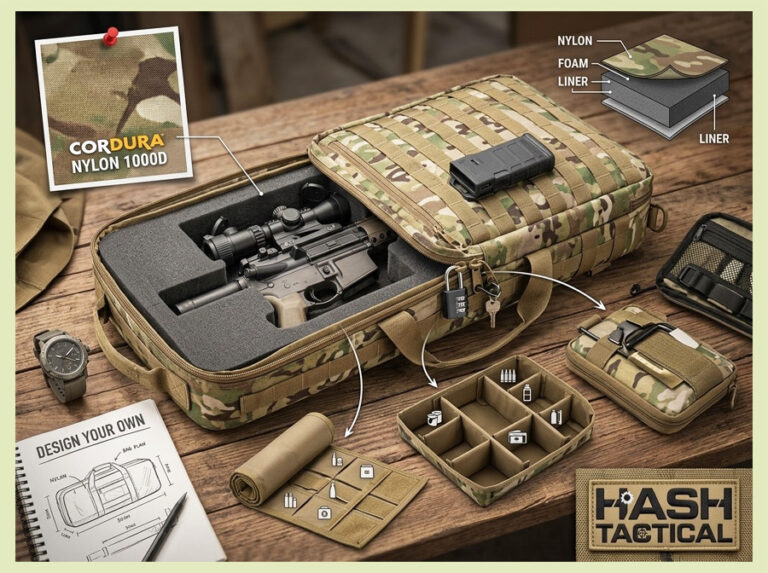
Ballistic nylon is a thick, tough, basket-weave nylon fabric. The name sounds like armor, but the fabric alone does not stop bullets. It was first made for flak jackets in World War II to resist shrapnel. Today it is mainly used for abrasion-resistant bags and gear.
Common Fabrics in Tactical Gear
| Fabric | Typical Use | Key Strength |
|---|---|---|
| 500D nylon | Pouches, light packs, carriers | Good balance of weight and toughness |
| 1000D nylon | Heavy packs, duty belts, high-wear panels | Very high abrasion resistance |
| 1050D ballistic nylon | Rugged bags, cases | Thick, durable, resists tearing |
| Ripstop nylon or poly-cotton | Uniforms, light shells | Stops small tears from spreading |
| Laser-cut laminate | Low-profile modern carriers | Light, low bulk, clean edges |
The “D” stands for denier. It measures yarn thickness. A higher number means a thicker yarn and usually a tougher fabric. It also means more weight.
Coatings and Finishes
Fabric alone is not enough. Ask your factory about:
- PU or PVC backing: adds water resistance.
- DWR finish: makes water bead and roll off.
- IR-compliant dyes: reduce visibility under night-vision devices, if your buyers need it.
- Flame-resistant options: needed for some operations.
A Note on Camouflage
Some patterns are licensed. MultiCam, for example, is a protected pattern. If you print it without a license, you risk legal trouble. Ask your factory whether they hold a license or use approved suppliers.
Hardware Matters Too
A strong fabric fails if the buckle breaks. Ask which brands of zippers, buckles, and hook-and-loop fasteners are used. Well-known names include YKK for zippers and Duraflex for buckles. Ask for specs, not just names.
Sustainable Tactical Fabrics: Real Options, Real Limits
Sustainable options exist, but they come with trade-offs. You can get recycled nylon, solution-dyed fabrics, and PFC-free water repellents. Some cost more. Some have slightly different strength numbers.
What You Can Ask For
- Recycled nylon: made from waste such as fishing nets or fabric scraps. Many versions match virgin nylon in strength.
- Solution-dyed fabric: color is added to the melted fiber, which uses less water than normal dyeing.
- PFAS-free DWR: a water-repellent finish without “forever chemicals.” Rules on PFAS are tightening in several regions, so this is a smart move.
- Lower-waste cutting: smart nesting software and laser cutting reduce scrap.
Honest Trade-Offs
- Some recycled fabrics have a different hand feel.
- Lead times for specialty fabric can be longer.
- Certifications add paperwork.
For defense and law enforcement buyers, performance comes first. Test every sustainable fabric against your own specs before you commit.
Certifications Worth Asking About
| Certification | What It Covers |
|---|---|
| OEKO-TEX Standard 100 | Harmful substances in textiles |
| bluesign | Chemical and resource use in textile production |
| GRS (Global Recycled Standard) | Recycled content and responsible production |
| ISO 14001 | Environmental management systems |
Ask to see actual certificates. Check the dates and the certificate holder’s name.
Lean Manufacturing and Lead-Time Reduction
Lean manufacturing means cutting waste while keeping quality high. In a sewing factory, waste includes waiting, rework, extra movement, and unused fabric. A lean factory can ship faster without cutting corners.
Where Lead Time Gets Lost
A typical order has five phases:
- Design and tech pack: you define the product.
- Sampling: the factory builds prototypes.
- Material sourcing: fabric and parts are ordered.
- Production: cutting, sewing, QC, and packing.
- Shipping: by sea or air, plus customs.
Delays hide in each phase. The biggest ones are slow sample approvals, late fabric, and shipping waits.
Ways to Shorten Each Phase
| Phase | How to Cut Time |
|---|---|
| Design | Send a complete tech pack with clear drawings |
| Sampling | Approve in one round by giving fast, clear feedback |
| Materials | Use stocked fabrics and standard hardware |
| Production | Use cell-based sewing lines and in-line QC |
| Shipping | Split orders: air-ship a small batch, sea-ship the rest |
Lean Tools Good Factories Use
- Cell manufacturing: small teams own a full product. This removes waiting between stations.
- Pre-production meetings: everyone checks the spec before sewing starts.
- In-line inspection: problems are caught early, not at the end.
- Standard work instructions: each worker follows the same steps.
- Digital pattern and cutting: less fabric waste and faster cutting.
Typical Timelines
Timelines vary by product, season, and factory load. As a rough guide, many factories can make a first sample in about one to two weeks. Bulk production often takes about four to eight weeks after sample approval. Complex items and special fabrics can take longer. Always get dates in writing.
Cost Optimization: Where the Money Really Goes
Fabric and labor drive most of the cost. Hardware, packaging, testing, and freight make up the rest. Knowing this helps you cut cost without hurting quality.
Rough Cost Drivers
| Cost Area | What Affects It |
|---|---|
| Fabric | Type, denier, coating, order size |
| Labor | Product complexity, stitch count, country |
| Hardware | Brand, quality, custom molds |
| Trims and labels | Custom woven labels, patches, printed tags |
| Packaging | Polybags, cartons, custom boxes |
| Testing | Lab tests, certifications |
| Freight and duties | Mode, distance, tariff rules |
Smart Ways to Save
- Simplify the design. Every extra pocket adds sewing time.
- Use standard hardware. Custom molds cost thousands.
- Order in fabric-friendly quantities. Fabric is sold in rolls. Order sizes that use full rolls to cut waste.
- Reuse parts across styles. Share one panel pattern across several products.
- Plan early. Rush orders cost more.
- Negotiate by volume tiers. Ask for price breaks at 300, 500, and 1,000 units.
Do Not Chase the Lowest Price
The cheapest quote often hides weaker thread, thinner foam, or skipped stitching steps. A failed vest costs far more than a slightly higher price. Compare quotes line by line, using the same spec.
Compliance and Trade Rules You Should Not Ignore
Rules vary by customer and country, and they change over time. Always check current regulations before you place an order.
Key Points for U.S. Buyers
- Berry Amendment: for many U.S. Department of Defense purchases, certain textiles and items must be made in the United States. Direct-to-factory sourcing from overseas may not qualify for those contracts.
- Trade Agreements Act (TAA): many federal purchases must come from TAA-designated countries.
- Tariffs and duties: rates change often. Confirm the current rate with a customs broker.
- Export rules: some protective gear can fall under export controls. Check before shipping across borders.
- Labeling: U.S. rules require fiber content and country-of-origin labels on many textile products.
Before You Order, Ask Yourself
- Who is my end customer?
- Does that customer require domestic or TAA-compliant products?
- Does my product need third-party testing?
If you are unsure, talk to a trade compliance expert. A short call can prevent a costly mistake.
Your Step-by-Step Factory-Direct Roadmap
Follow these eight steps to lower risk and speed things up.
- Define your need. Write the use case, user, climate, and budget.
- Build a tech pack. Include drawings, measurements, materials, colors, and labels.
- Shortlist factories. Look for experience with tactical products, not just general apparel.
- Verify them. Use video tours, audits, and references.
- Request prototypes. Test fit, stitching, and strength.
- Run a pilot order. Start small to test quality and timing.
- Inspect before shipping. Use a third-party inspector for larger orders.
- Scale up. Place bulk orders and set a reorder schedule.
What Goes in a Good Tech Pack
- Front, back, and side drawings
- Dimensions with tolerances
- Fabric type, weight, and color codes
- Thread type and stitch density
- Hardware brands and sizes
- Label and logo placement
- Packing method
- Testing needs
The clearer your tech pack, the fewer sample rounds you need.
Quality Control: Simple Checks That Catch Big Problems
Good QC happens at three points: before, during, and after production.
Before Production
- Check fabric strength and color.
- Confirm hardware samples.
- Approve a “golden sample” that everyone uses as the standard.
During Production
- Inspect stitching on the first finished pieces.
- Check measurements across sizes.
- Test strap strength and buckle function.
After Production
Many buyers use AQL sampling. AQL stands for Acceptable Quality Limit. The inspector checks a random sample from the batch and compares defects against agreed limits.
Common Defects to Watch
| Defect | Why It Matters |
|---|---|
| Loose or skipped stitches | Seams can fail under load |
| Weak bar-tacks | Stress points can tear |
| Misaligned webbing | Pouches may not attach |
| Color mismatch | Parts of one kit look different |
| Frayed edges | Fabric can unravel |
Factory-Direct vs. Other Sourcing Models
Factory-direct wins on cost and control. Distributors win on convenience. The right path depends on your volume and resources.
| Factor | Factory-Direct | Trading Company | Domestic Distributor |
|---|---|---|---|
| Unit cost | Lowest | Medium | Highest |
| Customization | High | Medium | Low |
| Minimum order | Higher | Medium | Low |
| Lead time | Medium | Medium to long | Short (stock items) |
| Your workload | High | Medium | Low |
| Quality control | Direct | Indirect | Indirect |
Who Should Pick What?
- Pick factory-direct if you order repeatedly and want your own designs.
- Pick a trading company if you need help managing several suppliers and have little in-house expertise.
- Pick a distributor if you need small quantities fast and can accept a higher price.
Factory-Direct Tactical Gear
Fewer middlemen. Faster delivery. More control.
Cut the Chain
Old way: every link adds a fee and a delay
Factory-direct way
OEM or ODM?
OEM
Factory builds your design.
Unique. Slower. Higher setup cost.
ODM
You brand the factory’s design.
Faster. Cheaper to start.
Hybrid
Start with an ODM base.
Then ask for changes.
Pick the Right Fabric
500D
Pouches and light carriers
1000D
Heavy packs and duty belts
1050D
Rugged bags and cases
Ripstop
Uniforms and light shells
Ballistic nylon is tough, but it does not stop bullets. Use certified armor plates (NIJ 0101.06).
Why Modular Wins
One base carrier
PALS/MOLLE webbing fits many pouches.
Smaller stock
Fewer styles to hold.
Easy reorders
Fast custom runs.
Your 8-Step Roadmap
Typical Timeline
1–2 wks
First sample
4–8 wks
Bulk production after approval
Rough guide only. Get dates in writing.
Check the Rules First
Ready for a rapid prototype and direct bulk quote?
Contact Our Factory EngineersNeed ready-made team apparel now? Browse USA Teamwear.
Common Mistakes to Avoid
- Skipping samples. A photo is not a product.
- Vague specs. “Strong and light” is not a spec.
- Ignoring MOQ. Know the minimum order before you plan.
- No written agreement. Get terms, dates, and quality limits on paper.
- Forgetting IP protection. Use an NDA and clear ownership terms.
- Underestimating shipping. Freight and customs can add weeks.
- Ordering large first. Always test with a pilot batch.
Frequently Asked Questions
It is gear you buy straight from the maker, not from a reseller or trader. You work with the factory on design, price, and delivery.
OEM means the factory builds your design. ODM means you choose from the factory’s existing designs and add your brand.
It varies by factory and product. Many factories ask for a few hundred pieces per style. Some offer lower quantities for simple items or stock fabrics. Always ask.
Often one to two weeks, depending on complexity. Complex carriers with custom parts may take longer.
No. It resists abrasion and tearing. Bullet protection comes from certified armor plates or soft armor panels, not from the carrier fabric.
Yes. Recycled nylon, solution-dyed fabrics, and PFAS-free water repellents are available. Test them against your performance needs.
Sign an NDA and a manufacturing agreement. Limit who sees your full files. Register your trademarks where you sell.
Often not for contracts covered by the Berry Amendment or TAA rules. Check your procurement rules first.
Ask for a live video tour, a business license, audit reports, and customer references. A visit or third-party audit is even better.
Final Takeaways
- Factory-direct sourcing cuts layers, saves money, and speeds up communication.
- OEM gives you control. ODM gives you speed. A hybrid often gives you both.
- Modular designs reduce inventory and make custom orders easier.
- Fabric, hardware, and stitching decide how long gear lasts.
- Lean production and clear tech packs shorten lead times.
- Check compliance rules before you commit.
- Start with a prototype, then a pilot, then bulk.
Ready to Take the Next Step?
Ready to streamline your supply chain and launch custom tactical gear built to exact mission specs? Please contact our factory engineers today to request a rapid prototype sample and a direct bulk quote. Start here: https://hashtactical.com
Need ready-made team and duty apparel while you plan your custom line? Browse the Hash Tactical product category pages to see styles you can order now. Whether you outfit a security crew, a field team, or a retail shelf, Hash Tactical can help you find the right fit.