Why Manufacturers Are Rethinking Tactical Products as Paintball Gear
Paintball is not a hobby market. It is a high-stress, high-volume testing ground that is exposing the limits of traditional mil-spec production — and forcing smart manufacturers to adapt. The brands that treat tactical products as paintball gear with intentional re-engineering are cutting costs, proving new materials, and building dual-revenue pipelines that defense-only suppliers will envy. This article breaks down exactly how and why.
The Field Is Talking. Most Manufacturers Aren’t Listening.
Let me paint you a picture. It’s 0700 on a Saturday. Two hundred players are gearing up at a mil-sim scenario field in the Mojave. They’re wearing plate carriers, running MOLLE chest rigs loaded with paintball pods, and crawling through terrain that would humble a Ranger School candidate. Their gear? Half of it was originally designed for combat. None of it was originally designed for this.
I spent years on factory floors watching how tactical gear gets made. I’ve seen the seam testing, the zipper pull loads, the abrasion rigs. And then I watched that same gear go through a 12-hour paintball event — and come back looking like it aged five years in a single day.
That gap between how tactical products are made and how they actually perform under paintball stress? That’s money. That’s market share. And that’s what this article is going to dissect with a scalpel.
The paintball market is not a footnote. It is a living laboratory. And the manufacturers who figure out how to engineer tactical products as paintball gear — on purpose, not by accident — are going to own a dual market that most of their competitors don’t even know exists yet.
Section 1: Military-Grade Fabrication Standards — and Where They Break Down on the Paintball Field
What Mil-Spec Actually Means on the Production Line
Military-grade is a phrase that gets thrown around in product descriptions like it’s a magic stamp. Let me tell you what it actually means on the factory floor.
Mil-spec fabrication for tactical apparel typically involves three cornerstone elements:
- Ripstop weave construction — a grid-reinforced textile architecture that prevents tear propagation
- YKK zippers — the gold standard in closure hardware, rated for tens of thousands of cycles under load
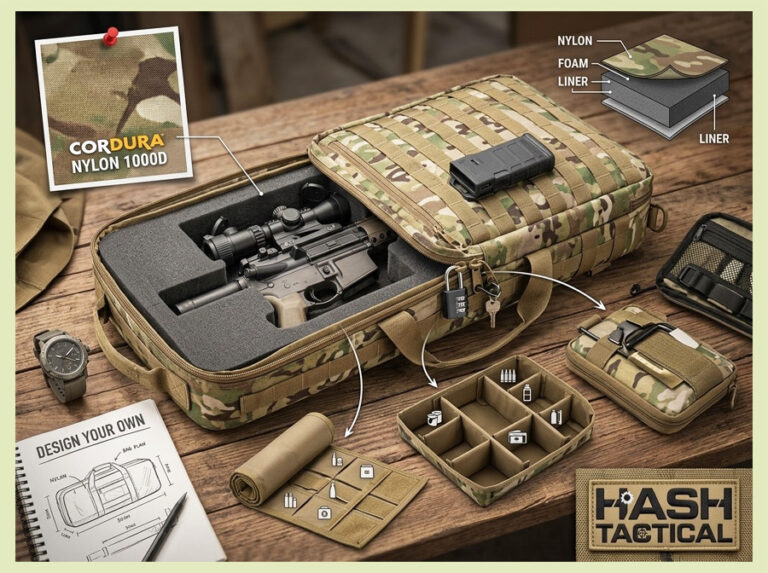
- Cordura nylon reinforcement panels — abrasion-resistant overlays placed at high-wear zones like elbows, knees, and drag points
These standards exist for one purpose: battlefield durability under conditions that include sharp debris, extreme weight loads, and sustained environmental exposure. They were not designed with lateral sprinting, ground dives, and oil-based paintball dye saturation in mind.
The Paintball Stress Pattern Is Fundamentally Different
Here is what the paintball field actually demands from gear — and it is not the same loading map as combat use:
| Stress Type | Combat (Mil-Spec Design Target) | Paintball (Actual Field Demand) |
|---|---|---|
| Primary movement | Patrol pace, prone position | Sprint, slide, dive, rapid direction change |
| Seam load direction | Vertical (weight-bearing) | Lateral and rotational (torso twist) |
| Surface abrasion | Ground crawl, occasional debris | Repeated hard surface impacts at speed |
| Chemical exposure | Water, mud, fuel | Oil-based dye, CO2 propellant residue |
| Cycle frequency | Extended wear, low event frequency | High-frequency use, multiple events per week |
| Fastener stress | Deliberate, controlled access | Rapid, often single-handed in-game access |
That table tells you the story. The stress patterns are not just different in degree — they’re different in kind. A mil-spec seam built to handle a 50-lb ruck load is not the same seam that needs to survive a full-speed slide into a bunker.
Where the Engineering Has to Change
Smart manufacturers re-engineer three specific areas when adapting tactical products as paintball gear:
1. Seam Architecture
Standard mil-spec uses flat-felled seams for strength under vertical tension. Paintball demands bound seams or double-stitched French seams in high-flex zones — specifically at the underarm gusset, crotch gusset, and inner thigh. These are the failure points. Visit any paintball field lost-and-found bin and check the seams. You’ll find the same rips in the same places every time.
2. Zipper Placement and Pull Design
YKK zippers are excellent. The problem isn’t the zipper — it’s where it’s placed and what kind of pull tab is specified. Tactical pouches built for deliberate access need to be redesigned for glove-compatible, single-handed rapid deployment. That means larger pull tabs, different slider configurations, and sometimes a different YKK product line entirely.
3. Cordura Weight Selection
Standard mil-spec uses 500D or 1000D Cordura for maximum abrasion resistance. For paintball, that weight adds unnecessary bulk and reduces mobility. The sweet spot for most paintball-specific panels sits at 330D to 500D — still durable, but with significantly reduced fabric weight and improved flex range.
Section 2: The Manufacturing Cost Delta — Why Brands That Ignore It Leave Money on the Table
The Mil-Spec Cost Structure
Military procurement is a different world from commercial manufacturing. Defense contracts involve extensive qualification testing, compliance documentation, auditing, and minimum quantity thresholds that commercial brands rarely deal with. The result is a cost structure built around unit economics that assume long lead times, stable order volumes, and government-tier margins.
A mil-spec tactical vest produced under defense procurement may have a unit cost that reflects:
- Extensive pre-production material qualification (ASTM, MIL-DTL standards)
- Low-to-medium production run volumes with high tooling amortization
- Premium-grade hardware specifications with zero substitution flexibility
- Compliance documentation overhead adding 8–15% to total production cost
- Extended lead times of 6–18 months from order to delivery
The Paintball-Spec Cost Structure
Paintball manufacturing lives in a completely different economic environment. The paintball consumer market demands:
- Shorter run cycles — seasonal drops, team orders, tournament-specific colorways
- Higher color and pattern variation — sublimation-friendly construction is a major advantage
- Lower per-unit price points for retail viability
- Faster time-to-market for trend responsiveness
- Tolerance for moderate material substitution where performance is not sacrificed
The cost delta between these two models is significant. Here’s a simplified comparison:
| Cost Factor | Mil-Spec Production | Paintball-Spec Production | Manufacturer Advantage |
|---|---|---|---|
| Compliance overhead | High (8–15%) | Low (1–3%) | Paintball saves 5–12% per unit |
| MOQ flexibility | Rigid (high minimums) | Flexible (smaller runs viable) | Paintball enables SKU diversity |
| Colorway tooling cost | High (limited palette) | Low (sublimation-compatible) | Paintball enables low-cost variation |
| Lead time | 6–18 months | 6–14 weeks | Paintball = faster revenue cycle |
| Retail margin potential | Compressed (gov contract) | Healthy (consumer market) | Paintball = better margin stack |
The brands leaving money on the table are the ones treating paintball as an afterthought — licensing their mil-spec designs to discount distributors without intentional reengineering. The smarter play is to design a paintball-spec production line that shares pattern assets and hardware relationships with the tactical line, while optimizing separately for each market’s cost structure.
The Sublimation Advantage
This is where cut-and-sew manufacturers with sublimation capability have a structural edge that pure tactical producers cannot easily replicate. Sublimation printing allows:
- Unlimited colorway production with zero additional tooling cost
- Team-specific and tournament-specific customization at small batch sizes
- Complex camouflage and graphic patterns that would be cost-prohibitive in traditional dyeing
- Faster response to market trends in the paintball community’s visual culture
A manufacturer that can run sublimated paintball jerseys and tactical base layers off the same production infrastructure has a cost efficiency advantage that compounds over time. The fixed costs are shared. The margin per SKU improves. The market addressability doubles.
Section 3: Case Study — How MOLLE Webbing Transitions from Load-Bearing Utility to Modular Pod Carrying
What MOLLE Was Built For
MOLLE — Modular Lightweight Load-carrying Equipment — is one of the most successful attachment system designs in military history. The webbing grid pattern, spaced at 1-inch intervals in staggered rows, allows modular pouches to attach via interlocking polymer clips or snap-weave straps.
In its original application, MOLLE handles serious weight. Magazine pouches, medical kits, radio pouches, hydration bladders. A fully loaded MOLLE vest can carry 40–60 lbs of equipment in sustained operational conditions. The webbing is load-rated, and the attachment geometry is engineered around that load distribution.
The Paintball Translation
Paintball players adopted MOLLE platforms because the visual and functional logic made perfect sense. You need modular storage for pods, loaders, CO2 canisters, and tools. The attachment system is proven. The aesthetic aligns with mil-sim gameplay culture.
But here’s what nobody on the manufacturing side talks about openly: the load profile of a paintball pod carrier is completely different from a magazine pouch under combat loads.
| Parameter | Mil-Spec MOLLE Use | Paintball MOLLE Use |
|---|---|---|
| Average pouch load | 0.8–2.5 lbs (full magazine) | 0.3–0.6 lbs (paintball pods) |
| Access frequency | Low (deliberate) | High (constant in-game) |
| Access style | Two-handed, deliberate extraction | Single-handed, running extraction |
| Attachment stress direction | Downward (gravity load) | Lateral + forward (body rotation) |
| Primary wear mode | Chest/back static carry | Active movement, constant flex |
The Re-Engineering Opportunity
When you understand that load profile difference, the re-engineering path becomes obvious. For tactical products as paintball gear, MOLLE-based pod carriers should incorporate:
- Reduced webbing channel depth — paintball pods don’t need the full retention depth designed for magazine pouches. Shallower channels mean faster single-hand extraction.
- Elastic-assist retention — replace rigid retention straps with elastic or bungee cord systems that allow faster access without sacrificing security during movement.
- Wider attachment geometry — spread the MOLLE attachment points to distribute lateral stress across more webbing rows, compensating for the rotational load profile.
- Lighter base webbing weight — dropping from military-grade 1.5-inch nylon webbing to 1-inch webbing reduces total weight while easily handling paintball pod loads.
- Subchannel organization — add internal dividers or tube-style pod organization within the carrier to prevent pod rattling and noise during play.
This is not complicated engineering. It is intentional engineering. The manufacturers who do this work will produce MOLLE pod carriers that outperform the mil-spec originals for paintball use — while costing less to produce, because they’re not overbuilt for load-bearing requirements the application doesn’t demand.
The Market Signal
Paintball players are already voting with their wallets for products that solve these problems. Brands like Custom Paintball, Virtue, Dye, and Empire have built loyal followings by solving exactly this kind of problem — not with tactical-grade construction, but with application-specific design intelligence. The opportunity for tactical manufacturers is to bring superior material knowledge and fabrication infrastructure to that same design intelligence. That combination is currently underserved.
Section 4: The Supply Chain Opportunity — Paintball’s Demand Cycles vs. Defense Procurement
How Defense Procurement Actually Works
Defense procurement is not a commercial supply chain. It runs on a fundamentally different rhythm. Contracts are awarded through competitive bidding processes that can take 12–24 months. Production is structured around delivery schedules tied to government fiscal cycles. Quality auditing is extensive and continuous. And once a contract is awarded, you are locked into specification compliance with zero flexibility.
This is not criticism. For a manufacturer building equipment that will be used in actual combat, this rigidity is appropriate and necessary. But it creates a supply chain structure that is inherently inflexible, capital-intensive, and slow to respond to design iteration feedback.
How Paintball Procurement Works
The paintball supply chain operates on commercial consumer timelines. Teams need gear before tournament seasons. Retailers need inventory before spring. A team sponsorship request that comes in January needs a product response by March. This is a supply chain built on speed and flexibility.
For manufacturers with the capacity to run both, paintball orders serve a function that defense contracts cannot: they fill production floor capacity between contract cycles.
The Capacity Fill Opportunity
Defense contracts are lumpy. You win a large contract, you run at high utilization, and then you wait for the next procurement cycle. Paintball orders smooth that utilization curve. They are lower per-unit revenue but higher margin flexibility, and they keep sewing lines running, operators skilled, and quality systems active between major contract runs.
| Supply Chain Factor | Defense Contracts | Paintball Commercial Orders |
|---|---|---|
| Average lead time | 6–18 months | 4–12 weeks |
| Order frequency | Low (contract cycles) | High (seasonal/event-driven) |
| Volume per order | Large, stable | Small to medium, variable |
| Design flexibility | None (spec-locked) | High (customer-directed) |
| Floor utilization role | Peak production | Capacity fill between cycles |
| Margin profile | Contract-compressed | Consumer-favorable |
| Feedback cycle speed | Slow (field reporting) | Fast (social + community) |
The Dual-Revenue Pipeline Strategy
The manufacturers who have figured this out are running what I’d call a dual-revenue pipeline. They maintain their tactical and defense capability as the foundation — the credentials, the certifications, the fabrication infrastructure. And they run a parallel commercial pipeline for paintball and recreational tactical products that operates on commercial timelines with commercial margins.
The fixed costs are shared across both pipelines. The specialized equipment — computerized cutting systems, industrial sewing infrastructure, embroidery and sublimation capability — serves both markets. The result is a more resilient business that isn’t entirely dependent on the unpredictable rhythm of government procurement.
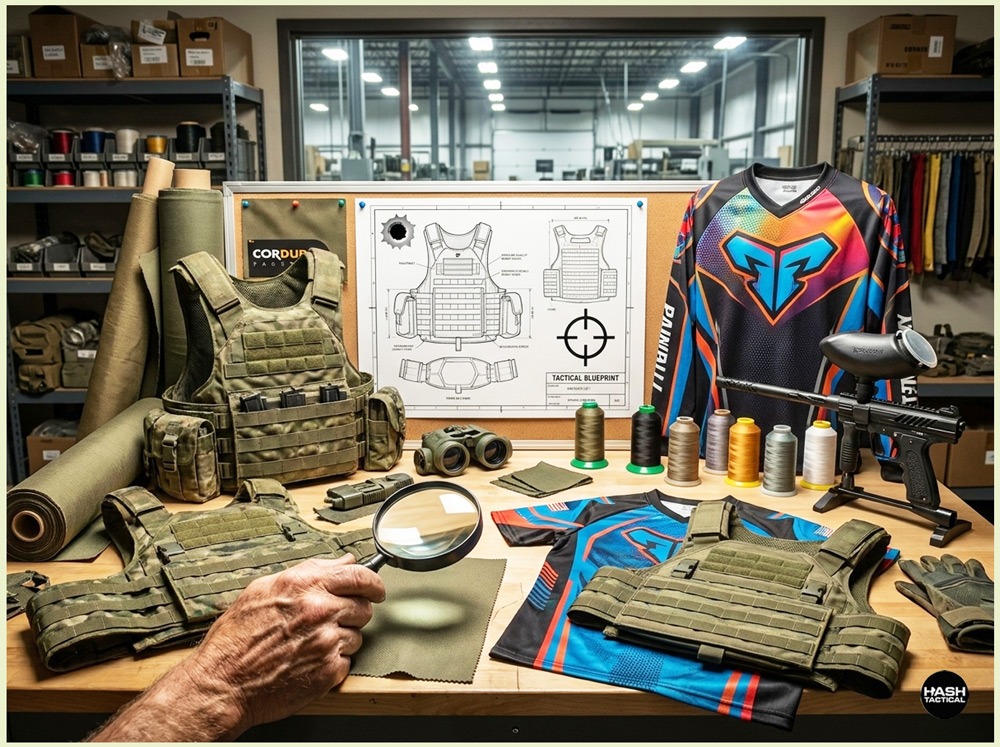
Hash Tactical operates exactly on this model. Cut-and-sew capability combined with sublimation means the production floor can pivot between defense-adjacent tactical production and paintball-specific custom orders without retooling. That flexibility is a structural business advantage that neither pure defense suppliers nor pure sportswear manufacturers can easily replicate.
Section 5: Why Paintball Is Becoming a Proving Ground for Prototype Tactical Materials
The Testing Problem That Paintball Solves
Here is a truth that military procurement officers and R&D directors know but rarely say out loud: controlled lab testing is not the same as real-world stress testing. You can put a fabric through a Taber abrasion machine, a Martindale wear tester, and a hydrostatic pressure rig — and still not know how it’s going to perform when a 185-lb player slides across a wooden barricade for the fourth time in a single afternoon.
Paintball provides something that lab testing cannot: unscripted, high-frequency, high-intensity real-world use at scale. A competitive paintball field might run 500 player-sessions per weekend. That’s 500 independent data points on fabric performance, seam integrity, and hardware function — generated organically, without a testing protocol or an observer.
Three Material Innovations Being Tested on Paintball Fields Right Now
1. Stretch-Incorporated Ripstop Fabrics
Traditional ripstop is dimensionally stable — that’s the point. But newer stretch-ripstop fabrics incorporating spandex into the weave grid are showing up in paintball jerseys and being evaluated for tactical application. Paintball’s movement demands — lateral lunges, prone-to-sprint transitions, crawling — stress these fabrics in ways that accelerate the evaluation timeline. What might take two years of rotational troop use to evaluate in a military context can be assessed in a single tournament season of hard paintball play.
2. Hydrophobic Dye-Resistant Coatings
One of the most interesting unintended testing scenarios: paintball’s oil-based dye fill is an excellent penetration test for water-resistant coatings. DWR (Durable Water Repellent) finishes designed to bead water behave differently against paintball fill because the surface tension and penetration dynamics are different. Manufacturers experimenting with next-generation hydrophobic coatings can use paintball field data to understand coating durability and chemical resistance in ways that standard washfastness testing doesn’t reveal.
3. Laser-Cut MOLLE Webbing Alternatives
The traditional woven MOLLE webbing grid adds weight and thickness to any platform it’s attached to. Laser-cut laminate MOLLE alternatives — thin polymer or reinforced textile sheets with die-cut MOLLE-compatible slots — are lighter, lower-profile, and cheaper to manufacture. Paintball’s load requirements are low enough to make these alternatives viable for field testing, while the high usage frequency accelerates wear data collection. If a laser-cut MOLLE panel survives a full paintball tournament season without attachment point failure, that’s meaningful data for its potential in light tactical applications.
The Feedback Loop Advantage
Paintball communities are vocal, informed, and connected. Forums, YouTube channels, Reddit communities, and Discord servers generate real-time feedback on product performance that no focus group replicates. A manufacturer paying attention to what competitive paintball players say about their gear — specifically, where it fails and what they wish it did differently — has access to an ongoing product development intelligence feed.
This feedback loop is one of the least-utilized advantages available to tactical gear manufacturers. The players doing the testing are not being paid. They are not writing formal reports. But they are being brutally honest about what holds up and what falls apart. And they are telling each other about it constantly.
Smart manufacturers are listening. They’re not just building gear — they’re building an intelligence relationship with one of the most demanding recreational user communities on the planet.
Implementation Playbook: How to Start Treating Tactical Products as Paintball Gear
The Five-Step Transition Framework
If you’re a tactical manufacturer looking to enter or optimize for the paintball market, here is the operational sequence:
- Audit your existing tactical line for cross-application potential. Which products, with minimal re-engineering, could serve the paintball market? Chest rigs, pants, gloves, and knee/elbow pads are the highest-potential candidates.
- Map the stress pattern differences. For each product identified, document where the paintball stress profile diverges from the mil-spec design target. This becomes your re-engineering brief.
- Prototype with paintball-spec modifications. Run small sample batches of the re-engineered designs and get them onto actual players at actual events. Not focus groups. Fields.
- Build the supply chain for commercial timelines. Paintball retailers and teams do not operate on government procurement schedules. Your production and fulfillment systems need to accommodate 4–12 week turnarounds.
- Engage the community directly. Sponsor a team. Partner with a field. Show up. The paintball community is small enough that genuine engagement gets noticed and rewarded with loyalty.
Frequently Asked Questions
A: Yes, they can be used — and many players do exactly that. But “can be used” is not the same as “optimized for.” Mil-spec tactical products used as paintball gear without modification will typically show accelerated seam failure at lateral flex points, suboptimal fastener accessibility under game conditions, and excess weight compared to purpose-built paintball alternatives. The product works. It just doesn’t work as well as it could.
A: For a manufacturer already running cut-and-sew production, the incremental investment is primarily in pattern development and sampling — typically representing 3–8% of anticipated first-year revenue from the new line. If sublimation capability is already present, colorway development costs are essentially zero. The largest incremental investment is typically in community engagement and distribution channel development, not production infrastructure.
A: Unlike military procurement, paintball gear has no mandatory certification standards for apparel. ASTM F1776 covers paintball safety equipment (masks and loaders), not apparel. This is actually an advantage for manufacturers — it allows faster market entry and product iteration without the qualification timelines associated with military procurement.
A: Based on community feedback analysis, the top five complaints are: (1) seam failure at the underarm and inner thigh after heavy use, (2) restricted mobility in high-intensity movement, (3) pod carrier access speed under game conditions, (4) excess weight compared to dedicated paintball products, and (5) color/pattern limitations from traditional military colorways. Each of these is an engineering-addressable problem — not a fundamental market misalignment.
The Field Is a Factory. Use It.
I’ve been in this industry long enough to have watched smart manufacturers build sustainable businesses by seeing opportunities that their competition ignored. The paintball market is one of those opportunities — sitting in plain sight, actively demanding better gear, and generating real-world performance data that no lab can replicate.
The playbook is not complicated. Audit your existing tactical line. Map the stress pattern differences. Re-engineer with intention. Build for commercial timelines. Engage the community.
What this requires is not genius. It requires the discipline to look at a recreational market without condescension, understand it on its own terms, and apply real manufacturing expertise to solve real engineering problems.
The manufacturers who treat tactical products as paintball gear with the same seriousness they bring to defense production will find a market that rewards them with loyalty, margin, and a proving ground for materials that eventually cycle back into their tactical lines better than when they left.
The field is talking. Listen to it.
Hash Tactical | Cut & Sew | Sublimation | Tactical Apparel Manufacturing