Beyond the Range: How Tactical Gun Bags Are Redefining Everyday Carry Culture
Tactical gun bags are no longer just for soldiers and cops. They’ve crossed the wire into civilian life — and they’re staying. Whether you’re a city professional who carries concealed, a weekend hunter, or someone who simply refuses to be unprepared, today’s tactical gun bags are purpose-built for real life. This article breaks down how that shift happened, why it matters, and what you need to know before you buy.
Introduction: The Bag That Grew Up
Let me tell you something I learned in the Corps.
The right gear doesn’t announce itself. It just works. Every single time, in every single situation, without drama or failure. That’s the standard. No exceptions.
I carried a bag on three deployments. It wasn’t pretty and marketed to me, and didn’t come in coyote brown, Multicam, or OD green with a brand tag. It was stitched, tested, trusted, held my gear, protected my weapons, and never let me down.
Fast-forward fifteen years. I’m standing in a coffee shop in Denver. The guy in front of me — clean sneakers, slim jeans, laptop bag over one shoulder — is carrying what I immediately recognize as a low-profile concealed carry sling bag. Cut-and-sew construction. Reinforced zipper pull. Sternum strap with a quick-release buckle.
That man is not military. He is not law enforcement. He is a civilian. And he is carrying smarter than most people I served with in 2004.
That moment told me everything. The tactical gun bag had gone mainstream — and the industry would never be the same.
Section 1: From Battlefield to Backpack — The Evolution of Tactical Gun Bags
How Military Gear Enters Civilian Life
It always follows the same path. War produces gear. Veterans bring that gear home. Civilians see it. Civilians want it.
It happened with cargo pants in the 1990s and with boots. It happened with watches, knives, and hydration systems. And it happened — decisively — with tactical gun bags.
The original tactical carry bag had one job: transport weapons and ammunition safely in a combat environment. These were range bags, hard cases, drag bags for precision rifles. Heavy-duty. Obvious. Unapologetic.
But the civilian market doesn’t need a drag bag for a 10-mile patrol. It needs something that works at the farmers market, the office parking lot, the school pickup line, and the shooting range — all on the same Saturday.
That demand forced manufacturers to rethink everything.
The Three Generations of Tactical Gun Bags
1 — Pure Utility (1980s–2000s)
- Hard-sided rifle cases
- Basic range bags with ammo pouches
- No aesthetic consideration
- Screamed “I have a gun” from across the room
- Built for transport, not carry
2 — Tactical Goes Mainstream (2000s–2015)
- MOLLE-webbed backpacks and shoulder bags
- Military-inspired styling with civilian sizing
- Still visually “tactical” — lots of patches and webbing
- Better materials, worse discretion
- Popular but conspicuous
3 — The Discreet Carry Era (2015–Present)
- Low-profile silhouettes with hidden compartments
- Civilian colorways: charcoal, black, navy, olive
- Integrated CCW pockets with retention systems
- Cut-and-sew craftsmanship replacing mass production
- Lifestyle integration without sacrificing function
We are living in Generation 3. And it is the best era in the history of tactical carry.
Section 2: Who Is Actually Carrying These Bags Now?
The New Face of Tactical EDC
Forget the stereotype. The modern tactical gun bag owner is not who you think.
Yes, veterans carry them. Yes, law enforcement off-duty carries them. But the fastest-growing demographic? Urban professionals. Outdoor enthusiasts. Parents. Small business owners. People who have decided that being prepared is not paranoia — it’s responsibility.
Let’s look at who is actually in this market.
| Carry Profile | Primary Need | Preferred Bag Style |
|---|---|---|
| Urban CCW Carrier | Concealed handgun, daily carry | Sling bag, messenger bag |
| Weekend Shooter | Range transport, ammo & gear | Range bag, duffel |
| Hunter / Outdoorsman | Rifle transport, field gear | Backpack, drag bag |
| Competitive Shooter | Multi-firearm transport | Large range bag with dividers |
| Tactical Professional | Duty carry, off-duty transition | Shoulder bag, brief-style |
| Preparedness-Minded Civilian | Bug-out, home defense | Backpack with modular system |
Each of these users has different requirements. But they share one thing: they need a bag that was built with intention.
The Urban Professional Carry Shift
This is the biggest story in tactical EDC right now.
Urban concealed carry is growing. Fast. More than 21.5 million Americans held a concealed carry permit as of recent reporting — and that number grows every year. A significant portion of those permit holders are city-dwellers. Office workers. Commuters.
These people cannot carry a range bag to work. They need something that transitions seamlessly from subway to office to parking garage to pickup line.
That demand drove a revolution in bag design.
The solution was hiding the tactical inside the professional. A sleek, minimalist outer shell. Reinforced internal CCW compartment. Lockable zippers. Zero visual indicators of what’s inside.
The result? A bag your coworker thinks holds your iPad. But you know better.
Section 3: The Psychology of “Prepared but Discreet”
Why It Matters How Your Bag Looks
Here’s a truth they don’t teach in any self-defense class: how your gear looks affects every interaction you have.
Walk into a school parking lot with a drop-leg holster and a plate carrier. See what happens. Now walk in with a clean, low-profile shoulder bag. Nobody looks twice.
That’s not weakness. That’s intelligence.
The prepared civilian doesn’t want attention. They want options. And the right tactical gun bag gives you both — the capability to defend yourself, and the social invisibility to move through public life without friction.
The Three Pillars of the Prepared Mindset
1. Access: Your firearm is useless if it takes 45 seconds to reach. A properly designed CCW bag puts your hand on your weapon in under two seconds.
2. Security: Your firearm must not be accessible to anyone but you. Quality tactical bags use retention systems, locking zippers, and concealed compartments that prevent unauthorized access.
3. Discretion: No one should know what you’re carrying. Not from across the room and the seat next to you. Not from a security camera.
When a bag gets all three pillars right, it stops being a product and starts being a tool.
Prepared vs. Paranoid: An Important Distinction
Some people confuse preparedness with fear. It’s not the same thing.
Carrying a quality tactical gun bag doesn’t mean you expect trouble. It means you’ve accepted a simple truth: trouble doesn’t call ahead. The people who are prepared are not the scared ones. They are the calm ones. When something goes wrong, they act. Everyone else reacts.
That mindset is the engine driving the entire EDC movement.
Section 4: The Gray Man Philosophy — Invisible and Ready
What Is the Gray Man?
The gray man is a concept that originated in intelligence and special operations culture. The idea is simple: the most dangerous person in a room is the one nobody noticed.
In tactical terms, the gray man blends into his environment. He carries no visible indicators of capability and wears normal clothes. He moves normally and looks like everyone else. But he is not like everyone else. He is prepared.
The gray man philosophy has migrated from special operations into the civilian preparedness community — and it has transformed how people think about EDC gear.
How Tactical Gun Bags Enable the Gray Man
A gray man doesn’t carry a bag that says “TACTICAL” on the side.
He carries a bag that looks like he’s heading to a meeting. But inside? That bag is a precision tool.
Key features that make a bag “gray man” compatible:
- No external MOLLE webbing — MOLLE is a visual marker of tactical intent
- Subdued colorways — black, charcoal, navy, dark olive
- Standard zipper pulls — no paracord or tactical rings
- No patches or hook-and-loop panels — these announce your community
- Profile matches the environment — a briefcase-style bag in a business district; a slim backpack in a university setting
- No brand logos — tactical brand logos are recognized by other prepared people, and by people who aren’t
This is not about hiding. This is about choosing when and how you are seen.
The Gray Man Bag Checklist
Ask these questions before buying any tactical gun bag:
- Does this bag look out of place in a grocery store?
- Does it have external features that signal “tactical”?
- Would a stranger ask about it?
- Does the colorway match everyday civilian clothing?
- Can I access my carry without drawing attention?
- Does it look like a bag I’d own regardless of the firearm?
If you answer yes to the first two questions, you don’t have a gray man bag. You have a range bag. Both have their place — but know which one you’re holding.
Section 5: Legal Landscape — How Bag Design Has Adapted to Concealment Laws
Laws governing how and where you can carry a firearm vary enormously. Your bag needs to work within those laws. Ignore this section at your own legal risk.
The Patchwork Reality of U.S. Carry Laws
There is no single national standard for concealed carry. Every state writes its own rules. Some cities layer additional restrictions on top. The result is a legal patchwork that a tactical gun bag must navigate.
Here is a simplified overview of how carry laws affect bag design requirements:
| Legal Category | What It Means for Your Bag |
|---|---|
| Shall-Issue CCW States | Broad civilian carry allowed; bag features can prioritize access speed |
| May-Issue CCW States | Carry harder to obtain; discreet designs more important |
| Constitutional Carry States | No permit required; EDC bags must still be discreet in restricted zones |
| Vehicle Carry Laws | Bag must enable legal storage when transitioning in/out of vehicles |
| Safe Storage Requirements | Some states mandate firearms be secured; bags with locking systems help |
| School / Government Zone Restrictions | Bag must support quick, legal removal of firearm before entering |
Features That Help Legal Compliance
A well-designed tactical gun bag does more than hold your weapon. It helps you stay legal.
Locking CCW Compartments Many states allow carry in bags only when the firearm is secured. A compartment with a lockable zipper supports this requirement.
Clear Separation Between CCW and Main Compartments If your state requires the firearm to be “stored separately” during transport, a dedicated internal CCW compartment with its own access point satisfies this in most jurisdictions. Always verify with local law.
Vehicle-Ready Design Several states allow vehicle carry under the seat or in the console. A compact range bag or sling bag that fits under a seat keeps you compliant during transit.
Important Disclaimer This article provides general information only. Carry laws change. Always consult current state statutes and a qualified attorney before making decisions about carrying a firearm in any bag, vehicle, or location.
Section 6: What to Actually Look for in a Tactical Gun Bag
The Non-Negotiables
If a bag doesn’t have these, walk away.
1. Dedicated CCW Compartment A main pocket with your firearm rattling against your laptop is not a CCW solution. You need a dedicated compartment, with a retention system — hook-and-loop, bungee, or molded insert — that keeps your firearm in the same position every time.
2. One-Handed Access A real defensive bag opens with one hand. If you need both hands to unzip or unfasten, you’ve lost precious seconds. Look for external CCW pockets with ambidextrous access or fast-pull zipper pulls.
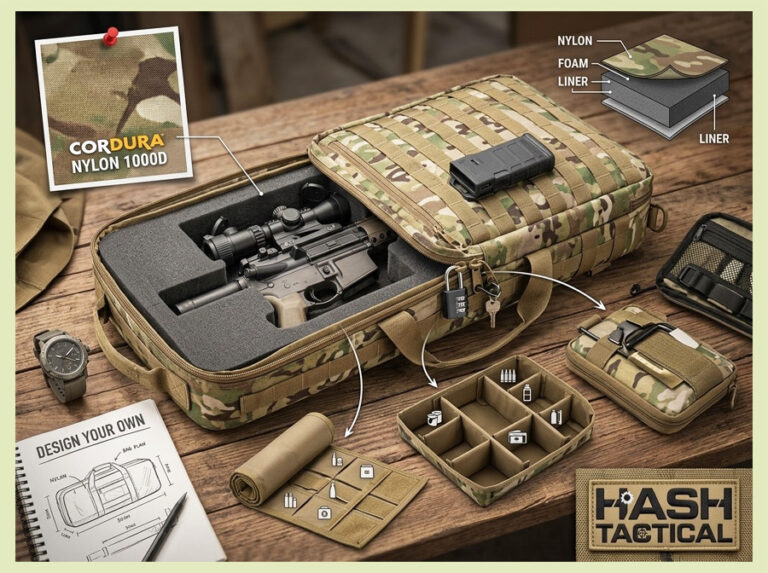
3. Material Quality Minimum 600D nylon for a budget bag. Serious users should be looking at 1000D Cordura or equivalent. YKK zippers are not optional. Cheap zippers fail at the worst possible time.
4. Stitching and Bar-Tacking Look at stress points. Bar-tack stitching at zipper attachment points, strap anchor points, and handle bases is the difference between a bag that lasts a decade and one that fails in six months.
5. Weapon Retention Inside the CCW compartment, your firearm must not move. An unsecured weapon shifts position with movement. You reach in under stress. Your hand goes to where the gun should be. It’s not there. That delay costs you.
Features That Separate Good from Great
| Feature | Why It Matters |
|---|---|
| Ambidextrous CCW access | Left and right-handed carry equally supported |
| Padded back panel | Comfort during extended wear; doubles as armor plate pocket on some models |
| Lockable zippers | Legal compliance and theft deterrence |
| RFID-blocking pocket | Protects cards and digital IDs in urban environments |
| Modular internal organization | Adapts to your specific loadout |
| Water-resistant coating | Protects your firearm and gear in weather |
| Low-profile sternum strap | Stabilizes bag during movement without looking tactical |
What Hash Tactical Gets Right
The best manufacturers in this space focus on cut-and-sew craftsmanship over mass production. When a bag is sublimated or built from premium cut-and-sew construction, every seam, every panel, every zipper placement is intentional. We don’t compromise on manufacturing speed. Hash Tactical builds with that philosophy at the foundation — gear designed for people who won’t accept failure.
Section 7: The Crossover Effect — When Tactical Meets Lifestyle
How the Outdoor Industry Opened the Door
The tactical gun bag didn’t conquer the mainstream alone. It had help.
The outdoor industry has spent thirty years training consumers to pay premium prices for technical gear. Gore-Tex. Cordura. Dyneema. Consumers learned the vocabulary of performance materials. They learned that gear matters. That quality is worth the price.
That education created the perfect conditions for tactical gear to cross over.
A consumer who pays $300 for a hiking backpack is already primed to pay $250 for a tactical EDC bag. The value proposition is the same: premium materials, technical construction, built to perform under real conditions.
The Athleisure Comparison
Think about how athleisure took over casual fashion. Technical athletic wear — designed for performance — became everyday clothing. People wear running shoes to dinner. They wear compression leggings to work. The performance-casual crossover is complete and permanent.
The same thing is happening with tactical gear.
Tactical bags are becoming everyday bags. Not because they look cool (though they do). But they perform better than traditional bags in daily life, with more organization. Better durability. Smarter access. Stronger construction.
Consumer Trends Driving the Crossover
Trend 1: The Preparedness Movement
COVID-19 changed how Americans think about self-reliance. Emergency supplies. Home defense. Bug-out readiness. This shift brought millions of new consumers into the preparedness space — and many of them needed tactical carry solutions for the first time.
Trend 2: Growth in Female Gun Ownership
The fastest-growing demographic in gun ownership is women. Women who carry have specific needs around bag design, concealability, and aesthetics. The tactical industry has been slow to respond, but the consumer demand is undeniable and growing.
Trend 3: The Rise of Competitive Shooting Sports
USPSA, IDPA, 3-Gun — competitive shooting is a growing sport. Competitive shooters need bags that transport multiple firearms, hundreds of rounds of ammunition, and shooting accessories. They need organization and need durability. They spend real money on gear that performs.
Trend 4: The Veteran Population
22 million veterans in the United States. Many of them carry. Most of them have strong gear opinions forged in experience. When they find a bag that meets military-derived standards in a civilian form factor, they become loyal customers and vocal advocates.
Section 8: Building Your Tactical EDC Kit Around the Right Bag
Start with the Mission
Before you buy tactical gun bags, define your mission. Every former operator will tell you: gear selection starts with the mission, not the gear.
Ask yourself:
- Where am I most often? Urban, suburban, rural?
- What am I carrying? Handgun only, or additional gear?
- How long am I out? A few hours or all day?
- What’s my vehicle situation? Daily driver, transit commuter, motorcycle?
- What environments do I transition through? Office, school zone, courthouse?
Your answers determine your bag. Not the other way around.
Recommended Bag Types by Mission Profile
Urban Daily Carry Mission: Concealed handgun, phone, wallet, keys, small EDC tools → Slim sling bag or shoulder bag, 8–15L capacity, single CCW compartment, laptop sleeve optional
Weekend Shooter Mission: Handgun or two, 200–500 rounds ammo, eye and ear protection, cleaning kit → Range bag, 20–35L capacity, multiple ammo pouches, padded dividers, easy cleaning access
Field Hunter Mission: Rifle transport, optics, field cleaning, ammunition → Rifle backpack or drag bag, 30L+, padded rifle sleeve, external attachment for tripod or bipod
Go-Bag / Bug Out Mission: 72-hour preparedness, firearm, first aid, water, food, comms → Large tactical backpack, 40L+, modular MOLLE, hydration compatibility, load-bearing frame
Section 9: Caring for Your Tactical Gun Bag
Maintenance Is Not Optional
A bag that fails is worse than no bag. Here’s how to keep yours in the fight.
Weekly Checks
- Inspect zippers for debris and smooth operation
- Check all stress points and stitching for fraying
- Clear the CCW compartment and inspect retention system
- Verify lock function if your bag has locking zippers
Monthly Maintenance
- Wipe down exterior with a damp cloth; mild soap for soiled areas
- Condition leather pulls or handles if applicable
- Inspect webbing and attachment hardware
- Test all buckles and closures under load
As-Needed Care
- Re-waterproof exterior with DWR spray after heavy rain exposure
- Replace worn zipper pulls before they fail
- Re-stitch any loose seams immediately — small failures become big ones
What to Avoid
- Machine washing (degrades coatings and adhesives)
- Leaving a loaded firearm unsecured in a bag unattended
- Overloading beyond rated capacity (stresses seams and zippers)
- Storing in direct sunlight long-term (degrades fabric and color)
Section 10: The Future of Tactical Gun Bags
Where This Category Is Heading
The tactical gun bag market is not standing still. Several forces are reshaping what the next generation of bags will look like.
Smarter Organization Systems Modular insert systems — like those already popular in camera bags — are entering the tactical space. You buy the shell once. You configure the inside for your mission.
Integrated Biometric Security Fingerprint-access CCW compartments already exist in handgun safes. They’re coming to soft-sided bags. The technology is shrinking fast.
Sustainable Materials Recycled Cordura and bio-based fabrics are entering the tactical market. The performance is there. The environmental story is increasingly important to younger buyers.
Custom and Semi-Custom Manufacturing Consumers are demanding gear built for them — not built for the average. Cut-and-sew manufacturing with sublimation printing is enabling small-batch, custom-configured tactical bags at accessible price points. This is where quality manufacturers are investing.
Smart Tracking Integration Tile and AirTag integration is already consumer behavior. Bags designed with discrete internal tracking pockets are a logical next step — and some already exist.
Frequently Asked Questions
A: In most states, carrying a firearm in a bag is legal if you have a valid CCW permit and the firearm is properly secured. However, laws vary widely by state, locality, and specific environment. Always verify with a legal professional and your state’s current statutes.
A: A range bag is designed for transporting firearms and shooting gear to and from the range. A tactical EDC bag is designed for daily carry — it holds a concealed firearm plus everyday items like a wallet, phone, and keys. Most range bags are too large and visually obvious for discreet daily carry.
A: Yes, with strict requirements. Firearms must be unloaded, in a locked hard-sided container, and declared at check-in. Soft-sided tactical bags do not meet TSA requirements for checked firearm transport. You will need a hard-sided case inside your checked luggage. Always verify current TSA regulations before travel.
A: Most full-size handguns (Glock 17, M&P 2.0, etc.) fit in CCW compartments as small as 8″ x 5″. The bag’s overall size is less relevant than the CCW compartment dimensions. Always check manufacturer specs before purchasing.
A: Never leave a loaded firearm in a bag unattended in a vehicle. At home, if the bag remains your primary storage, ensure it is in a secure location inaccessible to children and unauthorized persons. A locking bag in a quick-access safe is an excellent solution.
Conclusion: The Tactical Gun Bags are the Mission
Here’s what I want you to take away from all of this.
Gear selection is a serious decision. A tactical gun bag is not a fashion statement. It is not a hobby accessory. It is the interface between you and your ability to defend yourself and the people you love.
The right bag disappears. It blends into your life. It doesn’t slow you down, attract attention, or fail when conditions get difficult. It’s there when you need it, invisible when you don’t.
The military understood this a long time ago. The civilian market is catching up fast.
Whether you’re a first-time CCW holder trying to figure out your daily carry setup, or a thirty-year veteran looking to upgrade your off-duty kit, the modern tactical gun bag market has never had more to offer.
Do your research. Know your mission. Buy quality. Maintain your gear.
And carry with confidence.