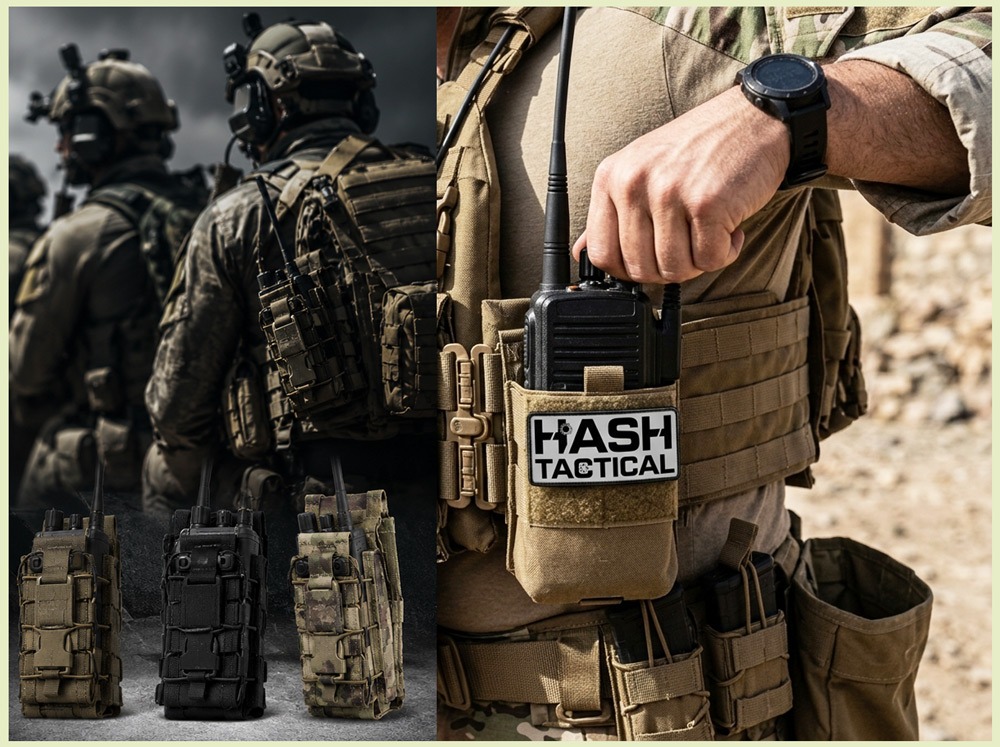
In the field, comms are your lifeline. The best Tactical Radio Pouch must provide a balance of rigid retention and instant accessibility. Choose pouches constructed from 500D Cordura for the optimal weight-to-durability ratio. Ensure your pouch features an open-top design or a “fold-down” flap to allow for frequency adjustments without removing the unit. A secure MOLLE attachment is non-negotiable; if your radio bounces, your antenna will snag, and your comms will fail.
Best Tactical Radio Pouches: Durability & Fit Guide
The Day the Silence Screamed
I remember a mountain op where the fog was so thick you couldn’t see your own boots. We were moving fast, and my RTO (Radio Telephone Operator) took a spill down a rock face. His cheap, “universal” pouch gave way. The radio didn’t just fall; it tumbled into a crevasse.
We were blind and deaf in enemy territory for six hours. That silence was the loudest thing I’ve ever heard. It taught me that your radio is only as good as the pouch holding it. At Hash Tactical, we don’t just sew bags; we build insurance policies for your comms. We know that when the lead starts flying, the last thing you should worry about is your radio hitting the dirt.
The Mission of the Tactical Radio Pouch
A Tactical Radio Pouch has a simple but brutal job. it has to protect a piece of sensitive electronics worth thousands of dollars while making sure you can hit the PTT (Push-To-Talk) button in a heartbeat. It needs to fight off abrasion, moisture, and the constant vibration of movement.
We focus on “Fit and Function.” Whether you’re carrying a small handheld or a heavy-duty MBITR, the pouch needs to be an extension of your kit. It shouldn’t be an afterthought. Today, we’re breaking down how to choose a pouch that keeps you connected when it matters most.
Material Matters: The Armor for Your Comms
500D vs. 1000D Nylon
When we talk about Tactical Radio Pouch, we usually live in the world of 500D Cordura. Why? Because 1000D is too stiff and heavy for most comms setups. 500D provides enough “give” to contour to the radio’s body while offering world-class abrasion resistance.
If you’re dragging your side against a brick wall in a CQB environment, you want fabric that can take the scrape without exposing the radio. Our “Cut & Sew” process reinforces the bottom of these pouches because that’s where the weight of the battery puts the most stress on the seams.
Elastic Side-Walls
A great pouch isn’t just a static box. We integrate heavy-duty elastic side panels. This allows the pouch to “shrink” or “expand” to fit different battery sizes. It keeps the radio from rattling, which is critical for noise discipline during a stealthy approach.
Pouch Styles: Speed vs. Security
| Pouch Type | Access Speed | Security Level | Best Use Case |
| Open-Top Bungee | Extreme | High | High-speed DA (Direct Action) |
| Fold-Down / Wing | Moderate | Extreme | RTO / Long-Range Patrol |
| Universal Pouch | Low | Moderate | Training / General Utility |
| Slick / Internal | Moderate | High | Under-jacket / Low-Vis Ops |
The Open-Top Bungee Design
This is the modern standard. A simple bungee cord with a pull-tab holds the radio in place. It’s fast. You can rip the radio out if you need to change a battery or hand it to a teammate. It also leaves the top of the radio clear for antenna and headset cables.
The Fold-Down Pouch
For the guys who need to see their screen constantly, the fold-down design is king. The pouch is hinged at the bottom. You release a buckle, and the radio tilts forward so you can change channels or check your GPS coordinates without unhooking any wires.
Anatomy of a Professional Fit
MOLLE Attachment Integrity
If your pouch has “play” on your vest, it’s going to fail. We use stiffened MOLLE straps to ensure a rock-solid interface. When you reach for your volume knob, the pouch shouldn’t move. It should feel like it’s molded onto your plate carrier.
Cable Management Ports
Wires are the enemy of movement. A professional Tactical Radio Pouch features dedicated exit ports or “cable tunnels.” This keeps your headset wires from becoming a snag hazard in thick brush or around vehicle door handles.
The Manufacturing Edge at Hash Tactical
As a specialized tactical gear manufacturer, we know that precision is everything. We use industrial-strength, bonded nylon thread that won’t rot when it gets soaked in sweat or rain. Every stress point is bar-tacked because we know a radio pouch takes more abuse than almost any other piece of gear.
Our sublimation process also allows us to offer these pouches in patterns that match your TJ-607 or TJ-612 jackets. By maintaining a consistent camouflage signature across your comms gear, you stay hidden from the eyes that are looking for you. We don’t just make gear; we make systems.
The “Wing” Position: Ergonomics in the Fight
The Dangler vs. The Side-Mount
Most pros are moving their radios to the “wing” position—the space between the front plate and the cummerbund. This keeps the front of your vest clear for magazines but keeps the radio within easy reach.
Ambidextrous Access
We design our pouches to be mounted on either side. Depending on if you’re a righty or a lefty, you need to be able to reach your emergency distress button without crossing your body. Our “Cut & Sew” patterns are symmetrical to give you that tactical flexibility.
Field Tips: Setting Up Your Comms
- Antenna Relocation: Don’t leave your antenna sticking up like a lightning rod. Use a relocation cable to move it to the back of your vest.
- Dummy Cords: Always, always use a piece of paracord to “dummy cord” your radio to your pouch. If the retention fails, you don’t lose the unit.
- Screen Protection: If your pouch has a clear window, keep it clean. Scratched plastic makes a screen unreadable under NODs (Night Vision).
- Heat Management: Radios get hot when they transmit. Ensure your pouch has enough breathability to prevent the battery from overheating in 100-degree weather.
Frequently Asked Questions (FAQ)
A: It will be loose. A Baofeng is much smaller. You should look for a “Small Format” radio pouch to ensure it doesn’t bounce around and break the antenna connector.
A: Only if you are an RTO running dual comms. For most operators, two radios on the chest is too much bulk. Stick to a single unit and keep it streamlined.
A: Yes, but take the radio out first! Hand wash with mild soap. Never use a dryer, as the heat can shrink the elastic and ruin the fit.
Mission Complete. Secure your comms, check your frequencies, and stay in the fight. A radio in the dirt is a man left behind. Don’t let your pouch be the weak link.