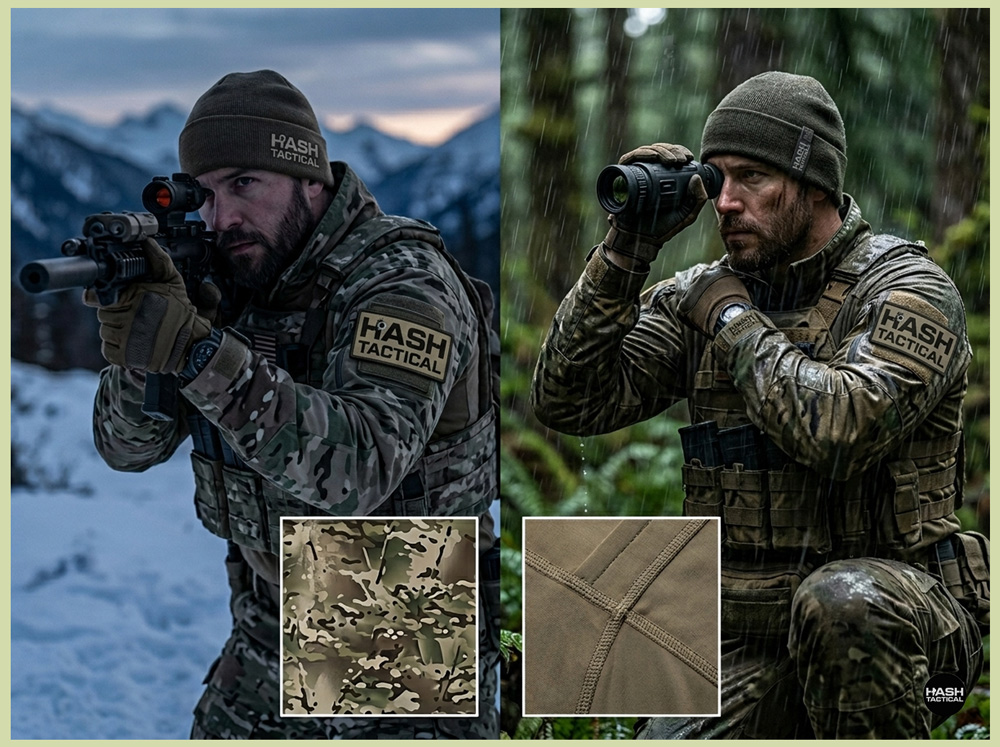
Custom Tactical Beanies: Maintain Operational Focus, Regardless of the Temperature
Your head loses up to 40% of your body heat. A cheap beanie fails in the field. Custom tactical beanies, engineered for stealth, thermal regulation, and durability — keep you mission-ready from the Arctic to the desert. This article tells you exactly why head protection matters, what separates a real tactical beanie from a fashion knockoff, and how to spec one that works as hard as you do.
It Was Minus 14 Degrees. The Mission Didn’t Care.
I remember the night clearly. Northern mountains. Pre-dawn darkness. The kind of cold that turns your fingers to wood and your brain to mush.
My fire team was four hours into a recon patrol. The wind had gone from bitter to savage. Two of my guys were already showing signs of cold-induced cognitive degradation — slow decisions, fumbled equipment, delayed responses.
Their headgear? Standard-issue wool caps. Loose. Thin. Wrong for the mission profile.
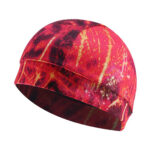
Mine? A fitted, sublimated tactical beanie. Moisture-wicking liner. Reinforced structure. Low-profile silhouette. No snag points.
I stayed sharp. They didn’t.
That night taught me something I’ve carried ever since: thermal protection at the head isn’t comfort gear. It’s operational gear. And if your head protection isn’t custom-built for what you’re doing, you’re going into the field with a liability on your skull.
This article is for the professionals, the veterans, the law enforcement operators, the security contractors, and the serious outdoors tacticians who understand that every piece of gear has a job. Your beanie has a job too. Let’s make sure it’s built to do it.
Section 1: Why Head Protection Is a Force Multiplier
The Science of Head Heat Loss
Your brain is the command center. It runs on oxygen and glucose — both regulated by blood flow. Blood flow is regulated by core and peripheral temperature. When your head gets cold, your body makes a decision: protect the core, sacrifice the extremities.
The scalp has an enormous concentration of blood vessels. It radiates heat aggressively. Studies have confirmed that head and neck exposure in cold environments can account for a disproportionate share of total body heat loss — especially when wind chill is factored in.
Here’s what that means in plain terms: cold head = degraded cognitive performance.
- Slower decision-making
- Reduced situational awareness
- Impaired fine motor control
- Increased error rates under stress
None of those are acceptable on a mission.
What the Military Has Known for Decades
Cold weather doctrine in military organizations worldwide includes mandatory head protection protocols. The reason is simple: operators who get cold make mistakes. Mistakes cost lives.
The problem is that issued gear is designed for the average soldier in average conditions. The average doesn’t cut it for specialized operations.
High-speed units figured this out fast. Custom headgear — fitted to the operator, optimized for the environment, designed around the mission — became standard practice in elite circles long before the commercial market caught up.
Section 2: What Makes a Tactical Beanie “Tactical”
Not All Beanies Are Created Equal
Walk into any sporting goods store. You’ll find beanies. Colorful ones. Slouchy ones. Branded ones. Cheap acrylic ones that pill after three washes.
None of those are tactical beanies.
A real tactical beanie is engineered around a specific set of performance requirements:
| Feature | Fashion Beanie | Tactical Beanie |
|---|---|---|
| Thermal regulation | Minimal | High — moisture-wicking + insulation |
| Profile | Bulky or loose | Low-profile, form-fitting |
| Snag resistance | None | Critical — no loops, no tags |
| Acoustic interference | Common | Minimized — allows comms clarity |
| Durability | Moderate | Extreme — field wash, abuse resistant |
| Customization | Logo only | Full sublimation or cut & sew |
| Moisture management | Poor | Active wicking, quick dry |
| Odor control | None | Antimicrobial treatment options |
The gap between those columns is the gap between “looks the part” and “does the job.”
The Critical Design Principles
1. Fit First
A beanie that rides up exposes your ears. A beanie that’s too tight restricts blood flow. Neither is acceptable. Tactical beanies are engineered to stay put. They conform to the skull without constricting. They stay down in the wind without needing constant adjustment.
2. Low Snag Profile
In dense vegetation, in vehicle ops, in close-quarters environments — loose fabric catches. It snags on gear, on doorframes, on branches. A tactical beanie is smooth. No exposed seams in the wrong places. No loops and excess material. Clean profile, all the time.
3. Communications Compatibility
Operators wear comms. Headsets. Earpieces. Helmet liners. A tactical beanie must work with that gear, not against it. That means fit that doesn’t bulk up under a helmet. Material that doesn’t muffle ear cups. Structure that stays flat against the head rather than bunching.
4. Thermal Layering Logic
The best tactical beanies aren’t just “warm.” They’re thermally intelligent. They trap heat when you’re static and vent heat when you’re moving hard. They pull moisture away from the skin so sweat doesn’t freeze on your head when you slow back down.
This is the difference between a beanie that works at one temperature and a beanie that works across a temperature range.
Section 3: Sublimation vs. Cut & Sew — The Construction Breakdown
Understanding Your Build Options
When it comes to custom tactical beanies, construction method is everything. There are two primary approaches: sublimation and cut & sew. Both have their place. The right choice depends on your mission requirements.
Sublimated Tactical Beanies
Sublimation printing infuses dye directly into the polyester fabric at the molecular level. The color doesn’t sit on top of the fabric — it becomes the fabric.
What this means operationally:
- Colors never crack, peel, or fade
- Pattern extends edge-to-edge with no white borders
- Full-panel custom graphics possible
- Lightweight result — the print adds zero weight
- Smooth surface — no raised ink to interfere with gear
- Moisture management is unaffected by the print
Best for:
- Unit identification beanies with custom insignia
- Team-specific colorways and patterns
- Camo patterns with precision detail
- High-volume runs with consistent output
Sublimation Limitation: Works only on light-colored polyester or polyester-blend fabrics. Dark base colors can’t be sublimated. If your operational requirement calls for a pure black base, cut & sew is your answer.
Cut & Sew Tactical Beanies
Cut & sew construction means the beanie is built panel by panel from pre-dyed or custom fabrics. Each panel is precisely cut, then sewn together by skilled craftspeople.
What this means operationally:
- Unlimited color options including true black
- Premium material choices (merino wool blends, fleece, thermal knits)
- Structural design flexibility — different materials per panel
- Thicker, heavier builds possible for extreme cold
- Custom patches, embroidery, and label placement
- Higher perceived durability and premium feel
Best for:
- Cold-weather specialist beanies requiring heavy insulation
- Operators who need true black or dark earth tones
- Custom structural configurations (foldover cuffs, ear coverage variations)
- Premium presentation pieces alongside functional gear
Which Construction Is Right for You?
| Requirement | Choose Sublimation | Choose Cut & Sew |
|---|---|---|
| Full custom graphic/pattern | ✓ | Limited |
| True black or dark base | ✗ | ✓ |
| Extreme cold insulation | Limited | ✓ |
| Large volume orders | ✓ | ✓ |
| Lightweight result | ✓ | Varies |
| Premium material feel | Moderate | ✓ |
| Edge-to-edge color | ✓ | ✓ |
The right call depends on your environment, your mission profile, and your branding requirements. In many cases, a combination approach — sublimated body with cut & sew panels — delivers the best of both worlds.
Section 4: Materials That Matter in the Field
Fabric Selection Is a Tactical Decision
What your beanie is made of determines how it performs under stress. Fabric selection isn’t a marketing decision. It’s an engineering decision.
Performance Fabric Categories
Polyester & Performance Blends
The workhorse of modern tactical textiles. Polyester is the foundation for sublimation and delivers excellent moisture management. High-quality polyester beanies wick sweat rapidly, dry fast, and hold their shape under hard use.
Polyester-spandex blends add the stretch and recovery operators need for comfort under helmets and with comms gear.
Merino Wool
Nature’s original performance fabric. Merino is remarkable:
- Naturally thermoregulating — warm when cold, cool when warm
- Inherently antimicrobial — resists odor through multi-day ops
- Moisture management that rivals synthetics
- Naturally fire-resistant
- Soft enough to wear against the skin without irritation
Merino beanies are the choice for extended operations in variable conditions. The weight rating (measured in grams per square meter, or GSM) determines warmth level.
Fleece & Thermal Knits
Heavy fleece beanies deliver bulk insulation for extreme cold environments. They’re best as standalone cold-weather headgear rather than under-helmet liners. Cut & sew construction allows fleece to be combined with windproof panels for enhanced protection.
Blended Materials
The most sophisticated tactical beanies combine fabrics. A typical premium construction might feature:
- Inner: moisture-wicking polyester microfiber
- Mid: thermal insulation layer
- Outer: wind-resistant or abrasion-resistant material
Each layer has a job. Together they perform across a wider operational temperature range.
The Weight vs. Warmth Decision
| Weight Class | GSM Range | Best For |
|---|---|---|
| Lightweight | 150–200 GSM | Under-helmet liner, mild cold |
| Midweight | 200–280 GSM | Active use, variable temps |
| Heavyweight | 280–350+ GSM | Static ops, extreme cold |
Choose your weight based on your coldest anticipated operating temperature and your activity level. Moving hard generates heat. Standing post generates cold. Your beanie weight should reflect your expected activity profile.
Section 5: Stealth Considerations — The Operator’s Edge
Visibility Is a Vulnerability
Stealth isn’t just about staying quiet. It’s about managing your visual signature. In any field environment, your head is one of the most exposed parts of your body. It’s high. It’s mobile. It contrasts against backgrounds.
Your headgear either amplifies your signature or reduces it.
Color discipline:
- High-visibility colors are a liability in the field
- Muted earth tones (coyote, ranger green, multicam patterns) reduce contrast
- True infrared (IR) management requires fabric that doesn’t reflect IR in environments with night-vision surveillance
- Dye lots matter — two “coyote” beanies from different manufacturers can photograph completely differently under tactical lighting
Texture and sheen:
- Glossy synthetic fabrics reflect light
- Matte finishes reduce shine signature
- Fleece textures scatter light better than smooth fabrics
Profile management:
- Bulky, slouchy beanies create a recognizable silhouette
- Form-fitting tactical beanies reduce your head’s profile
- Excess fabric can catch wind and create movement signatures
IR Reflectivity — The Silent Threat
If your operational environment includes adversaries with night-vision or thermal imaging capability, standard fabric choices become a liability. Commercially manufactured fabrics can reflect near-infrared light in ways that make an operator visible to NV-equipped opponents even in complete darkness.
Purpose-built low-observable fabrics manage IR signature as a design parameter. This is a specialist requirement, but for those who operate in contested environments, it’s non-negotiable.
Section 6: Identifying and Branding — The Unit Cohesion Factor
Custom Gear Builds Teams
There’s a reason elite units have always worn distinct gear. Identification under stress is critical. And unit cohesion — the psychological bond between operators — is strengthened when team members recognize each other as part of the same tribe.
Custom tactical beanies serve both functions.
Operational identification uses:
- Color codes for team differentiation (Alpha red, Bravo blue)
- Printed or embroidered unit insignia
- Rank or function indicators
- Jurisdiction markings for law enforcement
Morale and cohesion uses:
- Deployment commemoratives
- Unit mascots and mottos
- Subdued challenge coin equivalents in wearable form
- Team identity for training environments
The best custom beanies accomplish both simultaneously. They look professional. They function professionally. And they communicate to everyone who sees them: this team is organized, equipped, and ready.
Sublimation for Maximum Design Precision
For complex insignia, multicam-style patterns, or photographic-quality custom graphics, sublimation printing delivers precision that embroidery simply cannot match. Full-panel artwork, edge-to-edge color, gradient designs — all achievable in a sublimated tactical beanie.
Hash Tactical’s sublimation process ensures color accuracy across production runs. What you approve in the digital proof is what arrives on your operators’ heads.
Section 7: Sizing, Fit, and Helmet Compatibility
Fit Is Non-Negotiable
A tactical beanie that doesn’t fit is worse than no beanie. It distracts and slides. It interferes with equipment and degrades performance.
Sizing considerations:
- Head circumference is the primary measurement (measure at the widest point of the skull, above the ears)
- Most adult male heads fall between 54–62 cm
- Standard sizing must accommodate this range without excess bunching at small sizes or tension at large sizes
- Stretch fabrics allow a wider fit range; structured knits require more precise sizing
Under-Helmet Compatibility
Many operators wear tactical beanies under ballistic helmets or bump helmets. This creates specific fit requirements:
- The beanie must compress without folding or creating pressure points
- It must not shift when the helmet is put on or removed
- It must not reduce the effectiveness of helmet suspension systems
- It must not interfere with chinstrap attachment
Helmet compatibility checklist:
- Low-profile, minimal-bulk construction
- No bulky seams at the crown
- Snug enough to stay stationary when the helmet moves
- Material smooth enough to not bind against helmet liner
- Cuff that doesn’t ride up when helmet presses down
Ear Coverage Options
| Configuration | Coverage | Best Use |
|---|---|---|
| Standard | Covers skull, top of ears | Mild cold, active movement |
| Extended cuff | Doubles down over ears | Moderate cold, versatile |
| Full ear coverage | Sealed around ears | Cold static ops, arctic |
| Balaclava integration | Full face option | Extreme cold |
Communicate your ear coverage requirement clearly when ordering custom beanies. The configuration determines fabric yield, construction approach, and fit specifications.
Section 8: Care, Maintenance, and Field Longevity
Gear That Doesn’t Last Isn’t Gear
A tactical beanie sees hard use. It gets sweated in. Rained on. Stuffed in kit bags. Washed in field conditions. It gets worn for multi-day operations without a wash cycle in sight.
Your beanie’s durability is a direct function of the construction quality and material choices. But even the best gear requires some basic maintenance discipline.
Field Care Protocol
Washing:
- Machine wash cold when possible
- Avoid high heat — it degrades elastic fibers and causes shrinkage in knit constructions
- Turn inside out to protect any printed surfaces
- Lay flat to dry rather than machine drying when in garrison
Extended field use:
- Merino wool has natural antimicrobial properties — it can go longer without washing without odor buildup
- Synthetic beanies should be hand-washed with minimal soap if no machine is available
- Air out after high-sweat use when a wash isn’t possible
Storage:
- Fold flat rather than rolling tight — maintains shape
- Keep away from Velcro in kit bags — hook-face Velcro will snag and pill many fabrics
- Inspect periodically for seam integrity — early repair prevents full failure
Lifespan Expectations
A quality tactical beanie, maintained properly, should last through hundreds of field uses without significant performance degradation. The sublimation print — embedded in the fiber itself — will outlast the fabric. Cut & sew construction, with proper thread and seam quality, will hold under significant stress.
What will degrade first, typically, is elastic recovery in the cuff and crown. This is normal wear. When the beanie no longer snaps back to shape after stretching, it’s time for replacement.
Section 9: Applications Across Environments
The Tactical Beanie Is Not One-Mission Gear
A common mistake is thinking of a tactical beanie as a “cold weather item.” That’s incorrect.
Military Operations:
- Arctic and mountain warfare (primary thermal protection)
- Under-helmet liner in all seasons (adds warmth without bulk)
- Low-signature headgear for surveillance and recon
- Unit identification in training environments
Law Enforcement:
- SWAT and tactical team identifier
- Cold-weather patrol gear
- Undercover operations (civilian-appearing beanie in subdued color)
- Range day warmth and identification
Security Contracting:
- High-value protection details in cold climates
- Low-profile headgear for soft-security environments
- Organizational identification without uniformed appearance
Search and Rescue:
- High-visibility colorways for search environments
- Thermal protection during extended operations
- Team identification across large deployment areas
Outdoor and Expedition:
- Mountaineering and alpine operations
- Cold-weather hunting and surveillance
- Backcountry operations requiring lightweight packable warmth
The tactical beanie’s job is always the same: protect the head, maintain thermal comfort, and not get in the way of the mission.
Section 10: Ordering Custom Tactical Beanies — What You Need to Know
The Specification Process
Getting a custom tactical beanie right requires clear communication. Here’s what you need to define before going into production:
1. Intended Use Environment Be specific. “Cold weather” isn’t enough. What temperature range? What activity level? Under a helmet or standalone? These answers drive material selection.
2. Construction Method Sublimation for complex custom graphics on lighter bases. Cut & sew for dark base colors, premium materials, or structured designs.
3. Design Requirements Unit insignia, color codes, patterns, text. Provide vector files where possible. Higher resolution artwork produces higher-quality sublimated output.
4. Fit Specifications Head circumference range for your team. Ear coverage configuration. Cuff style. Under-helmet or standalone.
5. Quantity Higher quantities drive down per-unit cost significantly. Plan for attrition — order spares for replacements.
6. Timeline Custom manufacturing takes time. Rush orders are possible but cost more. Plan your procurement cycle realistically.
Minimum Order and Customization
Custom tactical gear is manufactured in runs, not individual pieces. Minimum order quantities depend on the construction method and complexity of customization. Sublimated beanies can typically be produced in smaller runs than complex cut & sew constructions.
Hash Tactical works with units of all sizes — from small specialized teams to large organizational orders — to find the right production approach for each requirement.
Comparison: Standard Issued vs. Custom Tactical Beanies
| Factor | Standard Issued | Custom Tactical |
|---|---|---|
| Thermal performance | Adequate | Optimized for specific environment |
| Fit | Generic | Team/operator specific |
| Stealth profile | Unoptimized | Designed for mission |
| Unit identification | None | Fully customizable |
| Material quality | Variable | Specified per requirement |
| Durability | Moderate | High — built for hard use |
| Helmet compatibility | Inconsistent | Engineered for it |
| Comms integration | Not considered | Designed around it |
| Operator morale | Neutral | Positive — team cohesion |
The numbers don’t lie. Custom-built outperforms generic-issued in every category that matters operationally.
FAQ — Frequently Asked Questions
A: Yes. Sublimation can reproduce licensed camo patterns with high accuracy. Confirm intellectual property rights for your specific use case if you’re reproducing trademarked patterns commercially.
A: Use a soft measuring tape. Measure circumference at the widest point of the skull, typically about an inch above the eyebrows and ears. Collect measurements across your team and order to accommodate the range. Most custom beanies are produced in S/M and L/XL to cover the typical range.
A: Each headgear type has a specific role. The balaclava covers the face and neck — essential for extreme cold. The Shemagh provides face/neck protection and dust shielding. The tactical beanie provides primary scalp insulation and sits under helmets. They’re not substitutes — they’re layers in a complete head protection system.
A: Yes. Silver-ion antimicrobial treatments are available for synthetic fabric constructions. Merino wool is naturally antimicrobial. Specify your requirement at the design stage.
A: Properly sublimated prints are essentially permanent — the dye is part of the fiber, not sitting on top of it. Unlike screen printing or iron-on transfers, sublimation prints do not crack, peel, or fade with normal washing and field use. Color may shift very slightly over hundreds of wash cycles, but the print will remain sharp.
Section 11: Building a Complete Head Protection System
Layering Is the Doctrine
No single piece of headgear covers every condition. Operators who understand this build a head protection system — layered assets that cover the full operational temperature spectrum.
The Full System:
- Base layer: Moisture-wicking skull cap or tactical beanie (lightweight)
- Insulation layer: Midweight tactical beanie or fleece watch cap
- Protection layer: Ballistic helmet, bump helmet, or winter shell
- Environmental layer: Balaclava for face/neck in extreme cold; Shemagh for dust/heat/partial concealment
The tactical beanie lives primarily in the first and second layers. It’s the foundation of the system. Get it right and everything above it works better.
Matching Headgear to Weather
| Temperature | Recommended Configuration |
|---|---|
| Above 50°F / 10°C | Lightweight beanie as liner only |
| 32–50°F / 0–10°C | Midweight beanie standalone or light liner |
| 15–32°F / -9–0°C | Heavyweight beanie + ear coverage |
| Below 15°F / -9°C | Heavyweight beanie + balaclava + helmet |
| Arctic operations | Full layered system with all assets |
These are starting points, not absolutes. Wind chill, humidity, and activity level all modify the equation. Know your environment. Build your system accordingly.
Final Brief: What You Take Away From This
Let’s bring it home.
Your head is mission-critical hardware. It runs the show. Protecting it from the cold isn’t softness — it’s sound tactics. Every degree of cognitive degradation you allow through inadequate head protection is a degree of mission effectiveness you’ve sacrificed before the first contact.
Custom tactical beanies solve this problem. They’re not fashion accessories. They’re engineered solutions to a real operational problem: maintaining human performance across the full temperature spectrum of the mission.
The right tactical beanie:
- Manages thermal load intelligently — warming when you need it, venting when you’re moving hard
- Maintains a low visual and IR profile consistent with your operational environment
- Fits precisely under helmets and with comms gear without interference
- Carries your unit identity with precision and professionalism
- Holds up through hard use, field washing, and extended deployment
- Is built for your team, your mission, and your environment — not for the average
When you order custom, you’re not paying for a logo on a beanie. You’re commissioning purpose-built kit that gives your team a measurable edge in performance, identification, and cohesion.
The mission doesn’t care what the temperature is. Your headgear should.
Spec it right. Build it right. Deploy it right.
👉 For more information before purchasing your desired custom tactical gear, feel free to contact our support team for guidance!