Listen up. If you think a tactical shemagh is just a fancy scarf for looking “operator” in photos, you’ve got a lot to learn. In the desert, it’s a filter for your lungs, and in the cold, it’s a heat trap for your neck. In a medical emergency, it’s a tourniquet, a sling, or a pressure bandage.
I’ve carried one in every theater I’ve ever deployed to. It’s the most versatile piece of fabric in your entire kit. It doesn’t need batteries and doesn’t break. It just works. Today, we’re going beyond the basics. We’re talking about the history, the utility, and the five essential folds that every professional should master.
How to Use a Tactical Shemagh: 5 Practical Folds
The Dust Storm That Taught Me Respect
I remember a mounted patrol where the wind turned into a wall of brown silt. We couldn’t see five feet in front of the hood. The sand was so fine it got into everything—your ears, your rifle action, and your throat. There was a guy who didn’t have a wrap coughing until they retched.
I had my shemagh draped around my neck, pulled it up, did a quick wrap, and tucked it under my goggles. I breathed filtered air for three hours while the world turned into sandpaper. At Hash Tactical, we respect the classics. We know that sometimes the simplest “Cut & Sew” solution is the best.
What Is a Shemagh?
It’s a square piece of cotton, usually 42 by 42 inches. It’s been used for centuries by people who live in the harshest environments on the planet. Why? Because cotton is breathable. It keeps you cool when it’s wet and warm when it’s dry.
Modern tactical shemaghs often come in patterns like Multicam, OD Green, or Coyote Tan to match your loadout. But the mission remains the same: protection. It breaks up the outline of your head and neck, which are two of the easiest things for an enemy to spot.
The 5 Practical Folds Every Pro Needs
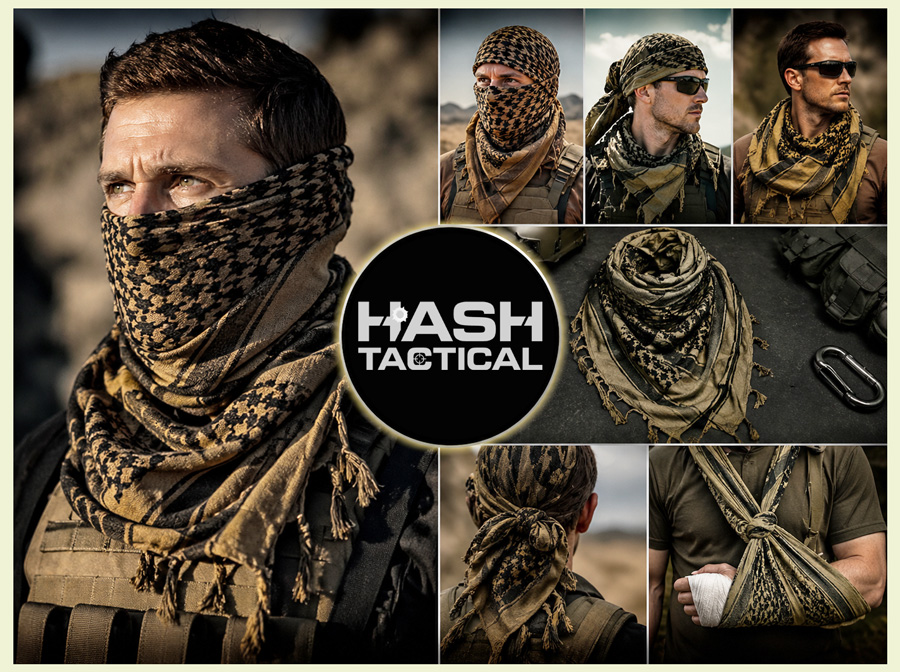
1. The Full Tactical Wrap (The “Ninja”)
This is the gold standard for high-wind or high-dust environments. It covers everything but your eyes.
- How to do it: Fold the square into a triangle. Drape it over your head with the center point on your forehead. Wrap the long ends around your face, crossing over your nose, and tie them at the back of your skull.
- Best use: Sandstorms, cold weather, or when you need total facial anonymity.
2. The Loose Neck Scarf (The “Traditional”)
This is how you’ll see most operators wear it day-to-day. It’s comfortable and keeps your neck protected from “vest bite” (the chafing from your plate carrier straps).
- How to do it: Fold into a triangle. Let the point hang down over your chest. Wrap the ends loosely around your neck and let them hang.
- Best use: General sun protection and moisture wicking.
3. The Cowboy (The “Dust Mask”)
Sometimes you don’t need your whole head covered, just your mouth and nose.
- How to do it: Tie the triangle ends behind your neck so the cloth hangs like a bandana over your chest. Pull it up over your nose when the dust kicks up.
- Best use: Riding in open vehicles or working in urban environments with heavy debris.
4. The Sun Shield (The “Havelock”)
If you’re stuck in a static position under a brutal sun, you need to protect the back of your neck to prevent heatstroke.
- How to do it: Drape the shemagh over your head, then put your tactical cap or helmet on over it. Let the fabric hang down the back and sides.
- Best use: Long-range surveillance or desert hiking.
5. The Emergency Sling
This isn’t a “fold” for fashion; it’s a fold for survival.
- How to do it: Keep the shemagh in its large triangle shape. Place the injured arm in the center and tie the ends behind the neck.
- Best use: Medical emergencies when you’re miles from a medevac.
Technical Specs: Why Fabric Matters
| Feature | Performance Benefit | Tactical Advantage |
| 100% Premium Cotton | Breathability and Softness | Won’t irritate skin during 24+ hour ops. |
| Sublimated Patterns | Permanent Camouflage | Colors won’t bleed or fade in the sun. |
| Reinforced Edges | Prevents Fraying | Keeps the fabric from unraveling in the wash. |
| Oversized Dimensions | Versatility | Large enough to be used as a blanket or towel. |
Sublimation vs. Weaving
Traditional shemaghs have the pattern woven in. This is great, but it can make the fabric heavy. At Hash Tactical, we use advanced sublimation to create our specialized patterns. This allows us to get crisp, clear camouflage on a lighter, more breathable cotton base. It’s the modern evolution of an ancient tool.
The “Wet” Trick for Heat
When the temperature hits 110 degrees, soak your shemagh in water and wrap it around your neck. The evaporation will drop your body temp significantly. It’s like having a portable air conditioner. Because we use high-quality cotton, our wraps hold moisture longer than cheap synthetics.
Beyond the Wrap: 10 Alternate Uses
A veteran knows that gear should have more than one job. Here is what your shemagh can do when it’s not on your head:
- Water Filter: Fold it several times to strain large debris out of water before boiling.
- Rifle Wipe: Clean the dust off your optic or receiver.
- Pot Holder: Grab a hot mess kit off a stove.
- Towel: It dries faster than a standard bath towel.
- Blindfold/Gag: For prisoner transport or survival signaling.
- Pillow: Stuff it with spare socks for a bit of comfort in the dirt.
- Signal Flag: A bright-colored shemagh can be used to signal aircraft.
- Sweatband: Wrap it around your forehead under your helmet.
- Knee Pad: Fold it up and put it under your knee in a pinch.
- Gear Bundle: Tie the corners together to carry extra forage or supplies.
The Manufacturing Difference at Hash Tactical
We are a tactical gear manufacturer that understands that even a “simple” cloth needs to be built right. Our “Cut & Sew” process ensures that the dimensions are perfectly square—nothing is more annoying than a lopsided triangle when you’re trying to do a professional wrap.
We use high-tensile thread for the hems because we know this cloth is going to be pulled, twisted, and used as a rope. We build it to a professional standard because we know that out there, “good enough” isn’t good enough.
Maintenance: Keeping Your Tactical Shemagh in the Fight
- Cold Wash Only: Cotton shrinks. If you put it in hot water, your 42-inch wrap will become a 30-inch handkerchief.
- Avoid Bleach: It eats the fibers. If it’s dirty, use a bit of dish soap and elbow grease.
- Air Dry: Hang it on a line. It will dry in 20 minutes in the sun.
- Watch the Tassels: If the tassels start to untie, knot them back up immediately to prevent the main body from fraying.
Frequently Asked Questions (FAQ) About Tactical Shemagh
A: In a tactical context, it’s viewed as a piece of professional equipment. It has been adopted by almost every western special forces unit because of its sheer utility in the desert.
A: Tan or Coyote is the most versatile. However, if you work in the woods, OD Green or a sublimated woodland pattern is better for breaking up your silhouette.
A: Yes, it will keep the water from running down your neck and into your plate carrier, which is a major comfort win.
Mission Complete. Grab your tactical shemagh, master the folds, and stay protected. Whether it’s sun, sand, or snow, don’t leave the wire without it.
👉 For more information before purchasing your desired custom tactical gear, feel free to contact our support team for guidance!