For maximum performance, choose Tactical Face Covers made from moisture-wicking synthetic blends (polyester/spandex) for high-activity missions or lightweight protection. If you are operating in fire-threat environments (CQB/Vehicle ops), flame-resistant (FR) materials like Nomex are mandatory. Your face cover must prioritize breathability to prevent goggle fogging, offer UV protection, and utilize flat-lock stitching to remain comfortable under a ballistic helmet for extended durations.
Best Tactical Face Covers for Performance & Protection
The Dust, The Heat, and The Mask
I remember a long-range desert patrol where the wind didn’t just blow; it bit. The sand was so fine it found its way into your teeth, your lungs, and every pore of your skin. I saw a rookie try to use a standard cotton bandana. Within an hour, it was a wet, heavy rag that made it harder to breathe than the sandstorm itself.
I had a high-performance synthetic wrap pulled tight. It filtered the grit, wicked my sweat, and kept my skin from frying under the mid-day sun. That day proved that a face cover isn’t a fashion choice; it’s a piece of life-support equipment. At Hash Tactical, we don’t just “cut and sew” fabric; we engineer barriers. We build the gear that stands between your vitals and the harshest environments on the planet.
The Tactical Necessity of Concealment
In our world, anonymity is armor. Protecting your identity is just as important as protecting your skin. Whether you are avoiding facial recognition technology or simply breaking up the “human” silhouette in the brush, the right headgear is critical.
A professional face cover disrupts the natural highlights and shadows of the human face. It turns a recognizable target into an ambiguous shape. Today, we’re breaking down the materials, the designs, and the “why” behind the best Tactical Face Covers in the industry.
Material Science: What’s Touching Your Skin?
Synthetic Blends: The High-Activity King
Most modern operators prefer a polyester and spandex blend. Why? Because it’s a “dry” fiber. It doesn’t hold onto moisture. When you’re breathing heavy during a breach, you need that humidity to move out, not stay trapped against your skin.
These materials also offer 4-way stretch. This ensures the mask stays tight against your face without restricting your jaw movement. At Hash Tactical, we utilize these blends because they take sublimation perfectly. This means your camouflage pattern is dyed into the fiber, so it won’t fade or peel when the sweat starts pouring.
FR Materials: The Shield Against Flash
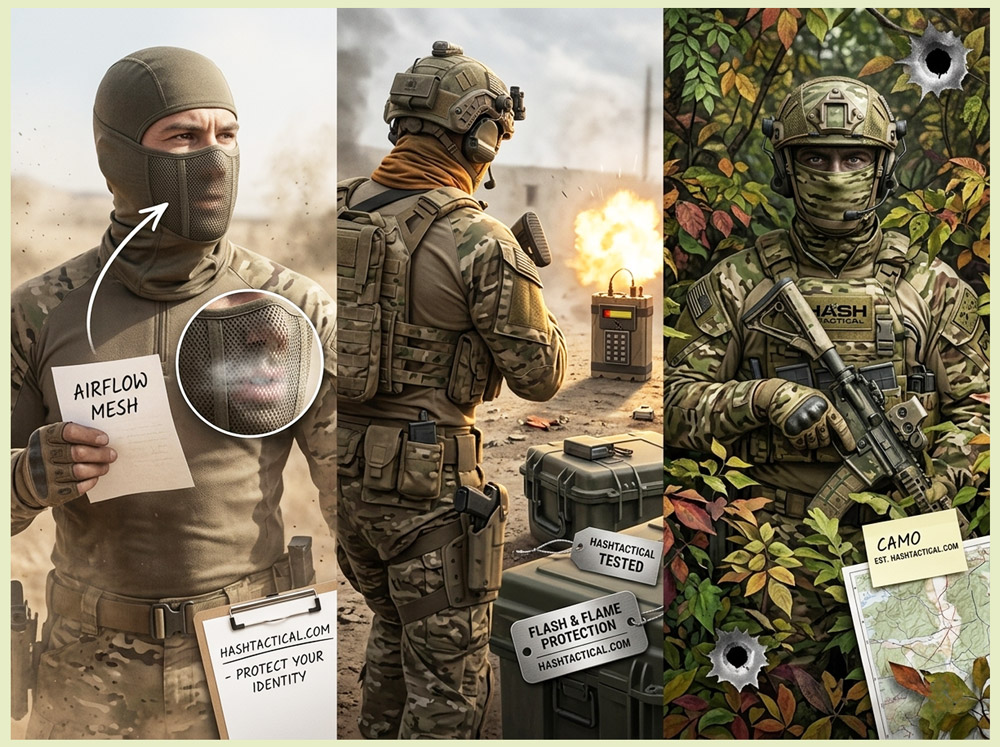
In Close Quarters Battle (CQB), fire is a constant reality. Flash-bangs, breaching charges, and fuel leaks are part of the job. For these environments, you need Flame-Resistant (FR) materials. They won’t melt or drip onto your skin during a thermal event.
Comparing Tactical Face Cover Styles
| Style | Best Use Case | Protection Level | Breathability |
| Full Balaclava | Identity Protection / Cold | High (Full Coverage) | Moderate |
| Neck Gaiter (Wrap) | Dusty Environments / Summer | Moderate (Versatile) | High |
| Half-Face Mask | High-Speed Ops / Shooting | Low (Lower Face) | Extreme |
| FR Flash Hood | CQB / Vehicle Operations | Extreme (Fire Rated) | Low |
The Versatile Neck Gaiter
The gaiter is the most popular choice for a reason. You can wear it as a scarf, pull it up as a mask, or fold it into a headband. It’s low-profile and fits easily into a pocket when not in use. For general field work, it’s the “Swiss Army Knife” of headgear.
The Integrated Balaclava
When you need your headgear to stay put under a helmet, a full balaclava is the answer. We design ours with a hinged front. This allows you to pull the chin piece down for a drink or a radio call without taking off your helmet. It’s about the economy of motion.
The Anatomy of a Professional Face Cover
Flat-Lock Stitching: The Silent Comfort
Standard seams are bulky. When a 3-pound ballistic helmet is pressing that seam into your temple for twelve hours, it feels like a railroad spike. We use flat-lock “Cut & Sew” techniques to ensure the seams are flush with the fabric. No pressure points. No headaches.
Sublimation and Camouflage Integrity
A face cover is a primary “Signature Management” tool. Our sublimation process allows for high-fidelity patterns that match your TJ-607 or TJ-612 jackets exactly. By matching the pattern of your face to your torso, you create a seamless “Visual Breakup” that is incredibly hard for the human eye to track.
Performance Features to Look For
- Anti-Microbial Treatment: Your breath is full of bacteria. A mask that isn’t treated will start to smell—and rot—within days.
- UV Protection (UPF 50+): Sunburn on your face is more than a nuisance; it’s a distraction that saps your energy.
- Moisture Wicking: The fabric must pull sweat away from your mouth and nose to prevent that “suffocating” feeling.
- Mesh Venting: Professional masks often feature specialized mesh over the mouth and ears to improve airflow and situational awareness.
The Manufacturing Edge at Hash Tactical
As a tactical gear manufacturer, we know that a mask is only as good as its fit. We don’t believe in “One Size Fits All.” We use ergonomic patterns that follow the jawline and the bridge of the nose. This prevents the mask from sliding down when you’re talking or moving.
Through our specialized “Cut & Sew” process, we reinforce the edges with elastic binding. This keeps the mask from fraying and ensures it retains its shape after hundreds of washes. We build it to a professional standard because we know your mission depends on it.
Goggle Integration: Solving the Fog Problem
The Warm Air Trap
The biggest complaint about Tactical Face Covers is fogged lenses. This happens because warm, moist air is pushed up under your goggles. To solve this, you need a mask that seals well over the nose or features a dedicated “exhaust” vent.
Tucking Technique
A pro tip: Don’t tuck your mask under your goggle seal. This creates a gap for air to escape upward. Instead, let the goggle sit directly on your skin and pull the mask up to the bottom edge of the frame. This forces your breath out through the fabric, not into your lenses.
Field Maintenance: Keeping the Gear Sharp
- Wash with Scent-Free Soap: Animals and sensitive detection equipment can smell laundry detergent from a mile away. Stay “scent-silent.”
- Air Dry Only: Synthetic fibers hate the high heat of a dryer. It kills the elasticity and the FR properties.
- Check the Stretch: If your mask starts to sag, it’s lost its spandex integrity. Replace it before it fails you in the field.
- Inspect for Fraying: Small loose threads can get into your mouth or nose at the worst possible time. Trim them and sear the edge if necessary.
Frequently Asked Questions (FAQ)
A: If you choose a lightweight synthetic blend with a mesh mouth panel, yes. Avoid heavy cotton or thick fleece for high-output movements.
A: No. These are for dust, sun, and flash protection. For chemical threats, you need a rated gas mask with a proper seal.
A: A hinge allows the top and bottom pieces to move independently. This means you can lower the face piece without pulling the whole mask off your head—critical for comms and hydration.
Mission Complete. Cover your face, stay hidden, and keep your focus on the objective. Whether it’s the desert sun or the CQB flash, make sure your headgear is built for the fight.