Listen up. If you think a harness is just for rock climbers or weekend hikers, you’re dead wrong. In our world, a harness is a lifeline. It’s the difference between a successful extract and a long fall into a dark place. Today, we’re breaking down a tactical harness. We’re talking about load-bearing, extraction, and safety. If you’re operating in high-angle environments or need to move heavy weights without breaking your back, you need to know this gear inside and out.
When to Use a Tactical Harness: A Safety Guide
The Drop That Changed Everything
I remember a night op in the mountains. We were moving fast and light. One of the guys took a bad step on a loose ledge. He wasn’t clipped in because he thought he was “too fast” for a harness. We spent four hours hauling him up with a makeshift rope drag.
That night cost us the mission. It almost cost him his life. Since then, I don’t go near a ledge or a helicopter without being cinched into a professional rig. At Hash Tactical, we don’t build gear for “looks.” We build it so you don’t end up like that guy on the ledge.
What Defines a Tactical Harness?
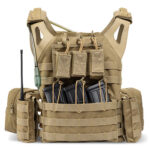
A standard climbing harness is built for comfort while hanging. A tactical harness is built for the mission. It needs to fit over your plate carrier. It needs to have silent hardware. Most importantly, it needs to integrate with the rest of your kit without snagging.
Whether it’s a full-body extraction rig or a simple sit-harness for rappelling, the mission dictates the gear. We specialize in the “Cut & Sew” precision required to make these rigs mission-ready. We use heavy-duty webbing and reinforced stitching that can handle the weight of a fully kitted operator.
Primary Use Cases for Tactical Harnesses
1. High-Angle Operations & Rappelling
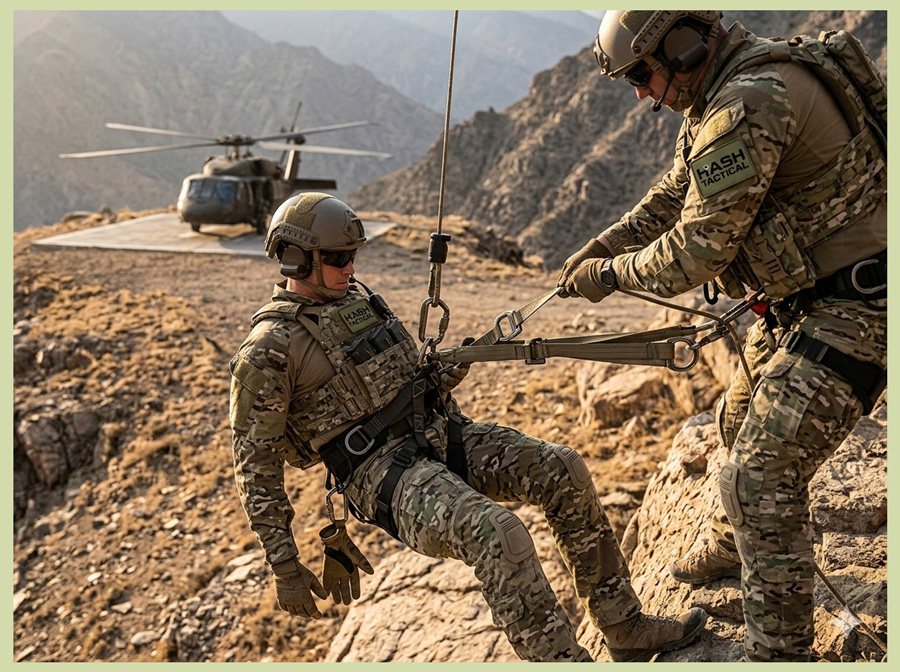
The most obvious use is vertical movement. If you’re breaching from a roof or descending a cliffside, you need a harness that centers your gravity. Tactical rappelling requires a low attachment point so you can keep your hands on your weapon while you descend.
2. Helicopter Extraction (SPIE Rigging)
Special Patrol Insertion/Extraction (SPIE) is a whole different beast. You’re hanging from a line under a bird. You need a full-body harness that distributes your weight across your shoulders and thighs. If that gear fails, there is no Plan B.
3. K9 Handling and Tandem Carry
Sometimes the harness isn’t for you. It’s for your four-legged partner or a casualty. Tactical canine harnesses allow you to fast-rope with your dog or hoist them into a vehicle. We use the same life-safety standards for K9 gear as we do for human rigs.
The Science of Strength: Webbing and Hardware
| Component | Tactical Standard | Why It Matters |
| Type XIII Nylon Webbing | 7,000 lbs Tensile Strength | Provides a massive safety margin for dynamic loads. |
| Cobra Buckles | Quick-Release / Load-Rated | Fast donning and doffing without sacrificing security. |
| V-Rings / D-Rings | Forged Steel or Aluminum | The primary point of failure; must be drop-tested. |
| Bar-Tack Stitching | MIL-SPEC Pattern | The “glue” that holds the webbing together under stress. |
The Power of MIL-SPEC Webbing
We don’t use the stuff you find at a hardware store. We use military-specification webbing designed to resist UV damage and abrasion. It’s stiff enough to hold its shape but flexible enough to move with your body.
Reinforced Stitching: The Invisible Safety Net
Every joint on a harness is a potential point of failure. At Hash Tactical, we use automated bar-tacking. This ensures every stitch is identical and meets the required depth. If a harness says it’s rated for 5,000 lbs, we make sure the stitching is the strongest part of the equation.
Full-Body vs. Sit Harnesses: Choosing Your Loadout
The Full-Body Rig
Best for air ops and heavy extractions. It keeps you upright even if you’re unconscious. It’s bulky, and it can be hot, but it’s the safest option for “worst-case” scenarios.
The Sit Harness (Lower Body)
This is your standard rappelling gear. It’s lightweight and easy to pack. It’s perfect for fast-roping or quick vertical descents where you don’t expect to be hanging for long periods.
Safety Protocols: The Veteran’s Checklist
Before you clip in, you follow the “Rule of Threes.”
- Three-Point Inspection: Check the webbing for frays, the buckles for grit, and the D-rings for cracks.
- The “Two-Finger” Rule: A harness should be tight enough that you can only fit two fingers between the webbing and your leg.
- Redundancy: Always have a backup carabiner or a secondary lanyard if you are working at height for extended periods.
Manufacturing Excellence at Hash Tactical
We treat every harness like it’s going to our own brothers in the field. As a tactical gear manufacturer, we have the ability to customize load-bearing points based on unit requirements.
Whether you need a sublimated camo pattern to match your uniform or a specific “Cut & Sew” configuration for a K9 unit, we handle it in-house. We don’t skip steps. We don’t use “cheap” substitutes. When lives are on the line, the gear has to be perfect.
Maintenance: Don’t Let Your Gear Rot
- Inspect After Every Use: Rocks and metal edges can nick webbing. A small nick becomes a snap under load.
- Wash with Clear Water: Salt from sweat can crystallize and “cut” the fibers from the inside out.
- Store in a Cool, Dark Place: UV rays are the silent killer of nylon. Never leave your harness on the dashboard of a truck.
- Retire the Gear: If a harness has taken a major “fall” load, it’s done. Retire it. It’s cheaper to buy a new rig than to pay for a funeral.
Frequently Asked Questions (FAQ)
A: You can, but it’s heavy. Tactical rigs are designed for durability over weight savings. For climbing, you want something lighter. For combat, you want something that won’t melt or tear.
A: It’s a patented high-strength fastener. It’s designed not to open under load. It’s the gold standard for tactical belts and harnesses because it’s fast and nearly indestructible.
A: With proper care, 5 to 7 years. However, if you are using it daily in saltwater or high-UV environments, check it every month.
Mission Complete. Stay hooked in, stay secure, and never trust a cheap buckle.