Listen up. If you think the shirt on your back is just a piece of clothing, you haven’t been in a real scrape. In the civilian world, fabric is about fashion. In our world, tactical fabric is a structural component. It’s the hull of your ship. It’s the skin of your shelter.
I’ve seen guys go into the bush wearing “heavy-duty” cotton work shirts. Within three days, they were soaked, chafed, and their sleeves were shredded by thorns. I’ve seen cheap polyester melt onto a man’s skin in a flash fire. Today, we are breaking down the science of what makes a textile “tactical.” We’re talking about denier, tensile strength, and why the right weave is the difference between gear that lasts a decade and gear that fails on day one.
Tactical Fabric Explained: Durability & Performance
The Day the Seams Stayed Tight
I remember a mountain extract where we had to slide down a fifty-foot scree slope on our backs. The rocks were like razor blades. Every time I hit a jagged edge, I waited for the sound of my pack or my pants ripping open. It never happened.
I was wearing 500D Cordura and reinforced ripstop. When I got to the bottom, I was bruised, but my gear was intact. My magazines were still in their pouches. My water bladder hadn’t burst. At Hash Tactical, we don’t just “sew clothes.” We engineer armor for your body. We know that the right tactical fabric is the silent partner in every successful mission.
What Makes a Fabric “Tactical”?
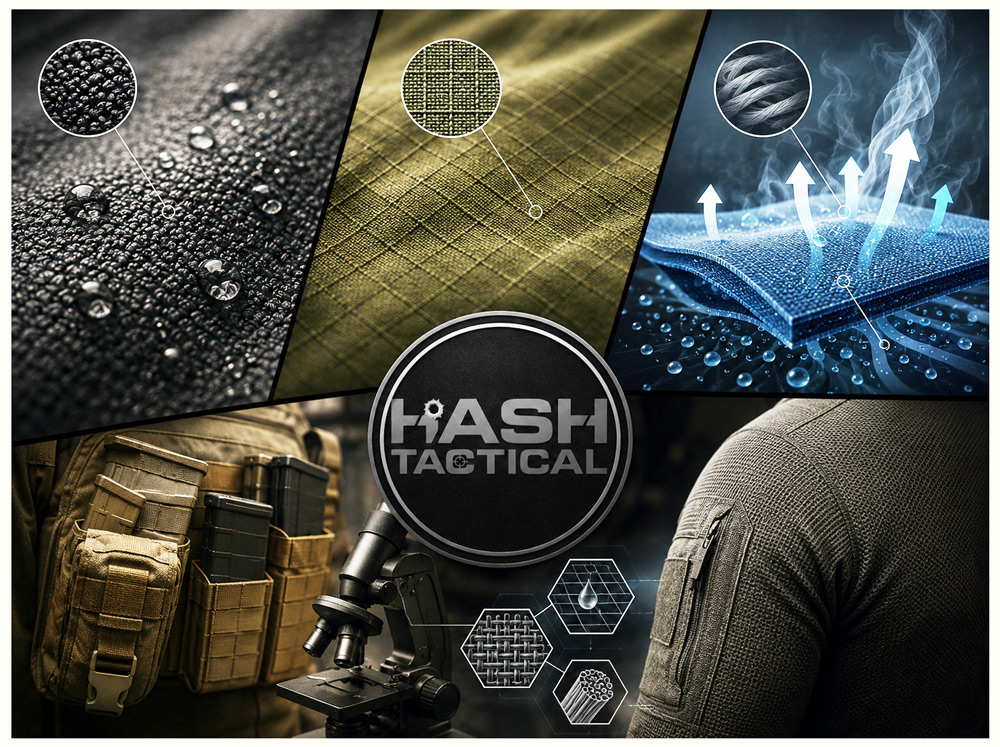
A fabric earns the title “tactical” when it meets three criteria: abrasion resistance, moisture management, and structural integrity under load. It’s not enough to be tough; it has to be smart. It needs to move with the operator, not against them.
Whether we are using a complex “Cut & Sew” assembly for a plate carrier or a high-performance sublimated knit for a jersey, we start with the fibers. We look for materials that can handle the grit of the desert, the humidity of the jungle, and the friction of a concrete breach.
The Anatomy of Tactical Fabric Strength: Understanding Denier
The Numbers Game
When you look at gear, you’ll see numbers like 500D or 1000D. That “D” stands for Denier. It’s a unit of measure for the thickness of the individual threads. The higher the number, the thicker and heavier the fabric.
- 500D Nylon: The “sweet spot.” It’s incredibly tough but light enough for high-speed movement. Most professional backpacks and vests live here.
- 1000D Nylon: The “tank” of fabrics. It’s heavy and stiff. It’s used for the bottom of packs and high-wear areas that take a constant beating.
- 330D Nylon: Used for lightweight mission sets or internal organizers where weight savings are more important than brute strength.
Why Ounces Equal Pounds
In the old days, everything was 1000D. It was indestructible, but it weighed a ton. Modern tactical fabric engineering has allowed us to move toward 500D and specialized laminates. You get the same protection but with 30% less weight. When you’re humping a 60-pound ruck, that 30% feels like a miracle.
Core Materials: The Big Three Tactical Fabric
| Material | Performance Benefit | Primary Use Case |
| Nylon (Cordura) | Extreme Abrasion Resistance | Plate Carriers, Pouches, Rucksacks. |
| Polyester | UV Resistance & Color Fastness | Sublimated Jerseys, Lightweight Layers. |
| Ripstop (NYCO) | Stop-Tear Technology | Combat Pants, Field Shirts, Boonies. |
The Power of Ripstop
Look closely at your combat pants. See that grid pattern? That’s Ripstop. It’s a “Cut & Sew” masterpiece where a thicker thread is woven into the fabric at regular intervals. If you get a small puncture from a piece of barbed wire, the tear stops at the grid. It prevents a small hole from becoming a massive flap that compromises your protection.
Polyester and Sublimation
For our high-performance jerseys, we use specialized polyesters. Why? Because polyester is a “dry” fiber. It doesn’t soak up sweat like cotton. It also takes sublimation ink perfectly. This allows us to dye camouflage patterns deep into the fabric so they never fade, peel, or crack under the sun.
Performance Enhancements: Beyond the Weave
DWR (Durable Water Repellent) Tactical Fabric
A tactical jacket should shed water like a duck’s back. We apply DWR coatings that cause water to bead up and roll off. This prevents “wet-out,” where the fabric becomes heavy and cold. It’s not waterproof—you need a membrane for that—but it keeps you dry in a drizzle or a morning mist.
NIR (Near-Infrared) Signature Management
If you’re operating against an enemy with night vision, your fabric needs to be “dark” in the IR spectrum. Many cheap fabrics glow like a lightbulb under NVGs. At Hash Tactical, we use dyes and materials designed to keep your signature low, ensuring you stay hidden in the shadows.
The Manufacturing Difference: Cut & Sew Precision
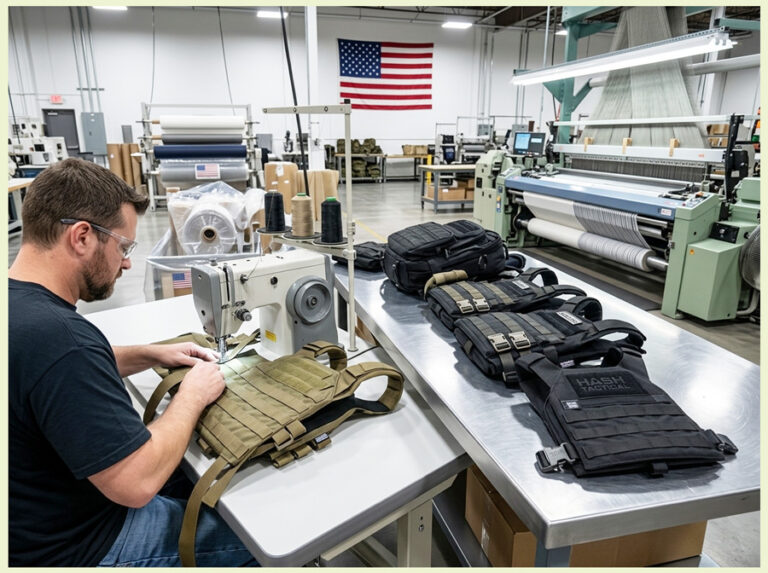
Fabric is only half the battle. How you put it together is the other half. We use industrial-grade, bonded nylon thread. It’s rot-resistant and incredibly strong. We use “Double-Needle” stitching on all major seams to ensure that even if one stitch pops, the whole seam doesn’t unzip.
Our “Cut & Sew” teams focus on the “Stress Points”—the crotch of the pants, the shoulder straps of the vest, and the armpits of the jacket. These areas are reinforced with bar-tacks (heavy-duty zig-zag stitches) to prevent failure during extreme physical exertion.
Thermal Regulation: Staying in the Fight
Moisture Wicking vs. Absorption
Cotton is a killer in the cold because it absorbs 27 times its weight in water. When it gets wet, it stays wet, leading to hypothermia. Tactical synthetics are “hydrophobic.” They push moisture away from your skin to the surface where it can evaporate.
The “No-Melt, No-Drip” Requirement
For guys working around IEDs or flash-bangs, we use NYCO (Nylon-Cotton) blends. These are designed to be “No-Melt, No-Drip.” If they catch fire, they char and crumble rather than melting onto your skin like pure plastic. It’s a critical safety feature for high-threat environments.
Field Care: Don’t Kill Your Gear
- Skip the Softener: Fabric softeners coat the fibers in a waxy film. This kills the moisture-wicking and the DWR.
- Air Dry Whenever Possible: High heat in a dryer can damage the elastic fibers and the specialized coatings of the tactical fabric.
- Brush off the Mud: Once mud dries, it becomes abrasive. It acts like tiny knives cutting the fibers. Brush your gear down after every op.
- Use Scent-Free Soap: If you’re hunting or on a recon mission, the smell of “lavender” detergent is a tactical liability.
Frequently Asked Questions (FAQ)
A: No. 1000D is too heavy for most garments. It’s better for stationary gear like bags or reinforced knee panels. For most of your kit, 500D is the professional’s choice.
A: We use a small percentage of Spandex (or Elastane) in “Gussets” to allow for 4-way stretch. This lets you lunge, climb, and crouch without the fabric binding or tearing.
A: Yes, but keep it on a cold, gentle cycle. Turn garments inside out to protect the sublimated patterns and the DWR coatings.
Mission Complete. Your gear is an investment in your survival. Respect the fabric, understand the weave, and never trust your life to “cheap” cloth.
👉 For more information before purchasing your desired custom tactical gear, feel free to contact our tactical gear expert team for guidance!