Listen up. If you think picking out one of our tactical jackets is about making a fashion statement, you’re in the wrong line of work. Out past the wire, “cool” doesn’t keep you alive. Science does. Specifically, the science of visual disruption.
I’ve spent years watching shadows move in places shadows shouldn’t move. I’ve seen guys get spotted from a clicks away because their jacket had a “blob” pattern that didn’t match the horizon. I’ve also seen guys practically disappear while standing in plain sight. Today, we’re going deep into the guts of camouflage. We’re talking about why the patterns on the TJ-607 and TJ-612 actually work when the stress levels redline.
Beyond the Camo: The Science of “Visual Breakup” in Tactical Jackets
The Man I Never Saw
I remember a training exercise in a dense, multi-terrain environment. We were hunting a scout who was wearing an early prototype of a high-resolution disruptive pattern. We knew he was in a fifty-yard box. We had glass in the area and four pairs of eyes scanning every inch.
We walked right past him. He was leaning against a downed tree, perfectly still. His jacket didn’t make him “invisible” like a movie; it just broke his shape into pieces the brain couldn’t assemble. At Hash Tactical, we don’t just “print patterns.” We engineer optical illusions. We build the gear that buys you those extra seconds of hesitation from an adversary.
The Human Brain: Your Greatest Enemy
Your brain is hardwired to find patterns. It looks for the curve of a shoulder, the straight line of a limb, or the solid block of a human torso. If your jacket is one solid, unnatural color, you are a target.
Camouflage is the art of “Visual Breakup.” It’s about using light and dark contrast to trick the brain into thinking it’s looking at leaves, shadows, or dirt—anything but a human being. Whether it’s a complex sublimated print or a precision cut & sew assembly, the goal is to disappear into the noise of the environment.
Macro vs. Micro: The Distance Game
The TJ-609 Digital Strategy
Take a look at the TJ-609. It uses a digital, pixelated approach. To the untrained eye, it looks like a computer glitch. But there’s a method to the madness. This is about managing “blobbing.”
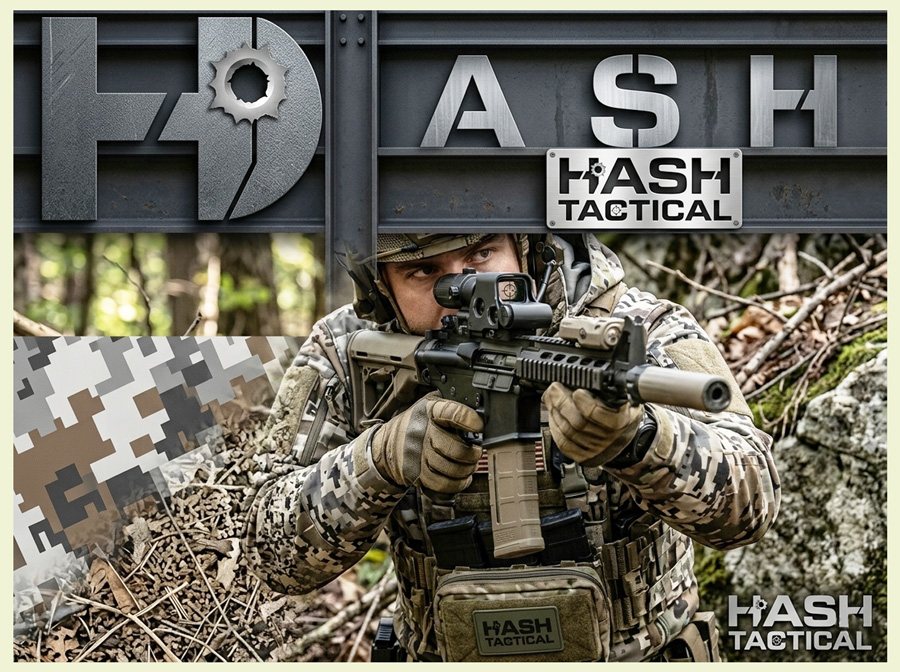
At close range, the “Micro” pattern—the tiny pixels—breaks up your texture. It mimics the small details of bark or stones. But as you move further away, those pixels bleed together to form “Macro” shapes. These larger shapes mimic the shadows between trees or the variations in a rock face.
Why Pixels Beat Blobs
Old-school camouflage used large, rounded blobs. At a distance, those blobs often merge into one solid dark mass. This makes you look like a big black hole in the middle of the woods.
Digital patterns, like the ones we use on our high-performance tactical jackets, maintain their disruptive quality at multiple distances. You get the benefit of concealment at 10 yards and 100 yards. It’s a multi-scale solution for a multi-scale fight.
Earth Tones: The Universal Language of Stealth
Transitioning from Urban to Woodland
Most missions aren’t purely one environment. You might start in an industrial zone and end up in a tree line. This is where “Earth Tones” like those on the TJ-608 (Coyote/Tan) and TJ-612 (Woodland Digital) come into play.
Earth tones are “low-chroma” colors. They don’t reflect much light. Because they are found in both man-made and natural environments, they act as a bridge. A tan jacket works in a desert, sure. But it also works against a brick wall or a dead wheat field.
Table: Environment vs. Pattern Selection
| Environment | Recommended Jacket | Primary Benefit |
| Arid / High Desert | TJ-608 (Coyote) | Blends with sand and dried vegetation. |
| Dense Forest / Jungle | TJ-612 (Woodland) | High contrast for shadow disruption. |
| Urban / Night Ops | TJ-611 (Navy) | Low-profile in low-light environments. |
| Multi-Terrain / Transitional | TJ-607 (Multi-Cam) | Adapts to varying light and foliage levels. |
The “Gray Man” Theory: Low-Profile Operations
Why Solid Colors Like TJ-611 Matter
Sometimes, disappearing doesn’t mean wearing camo. It means looking like you belong. This is the “Gray Man” concept. If you’re operating in a city, a full digital camo jacket makes you stand out like a neon sign.
The TJ-611 (Navy) or the TJ-608 (Coyote) allows you to move through a crowd without drawing eyes. You retain all the tactical utility—the reinforced elbows, the comms ports, the weather resistance—but you lose the “soldier” profile.
The Psychology of the Solid Color
In high-stress urban environments, people look for threats. A solid-colored jacket is perceived as “civilian” or “security.” It lowers the “threat temperature” of the room. At Hash Tactical, we produce these jackets with the same heavy-duty materials as our combat gear, giving you the stealth of a civilian with the protection of an operator.
Sublimation: The Ink is the Armor
We don’t just “paint” camouflage onto our tactical jackets. We use a high-heat sublimation process. This bonds the ink to the actual fibers of the fabric. Why does this matter for stealth?
- No Peel, No Fade: Cheap printed jackets peel and show white spots. That’s a “visual flare” that gives you away. Our patterns stay permanent.
- Low IR Signature: Our dyes are formulated to reduce Infrared (IR) reflection. Under night vision, you won’t glow like a ghost.
- Fabric Breathability: Sublimation doesn’t clog the pores of the fabric. You stay cool, meaning you move better.
The Manufacturing Difference: Cut & Sew Integrity
As a dedicated tactical gear manufacturer, we know that a pattern is only as good as the seams holding it together. If the seams of your tactical jackets pop during a low-crawl, the white internal lining of the fabric will show. That’s a death sentence for your concealment.
We use reinforced stitching and matching thread colors for every pattern. Our “Cut & Sew” experts align the patterns across the zippers and seams as much as possible to prevent “hard lines” that the human eye can track. It’s the attention to detail that separates a “coat” from a “kit.”
Field Performance: Living in the Disruption
Symmetry is the Enemy
Nature isn’t symmetrical. Humans are. One of the reasons our tactical jackets feature asymmetrical pocket layouts and slanted zippers is to help break up the human silhouette.
The Shadow Game
Camouflage works by creating “false shadows.” If you are standing in a sunny spot, the dark bits of the TJ-607 mimic the shadows of leaves. This “fools” the eye into thinking the space you occupy is actually empty air.
Maintenance: Don’t Compromise Your Stealth
- Avoid Optical Brighteners: Most “regular” laundry detergents have chemicals that reflect UV light. To a human, your jacket looks clean. To an animal or a guy with NVGs, you’re glowing. Use “Scent-Free/UV-Free” soap.
- Cold Wash Only: Heat can eventually break down the low-IR coatings of the fabric.
- No Fabric Softener: It adds a “sheen” to the fabric. You want your tactical gear to be matte. Reflection is the enemy.
- Mud is your Friend: In the field, don’t be afraid to rub some local dirt into your gear. It’s the best “free” camouflage upgrade you can get.
Frequently Asked Questions (FAQ)
A: It’s the best “average.” It works in 70% of environments. But if you’re strictly in deep green woods, the TJ-612 will outperform it every time.
A: Yes. True black is very rare in nature. “Navy” (TJ-611) or “Dark Gray” blends better with natural shadows and low-light urban environments.
A: Absolutely. The “Visual Breakup” technology that works on humans works even better on animals. The TJ-612 is a favorite for forest stalking.
Mission Complete. Stealth isn’t a superpower. It’s a science. Choose the pattern that matches your mission, stay still, and let the gear do the work.