Engineering the Best Custom Tactical Pants for Law Enforcement Officers
Standard-issue pants fail officers every day. They bind at the knee and tear at the seams. They don’t fit real bodies wearing real gear. Custom tactical pants fix this. They’re built around your body, your duty belt, and your daily tasks. The result: less pain, more mobility, and gear that lasts longer.
This guide compares off-the-shelf duty pants to custom-built alternatives. You’ll see the real differences in fit, durability, and comfort. By the end, you’ll know exactly what to look for and why officers are switching to custom builds like the ones made by Hash Tactical.
Why Standard-Issue Pants Let Officers Down
Most uniform pants are made for an “average” body. But there’s no such thing as an average cop.
Some officers are 5’6″, but some are 6’4″. Some carry extra gear on their belt, but some spend all day in a patrol car. Others chase suspects on foot. One pair of pants can’t serve all these needs well.
Common Complaints From Officers
- Knees wear out fast from kneeling on pavement or gravel.
- Waistbands dig in when sitting for long shifts.
- Pockets rip under the weight of a duty belt.
- Fabric bunches up behind the knee during foot pursuits.
- Seams split during physical arrests or takedowns.
These aren’t small annoyances. They affect job performance. A torn seam mid-shift is a distraction. A stiff knee joint can slow down a response.
The Cost of “Good Enough”
Departments often buy in bulk to save money. That means one design, a few sizes, and hope for the best. Officers end up altering pants themselves or buying gear on their own dime.
This is where custom tactical pants change the equation.
What Makes a Pair of Pants “Custom Tactical”
Custom doesn’t just mean a different color or logo. It means the pants are engineered around how officers actually move and work.
Core Elements of Custom Design
| Feature | Standard Duty Pants | Custom Tactical Pants |
|---|---|---|
| Sizing | Fixed size chart | Measured to the officer |
| Knee design | Flat, non-articulated | Articulated, pre-curved |
| Knee protection | None or add-on pads | Built-in internal knee pad pockets |
| Fabric | Basic cotton or poly blend | Ripstop, stretch-woven blends |
| Belt area | Standard loops | Reinforced, gear-ready loops |
| Pockets | Fixed placement | Placed for radios, mags, tools |
| Stitching | Single-stitch seams | Double or triple stitching at stress points |
This table shows the gap. Standard pants are made to fit a size chart. Custom pants are made to fit a job.
Anatomical Design: Building Pants Around the Body
Anatomical design means the pants follow the natural shape of the leg, hip, and waist, not a flat pattern cut from a bolt of fabric.
Why This Matters for Officers
The human leg doesn’t stay straight all day. It bends at the knee, twists at the hip, and flexes at the ankle. Flat-cut pants fight against this motion. Anatomical pants work with it.
Here’s what anatomical design changes:
- Hip mobility – A slightly higher rise in the back prevents gapping when bending or crouching.
- Thigh room – Extra fabric in the thigh allows a full stride without pulling.
- Calf taper – A closer fit at the calf keeps pants from catching on boots or gear.
- Waist shaping – A contoured waistband sits comfortably under a duty belt, even for 12-hour shifts.
Real-World Example
Picture an officer climbing over a fence during a foot chase. Standard pants often restrict that leg lift. Anatomical pants, cut with extra articulation at the hip and knee, move with the body instead of against it.
This is the difference between gear that helps and gear that gets in the way.
Articulated Knees: The Most Requested Upgrade
Ask any officer what they’d change about their duty pants, and articulated knees usually top the list.
What Are Articulated Knees?
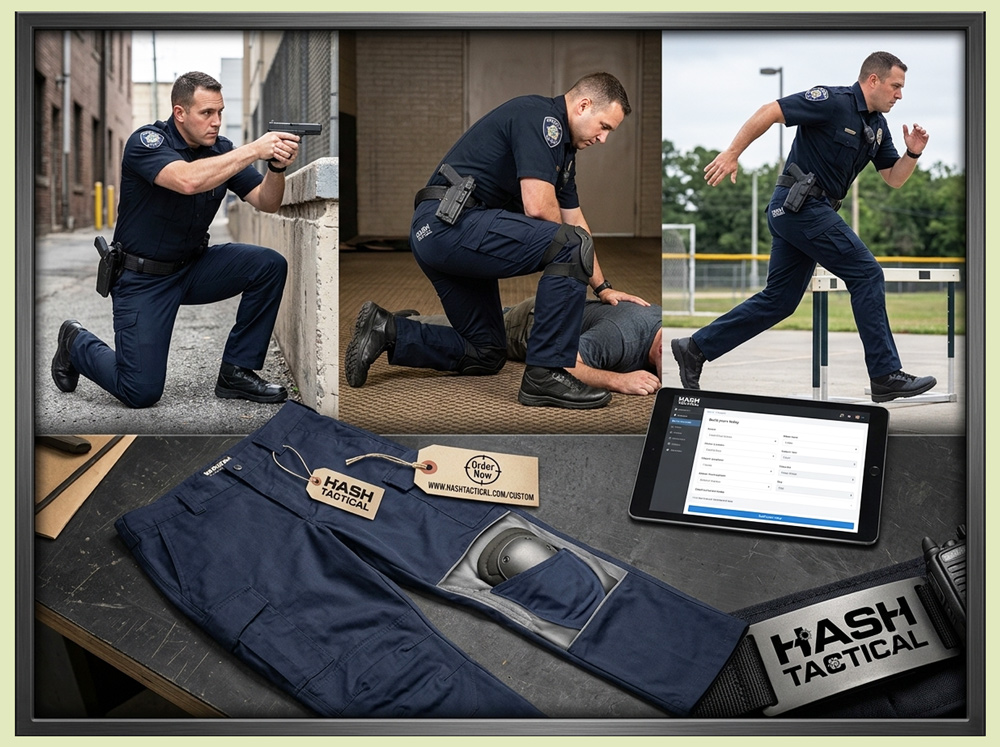
Articulated knees are pre-curved panels sewn into the pant leg. Instead of a flat piece of fabric across the knee, the fabric is shaped to match a slightly bent leg, the natural resting position of the human knee.
Benefits of Articulated Knees
- Less fabric strain. Pre-curved knees don’t stretch and tear as fast.
- Better range of motion. Officers can kneel, crouch, or run without fighting the fabric.
- Longer pant life. Less stress on seams means fewer replacements.
- More comfort during long shifts. Sitting in a patrol car for hours feels less restrictive.
Articulated vs. Standard Knee Comparison
| Situation | Standard Knee | Articulated Knee |
|---|---|---|
| Kneeling for a search | Fabric pulls tight | Fabric moves naturally |
| Running after a suspect | Restricts stride | Allows full leg extension |
| Sitting in a vehicle | Bunches at the knee | Sits flat and smooth |
| Long-term wear | Cracks and thins faster | Distributes stress evenly |
Officers who switch to articulated knees often say the change is noticeable within the first shift.
Internal Knee Pad Pockets: Protection Without the Bulk
Kneeling on concrete, gravel, or broken glass is part of the job. Internal knee pad pockets solve this problem without adding a separate strap-on pad.
How Internal Knee Pad Pockets Work
A internal knee pad pocket is a hidden sleeve sewn inside the pant leg, right over the knee. Officers slide a foam or hard-shell pad into the pocket. The pad stays in place during movement, but it’s invisible from the outside.
Why This Beats Strap-On Pads
- No extra straps to adjust or tighten.
- No slipping during a foot pursuit.
- No bulk that shows through the uniform.
- Pads can be removed and washed separately.
- Officers can add or remove pads based on the shift’s tasks.
Quick Comparison
| Feature | Strap-On Knee Pads | Internal Knee Pad Pockets |
|---|---|---|
| Visibility | Visible bulk | Hidden inside pant |
| Comfort | Straps can pinch | No pinching |
| Slippage | Common during movement | Rare, pad stays in place |
| Ease of use | Extra gear to put on | Built into the pants |
This feature alone can prevent knee injuries over a long career. Kneeling without protection, shift after shift, adds up.
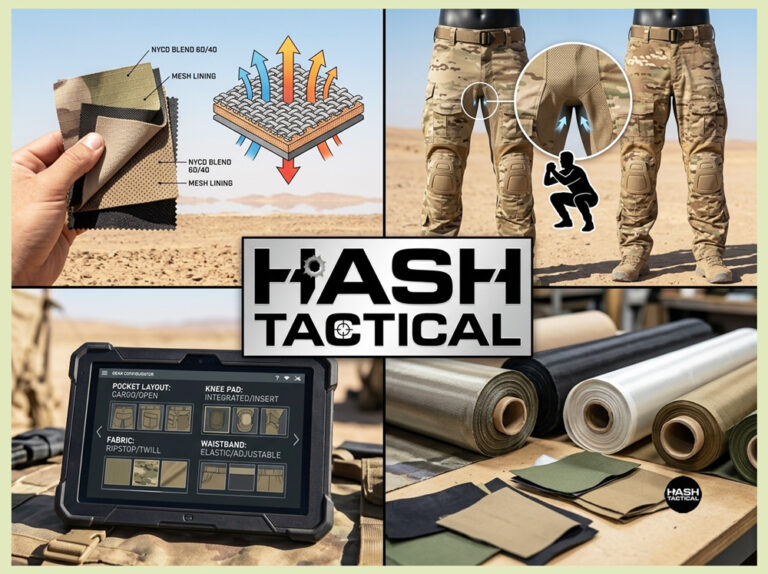
Fabric Choices That Actually Matter
Not all tactical fabric is the same. The right blend affects durability, comfort, and how the pants perform in different weather.
Common Fabric Options
- Ripstop cotton-poly blend – Strong, breathable, resists tearing.
- Stretch-woven fabric – Adds flexibility for high-movement tasks.
- Rugged canvas – Extra durability for K-9 units or outdoor patrol.
- Moisture-wicking blends – Keeps officers dry during physical activity.
Matching Fabric to Duty Type
| Duty Type | Best Fabric Choice |
|---|---|
| Patrol (mixed indoor/outdoor) | Ripstop cotton-poly blend |
| SWAT or tactical units | Stretch-woven fabric |
| K-9 or outdoor-heavy roles | Rugged canvas |
| Hot climates | Moisture-wicking blends |
Choosing the wrong fabric for the job leads to faster wear and more discomfort. Custom pants let officers pick fabric based on their actual daily tasks, not a one-size-fits-all department order.
Reinforced Stress Points: Where Pants Fail First
Most pant failures happen in the same few spots. Custom builders reinforce these areas before they become a problem.
Common Failure Points
- Crotch seam – Splits during high kicks, running, or straddling.
- Belt loops – Rip under the weight of a loaded duty belt.
- Pocket corners – Tear from repeated reaching for gear.
- Knee area – Thins out from kneeling and crawling.
How Custom Pants Fix This
Custom tactical pants use double or triple stitching at these exact points. Some builders add bar-tack stitching, a tight, boxed stitch pattern, at the corners of pockets and belt loops.
This isn’t just about looking tough. It’s about pants that survive years of hard use instead of months.
Fit Customization: Beyond Waist and Inseam
Standard sizing only accounts for waist and length. Custom fitting goes much deeper.
What Gets Measured for a True Custom Fit
- Waist and hip circumference
- Thigh circumference
- Inseam and outseam length
- Rise (front and back)
- Calf width
- Preferred belt height
Why Deeper Measurements Matter
An officer with a larger thigh but a smaller waist often struggles with standard sizing. They either buy a bigger waist size for thigh room, or a smaller size that binds. Custom measurements solve this mismatch completely.
This is one reason departments and individual officers are turning to companies like Hash Tactical, which builds pants from actual body measurements instead of a generic size chart.
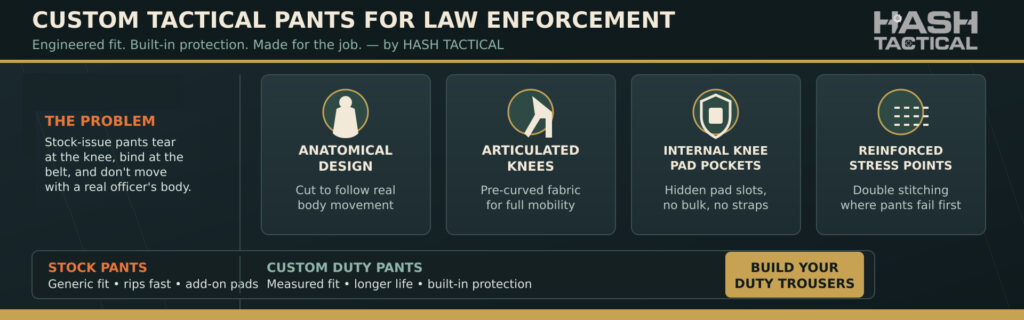
Comparing Custom vs. Off-the-Shelf: Full Breakdown
Here’s a side-by-side look at the full picture.
| Category | Off-the-Shelf Pants | Custom Tactical Pants |
|---|---|---|
| Fit | Generic sizing | Measured to the individual |
| Knee mobility | Limited | Articulated design |
| Knee protection | Add-on pads | Internal knee pad pockets |
| Durability | Standard stitching | Reinforced stress points |
| Fabric options | Limited | Multiple blends to choose from |
| Comfort over 12-hour shifts | Often poor | Designed for long wear |
| Long-term cost | Frequent replacement | Longer lifespan, fewer replacements |
| Personalization | None | Pockets, cut, and fabric chosen by officer |
The Real Cost Question
Custom pants often cost more upfront. But they last longer and reduce injury risk from poor-fitting gear. Departments that switch often see fewer uniform replacement requests over time.
Who Benefits Most From Custom Duty Pants
Not every officer has the same daily tasks. Custom pants can be tailored to match specific roles.
- Patrol officers – Need mobility for vehicle stops, foot pursuits, and long sitting periods.
- K-9 handlers – Need rugged fabric that survives outdoor terrain and kneeling with their dog.
- SWAT and tactical teams – Need maximum flexibility and reinforced knees for crawling and crouching.
- Detectives and plainclothes officers – Need a cleaner look with hidden functional features.
Each role has different stress points. Custom builders can adjust fabric, pocket placement, and reinforcement based on the officer’s actual assignment.
Step-by-Step: How the Custom Pants Process Works
- Measurement – Officer provides body measurements or visits for a fitting.
- Fabric selection – Officer chooses fabric based on climate and duty type.
- Feature selection – Officer picks knee articulation, internal knee pad pockets, pocket layout, and reinforcement level.
- Production – Pants are cut and sewn to the exact specifications.
- Delivery and fit check – Officer receives pants and can request adjustments if needed.
This process takes more time than grabbing a pair off a shelf. But the payoff is pants that actually work for the job.
Frequently Asked Questions
Custom pants typically last longer because of reinforced stitching and better fabric matched to the job. Many officers report double the lifespan compared to standard-issue gear.
Yes. Departments can order custom-fit pants for multiple officers, with each pair measured individually while keeping a consistent design across the unit.
Most internal knee pad pockets are designed to fit standard foam or hard-shell inserts. It’s best to confirm sizing with the manufacturer before ordering.
No. The pre-curved shape is subtle and doesn’t affect the pants’ appearance when standing at attention or in uniform inspection.
Pricing varies based on fabric and features. Custom pants generally cost more upfront but reduce long-term replacement costs due to better durability.
Many custom builders, including Hash Tactical, offer fit adjustments after the initial delivery to make sure the pants match the officer’s body correctly.
Final Thoughts: Gear That Works as Hard as You Do
Officers deserve gear built for real work, not just a size chart. Anatomical design, articulated knees, and internal knee pad pockets aren’t extra features; they’re solutions to problems officers face every single shift.
Standard-issue pants will always be a compromise. Custom tactical pants remove that compromise entirely.
Hash Tactical builds duty pants around the officer, not the other way around. Every measurement, every stitch, and every pocket is placed with the job in mind.
If your current pants are holding you back, it’s time for a change. Contact us for more guidance!