Custom Ripstop Cargo Pants for Wilderness Guides and Trackers
If you work outdoors for a living, your pants matter as much as your boots. Wilderness guides, trackers, and anti-poaching rangers need cargo pants that survive thorns, mud, heat, and hard crawling. Off-the-shelf pants rip fast and rarely fit the gear you actually carry. Custom ripstop cargo pants solve both problems. They use tough ripstop fabric that stops small tears from spreading, and they get built around your exact pocket and stretch needs. Hash Tactical builds these pants to order, so guides and trackers get gear made for real field work, not a warehouse shelf. This article compares fabric options, pocket layouts, and stretch technology so you can choose the right custom pants for your job.
Why Standard Cargo Pants Fail Field Professionals
Most cargo pants sold in stores are made for casual wear. They look tough but fold under real stress.
Here is what usually goes wrong:
- Thin fabric tears on thorns and rocks. One snag turns into a long rip.
- Pockets sit in the wrong spot. A radio pocket that digs into your ribs while crawling is useless.
- No stretch panels. Squatting to check a track or climbing over deadfall becomes a fight with your own pants.
- Fabric soaks up water and mud. Wet pants get heavy and cold fast.
- Stitching fails at the seams. Cheap thread breaks after a few months of daily wear.
Guides and trackers spend ten or more hours a day outdoors. Pants that fail mid-shift are not just annoying. They can be dangerous when you are far from base camp.
What Makes Ripstop Fabric Different
Ripstop fabric uses a special weave. Thicker threads run through the fabric in a grid pattern, spaced about a quarter inch apart. If the fabric tears, the tear stops at the next thick thread instead of spreading across the whole pant leg.
Picture chain-link fencing. A cut in fencing does not unravel the whole fence. Ripstop fabric works the same way.
Common Ripstop Materials Compared
| Fabric Type | Weight | Best For | Downside |
|---|---|---|---|
| Cotton ripstop | Medium-heavy | Breathability, comfort in heat | Slower to dry |
| Nylon ripstop | Light | Durability, quick dry | Less breathable |
| Poly-cotton blend | Medium | Balance of strength and comfort | Slightly heavier |
| Nylon-cotton (NyCo) | Medium | Military and tactical use | Higher cost |
For eco-tourism guides walking long trails in heat, cotton or poly-cotton ripstop breathes better. For anti-poaching units doing night patrols through brush, nylon or NyCo ripstop holds up better against snags and moisture.
Mechanical Stretch Fabric: Why It Matters
Tracking work means crouching low to read a print, climbing over rocks, and moving fast through brush. Stiff fabric slows you down and wears out at the knees and crotch first.
Mechanical stretch fabric solves this without using stretchy synthetic fibers that lose shape over time. Instead, the fabric is woven or cut in a way that lets it flex naturally with your body. The weave itself gives, not a chemical coating.
Benefits of mechanical stretch panels:
- Full range of motion for squatting, climbing, and crawling.
- Less fabric fatigue compared to spandex blends that stretch out permanently.
- Better durability because the weave holds its structure over years of wear.
- No sagging after repeated washing, unlike elastic-blend fabrics.
Custom builders place these stretch panels at the knees, seat, and waistband gusset — the three spots that take the most strain during field movement.
Teflon Fabric Protector: The Weather Shield
Wilderness work does not stop for rain or mud. A Teflon fabric protector coating adds a water- and stain-resistant layer to ripstop fabric without changing how it breathes.
How it helps in the field:
- Water beads off instead of soaking in, keeping pants lighter and drier.
- Mud and blood wipe off more easily, which matters for anti-poaching and wildlife work.
- UV resistance improves, slowing fabric breakdown from years of sun exposure.
- Fabric stays flexible, unlike waxed or rubberized coatings that stiffen over time.
This coating wears down over years, but most custom manufacturers, including Hash Tactical, offer reapplication guidance or retreatment services to keep pants performing at full strength.
Custom Pocket Layout: Built Around Your Gear
Generic cargo pants come with fixed pockets in fixed spots. That works fine for casual use. It does not work when you carry a GPS unit, radio, knife, first-aid kit, and tracking notebook every single day.
Custom pocket layout means you decide where every pocket goes, based on what you carry and how you move.
Common Pocket Requests From Field Professionals
| Role | Priority Pockets | Placement Reason |
|---|---|---|
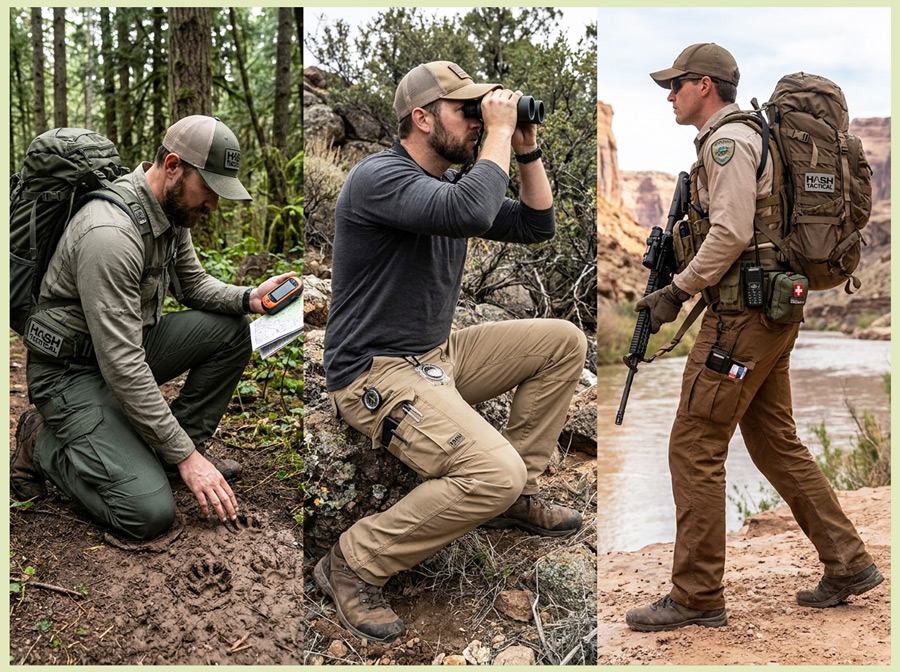
| Wilderness guide | Map pocket, water bottle loop | Easy access while walking |
| Tracker | Low-profile knee pocket for tools | Stays clear during crouching |
| Anti-poaching ranger | Radio pocket, magazine pouch | Quick reach without looking down |
| Eco-tourism lead | Phone pocket with flap closure | Security on uneven terrain |
A good custom layout also considers pocket depth and closure type. Velcro flaps are fast but noisy — a problem for trackers trying to move quietly. Button or zip closures are quieter but slower to open. Hash Tactical works with clients to match closure type to the job, not just the look.
Fit and Cut: Why Off-the-Rack Sizing Falls Short
Standard sizing assumes a standard body and a standard task. Field professionals are rarely standard.
A tracker who crouches for hours needs more room through the thigh and knee. A guide who hikes long distances needs a slimmer cut to avoid chafing. Anti-poaching teams often need extra room for body armor or duty belts underneath.
Custom-cut pants account for:
- Rise length for comfort when crouching or sitting on uneven ground.
- Leg taper to avoid snagging on brush while still allowing boot access.
- Waist and belt loop placement to support duty belts and holsters.
- Gusseted crotch for a wider range of motion without a blowout.
This is the biggest difference between a custom build and a store-bought pair. Fit changes how the fabric performs. Even the best ripstop fabric fails faster if it is pulling wrong across the body.
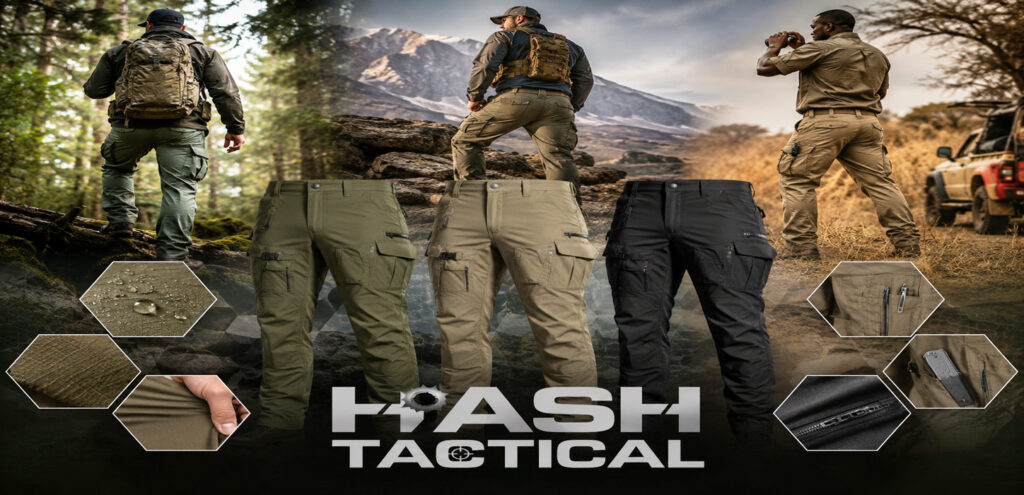
Comparing Custom vs. Off-the-Shelf Tactical Cargo Trousers
| Feature | Off-the-Shelf | Custom (Hash Tactical) |
|---|---|---|
| Fabric choice | Fixed, limited | Choose ripstop type and weight |
| Pocket layout | Fixed | Fully customizable |
| Stretch zones | Rare or synthetic-based | Mechanical stretch placement |
| Weather protection | Basic or none | Teflon fabric protector option |
| Fit | Standard sizing | Measured to body and task |
| Durability under field stress | Moderate | High |
| Cost | Lower upfront | Higher upfront, lower long-term cost |
Off-the-shelf pants cost less at checkout. But field professionals often replace them twice as often. Custom pants cost more upfront and last longer, which usually makes them cheaper per year of use.
Real-World Use Cases
Eco-Tourism Guide, East Africa A safari guide leading walking tours needs breathable cotton ripstop, a map pocket at chest height, and a slimmer cut for long daily hikes in heat.
Wildlife Tracker, North America A tracker crouching for hours to read animal sign benefits most from mechanical stretch at the knees and a low-profile tool pocket that will not dig into the leg while kneeling.
Anti-Poaching Ranger, Southern Africa Night patrols in brush call for nylon ripstop with Teflon fabric protector, quiet closures, and a cut that fits over body armor.
Each case needs a different combination of fabric, stretch, and pocket choices. That is the core argument for custom builds over generic tactical pants.
FAQ
Ripstop fabric is usually cotton, nylon, or a blend, woven with a reinforcing crosshatch pattern that stops small tears from spreading.
No. Mechanical stretch comes from the weave structure, not added elastic fibers, so it holds its shape longer than spandex blends, which tend to stretch out over time.
It varies by use, but most coatings hold up for one to two years of regular field wear before needing reapplication.
Yes. Custom builders like Hash Tactical let you choose pocket count, placement, size, and closure type based on your gear.
If you work more than a few months a year, the extra durability usually pays off within one season through fewer replacements.
Lighter nylon ripstop or a poly-cotton blend breathes better in heat while still resisting tears.
Final Word
Wilderness work is hard on gear. Pants built for casual wear cannot keep up with daily crawling, crouching, and brush contact. Custom ripstop cargo pants — with the right fabric, mechanical stretch zones, Teflon fabric protector, and a pocket layout built around your actual gear — hold up where standard pants fail. Hash Tactical builds these pants around the professional, not the shelf, so every pocket, seam, and stretch panel earns its place in the field.
Ready to gear up for the season? Buy Rugged Cargo Pants and get pants built for the work you actually do.