Selecting the Right Tactical Backpack for Your Mission
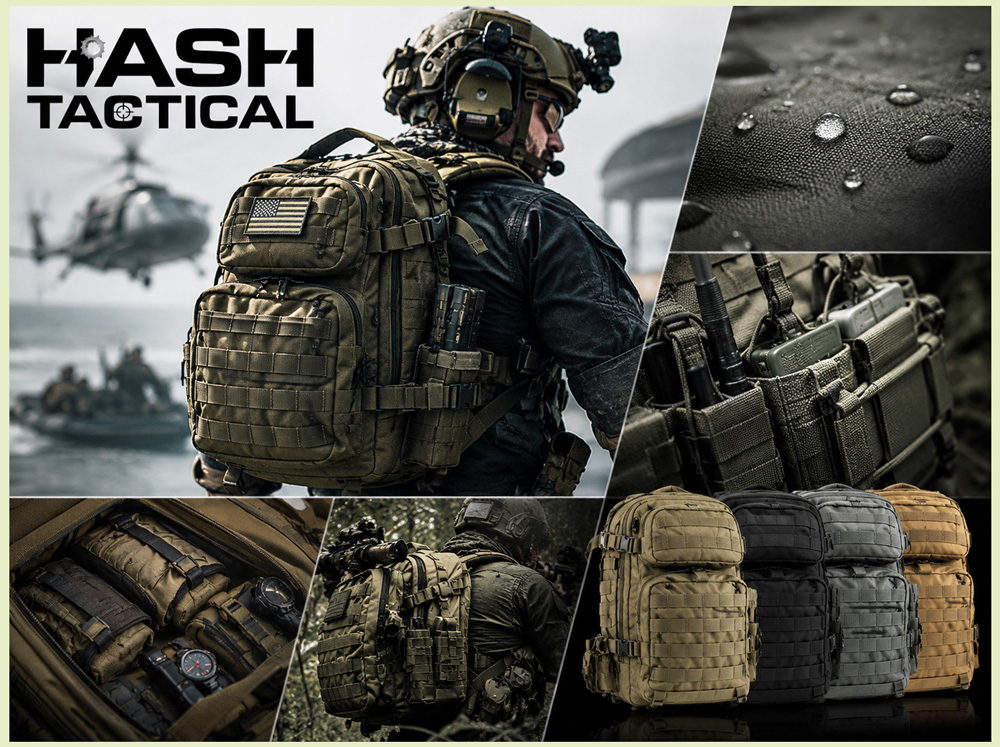
Whether you’re gearing up for an airsoft weekend, working through law enforcement academy PT, or building out a bug-out bag, the backpack you strap on is the single piece of gear that determines whether the rest of your loadout actually works. A tactical backpack isn’t just a bag with MOLLE webbing sewn on — it’s a load-bearing system that has to match your body, your mission profile, and the environment you’re operating in.
This guide breaks down how to choose the right tactical backpack for mission use, covering capacity, materials, organization, and weight limits, so you can stop guessing and start buying with confidence. Whether you’re chasing the best tactical backpack 2026 has to offer or just want a solid military backpack guide before your next range day, the fundamentals below apply across the board.
Why “Tactical” Means More Than Molle Webbing and Coyote Brown
A lot of buyers assume any bag with PALS webbing and a muted color palette qualifies as “tactical.” In reality, a genuine mission-ready backpack is defined by a handful of functional traits:
- Load stability — the pack keeps its shape and center of gravity under movement, not just when it’s sitting on a shelf.
- Rapid access — you can reach critical items (medical kit, radio, magazines) without digging through a single cavernous main compartment.
- Durability under abrasion, weather, and abuse — because failure in the field isn’t an inconvenience, it’s a liability.
- Modularity — the ability to add, remove, or reconfigure pouches as the mission changes.
- Low audible and visual signature — quiet zipper pulls, non-reflective hardware, and a silhouette that doesn’t snag on gear or brush.
If a bag doesn’t check most of these boxes, it’s cosmetically tactical but not functionally so. Keep this checklist in mind as we go through capacity, materials, compartments, and weight.
Capacity vs. Weight: Finding Your Actual Mission Profile
The single biggest mistake new buyers make — airsoft players especially — is buying the largest pack they can afford because “more room is always better.” It isn’t. Capacity and weight pull against each other, and matching pack size to mission duration is where most buying decisions should start.
Match Liters to Mission Length
A rough field-tested framework:
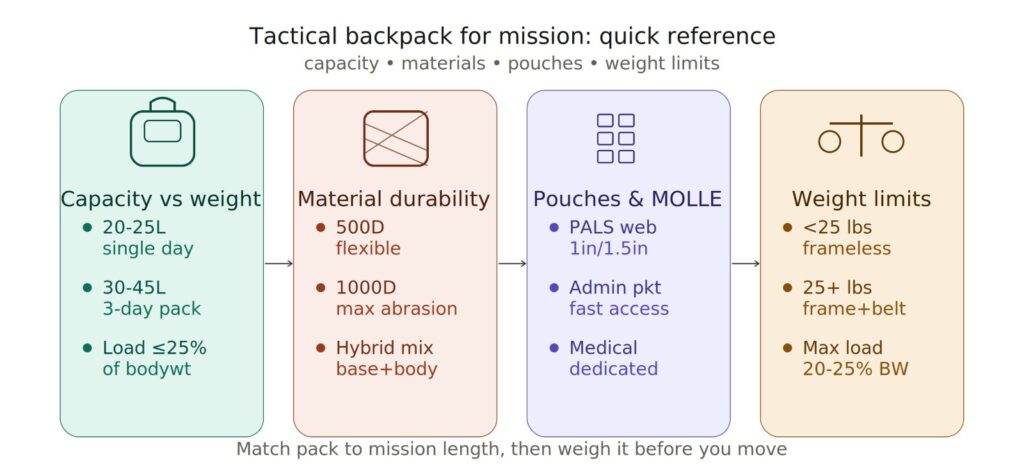
- 20–25L (patrol/assault pack): Single-day operations, airsoft skirmishes, day hikes, or an EDC-style loadout with room for a hydration bladder, spare mags, and a first-aid kit. This is the sweet spot for most airsoft players and LEO trainees doing single-day scenarios.
- 30–45L (3-day pack): Overnight training exercises, multi-day airsoft milsim events, or a bug-out bag meant to sustain you for 48–72 hours.
- 50L+ (expedition/rucksack): Extended field exercises, backcountry patrol simulations, or full sustainment loads with a sleep system, food, and layered clothing.
Buying a 50L pack for a single-day airsoft game means carrying an empty, flopping bag that shifts with every sprint and gives away your position with excess noise and movement. Buying a 20L pack for a 3-day training exercise means external-strapping gear that should be inside a weatherproof compartment. Size the bag to the mission, not to the “just in case” scenario that rarely happens.
Why Weight Beats Volume Every Time
Volume is a container spec. Weight is what your spine, hips, and shoulders actually have to manage. A frequently cited rule of thumb among load-carriage researchers and gear reviewers is to keep a sustained pack load under roughly 20–25% of your body weight for general fitness and mobility, with recreational ruckers often starting even lower, around 10–15%, before working up. Military training loads run considerably heavier out of operational necessity — candidates in schools like the Expert Infantryman Badge course ruck with roughly 45–48 pounds of gear over long distances — but that’s a conditioned, mission-driven exception, not a baseline civilians or trainees should default to.
Practical takeaway: before you buy a bigger bag, ask whether you actually need more volume, or whether you need lighter individual components (fabric, frame, pouches) so you can carry the same gear at a lower total weight. A well-designed 30L pack built from lighter materials will often out-perform a bulkier 40L bag stuffed at half capacity, because unused volume still adds bulk, snag points, and a less stable profile even when it’s not adding pack weight.
Material Durability: What Actually Holds Up in the Field
Fabric choice is where marketing language gets the loudest and the least useful. Here’s what the denier numbers and coatings actually mean for your mission.
Denier Isn’t a Strength Rating — It’s a Yarn Thickness Measurement
“Denier” measures the mass-per-length of the yarn used to weave the fabric, not a direct strength score. The most common face fabrics you’ll see on tactical packs are 500D and 1000D Cordura (a branded high-tenacity nylon originally developed by DuPont, now produced by Invista).
- 500D Cordura is lighter — often 25–40% less fabric weight than an equivalent 1000D build — more flexible, and dries faster because it holds less water. For day packs, airsoft loadouts, and gear you’ll wear for hours at a time, 500D typically provides more than enough abrasion resistance; some manufacturers report 500D packs lasting a decade or more under regular use.
- 1000D Cordura is stiffer, heavier, and provides a genuine edge in extreme abrasion scenarios — packs that get dragged across gravel, thrown in truck beds, or used for breaching and rope work. The U.S. military’s legacy MOLLE II rucksack system standardized on 1000D for exactly this kind of ground-contact abuse.
A growing number of premium manufacturers now use hybrid construction: 1000D (or heavier ballistic nylon) reinforcing the base panel and high-wear contact points, with lighter 500D across the main body and straps. This gives you abrasion resistance where the bag actually touches the ground or brushes against structures, without carrying the weight penalty across the entire shell.
Coatings and Water Resistance
Neither 500D nor 1000D Cordura is inherently waterproof on its own — water resistance comes from a polyurethane or DWR (durable water repellent) coating applied to the fabric. When comparing packs, check for:
- A PU-coated interior liner (not just a treated exterior)
- Water-resistant or laser-cut zippers on compartments carrying electronics or medical supplies
- Reinforced, bar-tacked stress points at strap junctions and haul handles, since stitching failure — not fabric tearing — is the more common real-world failure mode
Hardware Matters as Much as Fabric
A 1000D shell with plastic side-release buckles and unreinforced zipper pulls will fail before a 500D pack with metal or high-strength polymer hardware (like Duraflex or ITW buckles) and YKK or similar heavy-duty zippers. When you’re evaluating a military backpack guide–style spec sheet, treat buckles, zipper pulls, and stitching density as equally important as the denier count printed in the product title.
Pouches, Compartments, and MOLLE Configuration
Organization is where a tactical pack earns its name. The goal isn’t maximum pouch count — it’s predictable, muscle-memory access to the right item under stress.
Understanding the MOLLE/PALS System
Most tactical packs use the PALS (Pouch Attachment Ladder System) grid — rows of 1-inch nylon webbing bar-tacked at 1.5-inch intervals — which is often colloquially (if technically inaccurately) called “MOLLE webbing.” Because PALS dimensions are standardized, accessories from different manufacturers will generally interlock with any PALS-compliant platform, which is what lets you customize a bag over time rather than being locked into one manufacturer’s proprietary pouch ecosystem. When comparing packs, confirm the webbing is true 1-inch/1.5-inch spec — some budget bags use narrower, non-standard webbing that won’t reliably accept name-brand pouches.
Compartment Layout That Actually Works Under Stress
A well-designed layout typically separates gear by access speed and use case:
- Admin/EDC compartment — pens, notepad, phone, multitool, small electronics. Usually the outermost, fastest-access pocket.
- Medical compartment — dedicated, clearly identifiable (often marked or color-differentiated) so a trauma kit can be found by feel, not by searching.
- Hydration sleeve — an internal bladder pocket with a routed hose port, separate from your main gear compartment so a leak doesn’t soak your electronics or spare ammunition.
- Main compartment — layered clothing, food, sleep system components, or bulk gear that doesn’t need split-second access.
- External MOLLE real estate — for mission-specific attachments: mag pouches for airsoft loadouts, radio pouches for LEO trainees, or a dump pouch for expended brass and trash.
Compression Straps Are Underrated
Side and front compression straps do double duty: they cinch down partial loads so gear doesn’t shift during movement, and they let you lash on bulky items (a jacket, a helmet, a tripod) without needing a dedicated pouch. If a pack you’re considering has pouches but no compression straps, that’s a sign it was designed to look tactical rather than perform tactically.
Backpack Weight Limits: How Much Should You Actually Carry?
This is the section most buying guides skip, and it’s arguably the most important for injury prevention.
General Load-Carriage Guidelines
Across load-carriage research and military doctrine, a few consistent benchmarks show up:
- General fitness / recreational rucking: Start around 5–10% of body weight for beginners, progressing to 15–20% for regular exercisers, adding load gradually rather than jumping straight to a heavy pack.
- Civilian day-to-day carry / hiking: A commonly cited comfort ceiling is 20–25% of body weight before fatigue, joint strain, and postural compensation start working against you.
- Military training and operational loads: Substantially higher, often 30–45% of body weight or more, because mission requirements (ammunition, water, communications gear, body armor) outweigh comfort. This is achievable specifically because of structured physical conditioning most civilian users haven’t undergone — it is not a target to copy without that training base.
- International ergonomic standards: ISO 11228-1 and similar occupational-handling guidelines set maximum recommended manual load limits around 20–25 kg for adult males under optimal conditions, reflecting how quickly repeated heavy loads translate into lower-back and joint injury risk outside a military training context.
Why the Pack’s Frame Matters More as Load Increases
Below roughly 20–25 lbs, a simple frameless or soft-frame pack distributes weight adequately. Above that threshold, an internal or external frame becomes important because it transfers load from your shoulders onto a padded, structured hip belt — which is built to handle sustained weight far better than your trapezius muscles are. If your mission profile regularly pushes into 3-day pack territory (30–45L, 25+ lbs loaded), prioritize a framed pack with a load-bearing hip belt over a frameless bag with more MOLLE real estate.
A Practical Weight-Check Routine
Before a training day, skirmish, or field exercise:
- Weigh the pack fully loaded (a bathroom scale works fine).
- Compare that number against your body weight to sanity-check the percentage.
- If you’re consistently over 25% of body weight for anything beyond a short, structured event, audit your loadout for redundant items before you audit your fitness level.
Buyer Profiles: Matching the Pack to the Mission
Airsoft players generally benefit most from a 20–35L assault-style pack with fast-access mag pouches, a hydration bladder sleeve, and a lower-profile silhouette that won’t snag on brush or barriers during CQB movement. Weight matters less here than maneuverability and noise discipline.
LEO trainees should prioritize organization and predictability — a dedicated medical compartment, a stable platform for a duty-style loadout, and durable, water-resistant construction that can handle range days, field training exercises, and vehicle storage without degrading.
General mission/preparedness buyers building a bug-out or go-bag should weight their decision toward the 30–45L range with a genuine frame system, hybrid 500D/1000D construction for cost-effective durability, and enough external MOLLE space to scale the loadout as needs change — without exceeding the 20–25% body-weight guideline for a pack you may need to move with over distance.
Final Checklist Before You Buy
- Does the capacity match your actual mission duration, not your “what if” scenario?
- Is the fabric appropriately matched to abuse level — 500D for day-to-day mobility, 1000D (or hybrid) for ground contact and heavy abrasion?
- Is the webbing genuine 1-inch PALS spec, and does the compartment layout separate fast-access items from bulk storage?
- Have you weighed the fully loaded pack against your body weight, and does it fall within a sustainable range for your fitness level and mission length?
- Does the pack include a frame or structured hip belt if your loaded weight regularly exceeds 20–25 lbs?
Getting these five questions right will do more for your performance in the field than any single brand name or color pattern.
Ready to Gear Up?
A tactical backpack is only as good as the thought that goes into choosing it — and now you’ve got the framework to choose well. If you’re ready to put this guide into practice, check out Hash Tactical’s Backpack Collection for mission-ready packs built across capacity ranges, denier options, and MOLLE configurations to match whatever operation you’re gearing up for.