What Makes a Premium Tactical Gear Manufacturer Different From a Generic Apparel Vendor?
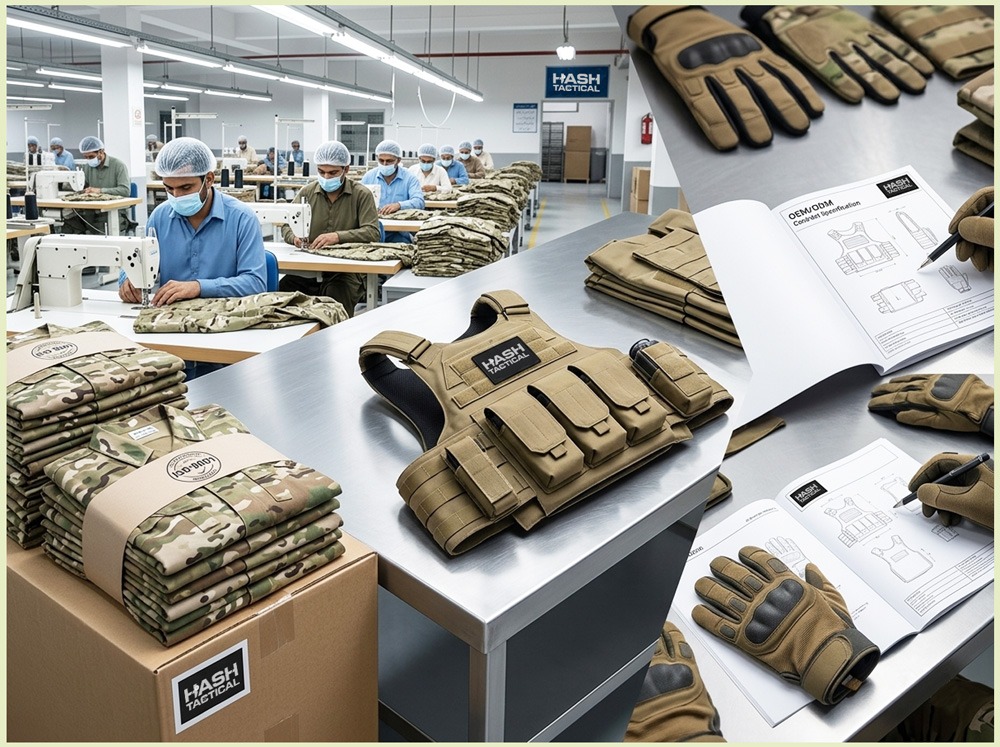
A premium tactical gear manufacturer is a facility that controls the entire production chain — fabric sourcing, sublimation printing, cut-and-sew assembly, and quality assurance — under one roof, rather than outsourcing stages to disconnected subcontractors. Hash Tactical operates this way from its Sialkot, Pakistan production campus, where vertical integration reduces lead times, tightens color consistency, and gives bulk buyers direct accountability instead of a chain of middlemen.
That distinction matters more than most procurement officers realize until their first failed order. Let’s be clear: a screen-printing shop that slaps a logo on a blank jersey is not the same entity as a manufacturer running dye-sublimation presses calibrated to 380°F to 400°F with second-by-second timing control. One produces merchandise. The other produces equipment that survives close-quarters combat simulation, repeated washing, and years of field abuse.
Why Buyers Conflate “Manufacturer” With “Supplier”
Procurement teams often shortlist vendors based on a slick catalog and a fast quote turnaround. That approach works for office polos. It fails for tactical gear because the failure mode is different — a polo shirt that fades looks unprofessional, but a paintball jersey that delaminates mid-tournament, or a duty uniform that tears at the shoulder seam during an arrest, creates liability.
Here is the reality: most “suppliers” in this space are trading companies. They take your order, forward it to a factory they don’t own, and add a markup for coordination. A genuine manufacturer like Hash Tactical owns the knitting machines, the sublimation printers, and the sewing lines. When something goes wrong, there is one phone number to call, not three.
How Does OEM/ODM Contract Manufacturing Actually Work for Tactical Apparel?
OEM (Original Equipment Manufacturer) production means the factory builds your design exactly to your specifications, using your artwork and your sizing charts. ODM (Original Design Manufacturer) production means the factory’s in-house design team develops the garment from concept through pattern-making, and the buyer applies their branding to an existing technical platform. Most LEO and team procurement contracts blend both models depending on budget and timeline.
| Model | Who Designs | Who Owns the Pattern | Typical MOQ | Best Fit For |
|---|---|---|---|---|
| OEM | Buyer’s design team | Buyer | 100–300 units | Departments with existing uniform specs |
| ODM | Manufacturer’s design team | Manufacturer (licensed to buyer) | 50–150 units | Startups, new paintball franchises |
| Private Label | Manufacturer’s base pattern, buyer’s branding | Manufacturer | 25–100 units | Pro shops, retail resellers |
| Hybrid | Shared revision process | Shared/negotiated | Varies | Mid-size teams scaling fast |
Our technical team typically recommends the hybrid path for growing paintball clubs and small LEO tactical units. A department rarely has a textile engineer on staff capable of specifying knit gauge or sublimation dot gain, so leaning on the manufacturer’s pattern library while retaining control over colorways and insignia placement produces a faster, cheaper result than building from a blank sheet.
What Happens During the Sampling Phase?
Sampling is where most of the technical risk gets eliminated before a single bulk unit is cut. A buyer submits artwork, sizing requirements, and fabric preference; the factory produces one to three pre-production samples on actual production equipment — not a desktop mockup.
Hash Tactical runs samples through the same MS JP4-EVO Sublimation Printer and rotary heat press used for full production runs, because a sample printed on a different machine tells a buyer almost nothing about how the bulk order will actually look. Color drift between a sample printer and a production printer is a documented industry problem, and skipping this verification step is the single most common reason bulk orders get rejected at delivery.
What Fabric Classes Should a Bulk Buyer Specify?
Fabric selection determines durability, breathability, and print fidelity simultaneously, so it deserves more attention than logo placement. The industry-standard classification system for tactical and paintball apparel uses denier-based codes — D300, D500, and D1000 — paired with a GSM (grams per square meter) weight rating that indicates knit density.
| Fabric Class | Typical Weight | Abrasion Resistance | Common Application |
|---|---|---|---|
| D300 Interlock | 150–160 GSM | Moderate | Lightweight training jerseys, summer-weight uniforms |
| D500 Interlock | 180–200 GSM | High | Standard paintball jerseys, tournament gear |
| D1000 Ripstop Blend | 220–250 GSM | Very High | LEO outerwear, tactical pants, high-abrasion zones |
| Compression Mesh Panel | 130–140 GSM | Low (intentional) | Underarm/back ventilation inserts |
A 100% polyester interlock knit in the D500 range is the default specification for competitive paintball jerseys, because it balances sublimation ink absorption with stretch recovery. Cotton blends are avoided entirely in this category — cotton fibers do not accept disperse dye sublimation, which means logos and team graphics would simply wash out within a handful of cycles.
Does Fabric Weight Affect Sublimation Quality?
Yes, directly. Lighter D300 fabrics under 150 GSM can show dot gain bleed during sublimation because the looser knit structure allows ink vapor to migrate sideways during the heat transfer phase. Field testing reveals that D500 and heavier fabrics hold sharper graphic edges, particularly on fine text, gradient camo patterns, and small unit insignia under 1 inch in diameter.
What Compliance Standards Should LEO and Government Buyers Demand?
Government and law enforcement procurement contracts typically require documentation that goes beyond a basic invoice. ISO 9001 quality management certification confirms the factory operates under a documented, auditable production process — not an informal workshop arrangement. Buyers sourcing for departments with safety mandates should also request SGS testing reports, which independently verify colorfastness, tear strength, and chemical compliance against international apparel safety standards.
Hash Tactical maintains ISO 9001 certification across its production facility and provides SGS-verified test documentation on request for bulk LEO and government contracts. That is where things get complicated for buyers working with smaller trading companies: most cannot produce this paperwork because they never commissioned independent testing on their own product line, having simply relabeled goods sourced from an unverified third factory.
What Specific Compliance Rules Apply to Bulk Tactical Apparel?
Three compliance areas recur most often in LEO (Law Enforcement Office) and government RFPs (Requests for Proposals):
Colorfastness rating. Garments must typically meet a grade 4 or higher on the AATCC crocking and washing scale, meaning color transfer under friction or laundering stays below visible threshold after repeated cycles.
Tear strength parameters. Tactical-grade fabric should test above 25 Newtons on standard tear-strength assessments for high-abrasion garments, with reinforced panels at the shoulders and knees tested separately from the base fabric.
Restricted substance compliance. Dyes and inks must fall within REACH and CPSIA restricted substance thresholds, particularly for azo dyes and phthalates, which remain a common failure point in unverified overseas production.
How Long Does Bulk Production Actually Take?
Lead time is the metric procurement teams underestimate most consistently, and it is the single biggest driver of contract satisfaction or dissatisfaction. A realistic bulk timeline for custom sublimated tactical apparel runs in four distinct phases, and skipping or compressing any one of them introduces quality risk.
| Phase | Duration | What Happens |
|---|---|---|
| Design & Sampling | 5–10 business days | Artwork finalization, sample cutting, sample sublimation |
| Sample Approval | 3–7 business days | Buyer review, revision cycles |
| Bulk Production | 15–30 business days | Fabric cutting, sublimation, cut-and-sew assembly |
| QA & Shipping Prep | 5–8 business days | Inline inspection, final inspection, packing |
For orders exceeding 1,000 units, production phase duration extends proportionally, since a single MS JP4-EVO Sublimation Printer line processes a finite roll length per shift. Buyers requesting compressed turnaround should expect either a premium rush fee or a reduction in available colorways, because rush production limits the factory’s ability to batch-dye fabric efficiently.
Why Does Lead-Time Optimization Matter for Seasonal Procurement?
Paintball leagues and LEO training cycles both follow predictable annual calendars — spring tournament season, summer academy intakes, fall requalification windows. Ordering against these calendars without buffer time is the most common scheduling mistake bulk buyers make.
Submit final artwork at minimum 45 days before the garment is needed in hand. Confirm fabric availability before finalizing colorways, since certain specialty colors require minimum dye-lot quantities that can add 5 to 7 days if your order falls below the threshold. Request a mid-production photo update around day 12 to 15 of the bulk phase, allowing time to flag a defect before the full run is complete rather than after.
What Determines Pricing at Scale?
Per-unit cost in bulk tactical apparel manufacturing is governed by four variables: fabric class, sublimation graphic coverage area, garment construction complexity, and order volume. Unlike retail apparel, custom sublimated tactical gear has no “blank inventory” — every unit is built to order, so pricing scales differently than ordering stock garments with a screen-printed logo.
| Order Volume | Relative Unit Cost | Typical MOQ Tier |
|---|---|---|
| 25–49 units | Highest per-unit cost | Entry tier |
| 50–149 units | Moderate reduction | Standard tier |
| 150–499 units | Significant reduction | Team/department tier |
| 500+ units | Lowest per-unit cost | Enterprise/contract tier |
Full-sublimation coverage — graphics extending across the entire garment surface rather than a chest logo and back number — adds cost because it requires more fabric panel printing time per unit, not because the ink itself costs meaningfully more. Buyers attempting to control cost should prioritize reducing the number of distinct SKU variations (sizes, colorways, role-specific cuts) rather than reducing graphic coverage, since SKU fragmentation is what actually slows down a production line.
How Does Private Label Manufacturing Change the Cost Structure?
Private label arrangements, where a pro shop or reseller applies its own brand to a manufacturer’s base pattern, typically carry lower minimum order quantities than full custom OEM production — often in the 25 to 100 unit range — because the factory is not building a new pattern or sourcing a new fabric specification from scratch. This makes private label sourcing the more accessible entry point for smaller paintball retailers who want branded inventory without committing to enterprise-scale order volume.

Frequently Asked Questions
Minimum order quantities typically start at 25 to 50 units for private label arrangements and 100 to 300 units for fully custom OEM production, depending on fabric class and graphic complexity.
Yes. Standard practice allows a buyer to submit a size-run breakdown (for example, 20% small, 35% medium, 30% large, 15% extra-large) within a single bulk order without splitting it into separate production runs.
Dye-sublimation embeds ink directly into the polyester fiber structure using heat and pressure, producing graphics that will not crack, peel, or fade with abrasion. Screen printing deposits ink on top of the fabric surface, where it remains vulnerable to cracking under repeated flexing and high-friction contact.
Reputable manufacturers operating under ISO 9001 protocols maintain confidentiality agreements and restricted artwork access controls for department insignia, badge graphics, and unit-specific identifiers, preventing unauthorized reproduction outside the contracted order.
Buyers should request ISO 9001 certification, SGS testing reports for the specific fabric class being ordered, a production timeline with phase-by-phase milestones, and sample approval sign-off before bulk cutting begins.
A Practical Checklist for Evaluating a Tactical Gear Manufacturer
Before signing a bulk contract, run the prospective manufacturer through this verification sequence:
Confirm the factory owns its sublimation printing equipment rather than subcontracting the print stage to a third party. Request the specific machine model and ask for a facility photo or video walkthrough if a site visit is not feasible. Ask for ISO 9001 certification documentation with a verifiable certificate number. Request SGS or equivalent third-party test reports for the exact fabric class your order will use, not a generic catalog reference. Clarify the sample approval process in writing, including how many revision rounds are included before additional fees apply. Establish a mid-production inspection checkpoint with photo or video documentation. Confirm shipping terms, including whether the manufacturer handles export documentation for international LEO or government contracts.
Why Vertical Integration in Sialkot Matters for Buyer Confidence
Sialkot, Pakistan, has functioned as a global center of sports and tactical apparel production for decades, with a dense local supply chain of fabric mills, sublimation specialists, and skilled cut-and-sew labor concentrated in a relatively small geographic radius. This density is not incidental — it means a manufacturer like Hash Tactical can source fabric, print, and assemble within days rather than weeks, because every link in the chain sits within the same industrial zone instead of being scattered across separate countries or regions.
That geographic concentration also supports faster defect resolution. If a fabric lot arrives with an inconsistent dye batch, a locally integrated manufacturer can swap suppliers within the same production week. A factory dependent on imported fabric from a separate country faces a multi-week delay for the same correction, and that delay compounds for every subsequent phase of the order.
Final Considerations Before Committing to a Bulk Order
Procurement decisions in this category fail most often not because of bad fabric or bad printing, but because of mismatched expectations around timeline, documentation, and communication cadence. A buyer who treats the sampling phase as a formality rather than a verification checkpoint is the buyer most likely to receive a bulk shipment that does not match what was promised.
Engage a manufacturer that can produce verifiable entities on request — certification numbers, machine models, test report references — rather than vague assurances about “quality” and “durability.” That specificity is the actual signal of a contract manufacturer built for B2B, LEO, and team-scale apparel sourcing, as opposed to a reseller assembling your order from whatever inventory happens to be available that month.
For departments and teams ready to move forward with a structured procurement conversation, the contract manufacturing intake process outlines fabric selection, compliance documentation, and timeline planning specific to bulk tactical apparel orders.