Listen up. If you’re heading into a situation where people are sending lead your way, you need to know exactly what’s sitting on your chest. I’ve seen guys show up to a high-speed direct action hit wearing a bulky load-bearing vest that felt like a winter parka. I’ve also seen guys try to do a three-day reconnaissance mission in a “slick” plate carrier and run out of water by noon because they had nowhere to mount a bladder.
Choosing between a plate carrier vest and a traditional tactical vest isn’t about fashion. It’s about mission requirements, weight distribution, and whether you want to stop a bullet or just carry a lot of gear. Today, we’re breaking down the hard truth about both. We’re looking at the guts of the gear so you don’t make a life-altering mistake when the pressure is on.
Plate Carrier vs. Tactical Vest: Key Differences
The Day My Gear Felt Like an Anchor
I remember a mission where we had to move across four miles of broken urban terrain. I was wearing an old-school, heavy-duty tactical vest stuffed to the gills. It had pockets for everything—extra mags, radios, snacks, even a backup for my backup. By the second mile, the weight was pulling my shoulders into my ears. I was slow. I was loud. And I was exhausted before the first shot was fired.
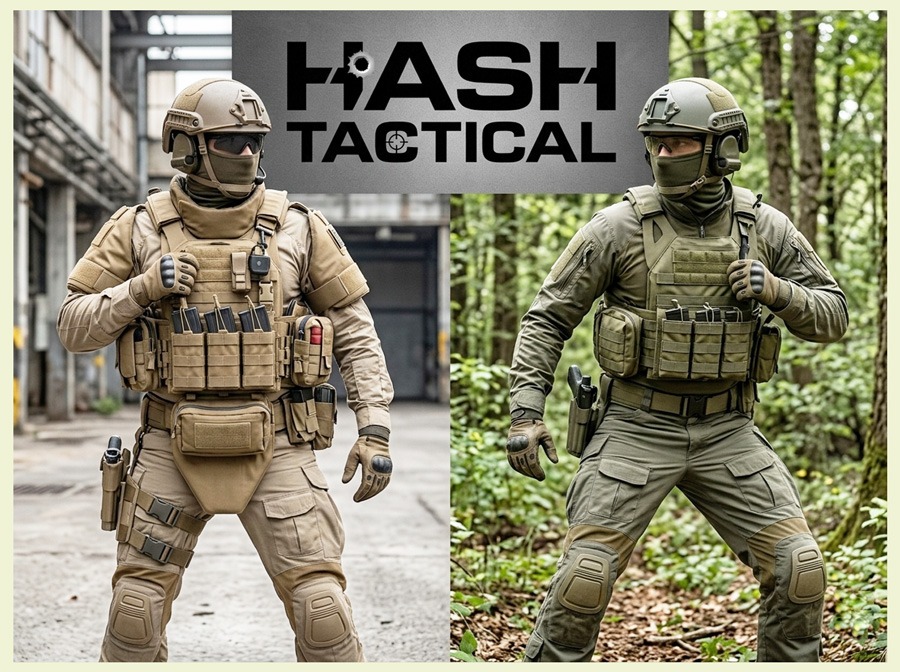
That’s when I realized that more pockets aren’t always better. At Hash Tactical, we design for the mission, not the “look.” We know that every ounce you carry is an ounce that slows your reaction time. Whether we are doing “Cut & Sew” for a heavy vest or a precision plate carrier, we focus on the ergonomics of the fight.
Defining the Plate Carrier
A plate carrier vest is a minimalist piece of armor. Its primary job is in the name: it carries ballistic plates. These plates are what stop rifle rounds. Without the plates, the carrier is just a lightweight harness. It’s designed for high-intensity, short-duration missions where stopping a bullet is the priority.
Modern carriers are stripped down. They use laser-cut MOLLE to save weight. They are designed to sit high on the chest to protect your “vitals”—your heart and lungs. If it hangs down past your belly button, you’re wearing it wrong.
The Anatomy of Protection
The Tactical Vest (LBV)
The traditional tactical vest, or Load Bearing Vest (LBV), is usually a mesh or solid fabric platform. It covers more of your torso. Its main job is to hold gear. While some can hold soft armor (which stops pistol rounds), most aren’t designed for heavy rifle plates.
- Storage Capacity: Massive. You can fit a whole weekend in one.
- Heat Management: Generally hotter because of the surface area.
- Mobility: Good for walking, but can be bulky in tight spaces.
The Plate Carrier (PC)
The plate carrier vest is the scalpel to the tactical vest’s sledgehammer. It’s tight. It’s compact. It allows for a full range of motion in your arms, which is critical for weapon manipulation and climbing.
Key Differences at a Glance
| Feature | Plate Carrier Vest | Traditional Tactical Vest |
| Primary Goal | Ballistic Protection | Gear Organization |
| Armor Type | Hard Rifle Plates (Level III/IV) | Soft Armor (Level IIIA) or None |
| Weight | Heavy (with plates), Light (without) | Consistent / Moderate |
| Bulk | Low Profile | High Profile |
| Heat Retention | Low (Minimal coverage) | High (Full torso wrap) |
When to Use a Plate Carrier
Direct Action & CQB
If you are kicking doors, you want a plate carrier vest. In Close Quarters Battle (CQB), you are likely to face direct, high-velocity fire. You need the plates to save your life. The low profile also prevents you from getting snagged on door frames or furniture.
Vehicle Operations
Driving while wearing a massive tactical vest is a nightmare. It pushes you away from the seat and makes it hard to reach your belt. A plate carrier is much more “driver-friendly.” It gives you the protection you need while allowing you to actually operate the vehicle.
When to Use a Tactical Vest
Long-Range Reconnaissance
If you’re humping a 60-pound ruck for ten miles, a plate carrier might be overkill. A tactical vest (or chest rig) allows for better airflow and focuses on keeping your magazines and water accessible. In the deep woods, mobility and staying cool are often more important than stopping a bullet.
Security and Law Enforcement
For patrol work, a tactical vest that holds a radio, handcuffs, and a flashlight is often the standard. It provides a professional appearance and keeps all tools within easy reach for non-combat interactions.
The Manufacturing Difference at Hash Tactical
We don’t just “sew” gear; we engineer it. As a specialized tactical gear manufacturer, we understand that the stress points on a plate carrier vest are immense. The weight of two ceramic plates puts a massive strain on the shoulder straps.
We use industrial-strength “Cut & Sew” techniques, including quad-stitching and reinforced bar-tacks. Our sublimation process also allows us to offer these carriers in high-fidelity camouflage that won’t fade or peel, even after months of hard use in the sun. We build it to a professional standard because we know the stakes.
Ballistic Plates: The Heart of the Carrier
Steel vs. Ceramic vs. Polyethylene
- Steel: Cheap and thin, but heavy. It can also cause “spalling” (metal fragments hitting your chin).
- Ceramic: The professional choice. Light and effective, but can crack if dropped.
- Polyethylene: Ultralight and stops most rounds, but usually doesn’t handle armor-piercing threats well.
Level III vs. Level IV
Level III stops standard rifle rounds like 5.56 and 7.62, and the level IV is the big dog. It’s designed to stop armor-piercing rounds. At Hash Tactical, we build our carriers to support the weight of Level IV plates without sagging or tearing.
Ergonomics: The “Comfort” Myth
Let’s be real: wearing 20 pounds of armor is never “comfortable.” But it can be “bearable.” We use 3D spacer mesh on the interior of our gear. This creates a gap between the plate and your chest, allowing air to flow and preventing “hot spots.”
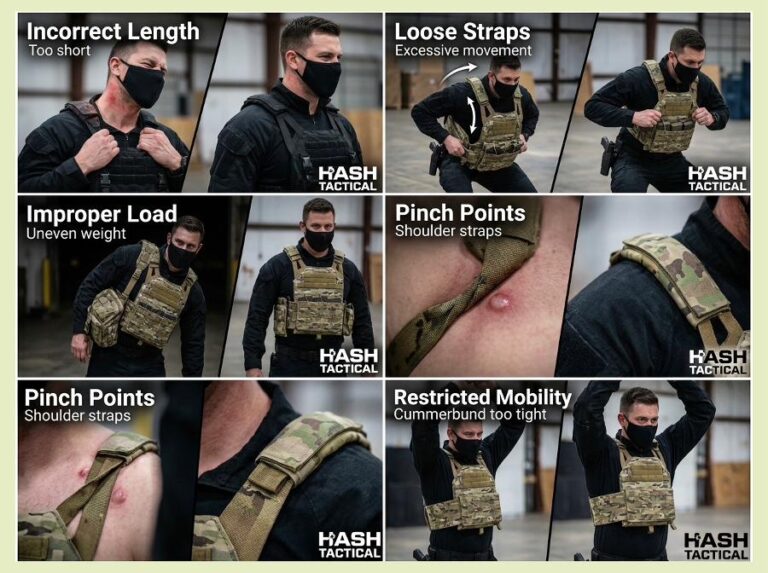
- Shoulder Padding: High-density foam is mandatory.
- Cummerbund Adjustability: It needs to be tight enough to not bounce, but loose enough so you can breathe during a sprint.
- Quick-Release Systems: In an emergency (like falling into water), you need to be able to ditch the weight in three seconds.
Frequently Asked Questions (FAQ)
A: You can, but it’s just a heavy shirt at that point. If you don’t need ballistic protection, a lightweight chest rig is a better option.
A: The top of the front plate should be at your “Sternal Notch”—that little dip at the base of your throat. This ensures your heart is protected.
A: Usually, no. Most are sold as “load-bearing” platforms. You have to buy the soft or hard armor separately.
Mission Complete. Choose the gear that fits the mission, not the ego. Stay protected, stay mobile, and keep your head in the game.