Listen up, recruit. Your pack isn’t just a bag. It’s your mobile base of operations. It’s the difference between having your gear when the lead starts flying and being the guy scavenging for a spare mag in the dirt. I’ve humped packs across every terrain imaginable, from jagged mountain ridges to swampy lowlands that eat boots for breakfast. I’ve seen cheap zippers explode at the worst possible moment and straps snap when a guy needed to move fast. Today, we’re talking about how to choose a tactical assault backpack that won’t betray you when the mission gets heavy.
How to Choose a Tactical Assault Backpack for Your Kit
The Walk That Never Ended
I remember a 20-mile movement in the humid heat of a jungle environment. I was young and dumb, carrying a pack that was “tactical-looking” but built like a school bag. Ten miles in, the weight shifted. The thin shoulder straps started cutting into my traps like piano wire. By mile fifteen, the frame sheet had warped, and every step felt like a midget was kicking me in the kidneys.
That day taught me that “cool” doesn’t carry weight. Engineering does. At Hash Tactical, we don’t just “sew bags.” We design load-carriage systems. We build gear for the guy who has to live out of his pack for 72 hours and still be ready to pull a trigger at the end of the march.
The 3-Day Rule: Size and Capacity
A true tactical assault backpack usually falls into the 30L to 50L range. It’s designed for short-duration missions. You need enough room for extra ammunition, water, a light layers, and your comms. If you go too big, you’ll overpack and slow down. If you go too small, you’re leaving life-saving gear behind.
We focus on the “Goldilocks” zone. Our designs prioritize a slim profile so you don’t get hung up in doorways or dense brush. You want the weight close to your spine, not sagging out behind you like a tail.
The Anatomy of a Battle-Ready Pack
The Suspension System: Shoulders and Hips
The straps are the most critical part of the pack. They need high-density closed-cell foam. Why? Because cheap foam collapses under weight, leaving you with just webbing digging into your skin.
A proper assault pack also needs a sternum strap and a removable waist belt. The waist belt isn’t just for comfort; it transfers the load to your hips, which are much stronger than your shoulders.
MOLLE/PALS Compatibility
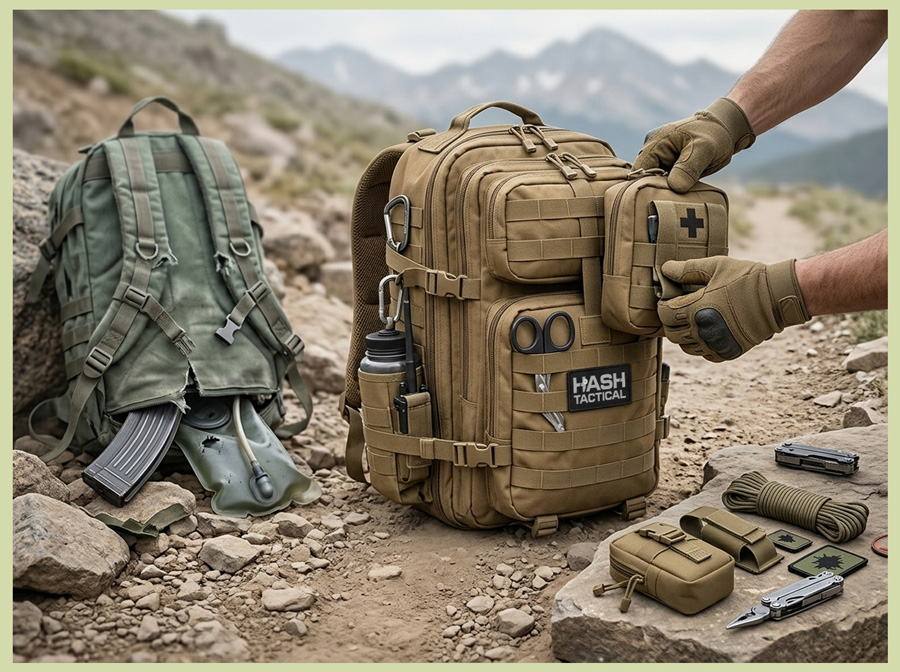
If your pack doesn’t have a grid of webbing on the outside, it’s not tactical. Period. Modular Lightweight Load-carrying Equipment (MOLLE) allows you to customize your kit. You can slap on a medic pouch, a radio holsters, or extra mag shingles exactly where you need them.
At Hash Tactical, we use laser-cut PALS or heavy-duty reinforced webbing. This ensures that when you hang a heavy pouch off the back, the fabric doesn’t sag or tear under the stress of high-speed movement.
Materials: Why 500D vs. 1000D Nylon Matters
| Material | Weight | Durability | Best Use Case |
| 500D Cordura | Lightweight | High | High-speed assault, reconnaissance. |
| 1000D Nylon | Heavy | Extreme | Dragging over rocks, heavy-duty hauling. |
| Ripstop Grid | Ultralight | Moderate | Internal organizers, lightweight liners. |
The Sweet Spot of 500D
Most modern elite units are moving toward 500D Nylon. Why? Because ounces equal pounds, and pounds equal pain. 500D is roughly half the weight of 1000D but still offers incredible abrasion resistance. It’s tough enough for a breach but light enough that you aren’t fighting your own gear.
Zippers and Hardware: The Breaking Points
I’ve seen more missions ruined by a broken zipper than a torn fabric. We only use heavy-duty, self-repairing coil zippers. If the teeth get misaligned, you just pull them back and forth to reset. We also use oversized pull-tabs so you can open your pack while wearing those thick hard-knuckle gloves we talked about earlier.
Internal Organization: Chaos vs. Order
The Clamshell Opening
In a gunfight, you don’t want to be “digging” to the bottom of a top-loading bag. You want a clamshell design. This allows the pack to open flat, giving you instant access to everything inside. It’s like a mobile workstation.
Hydration Compatibility
Water is life. A dedicated hydration bladder pocket and a port for the drinking tube are mandatory. We place the bladder pocket directly against the back panel. This keeps the water weight centered and protects the bladder from being punctured by your other gear.
- Admin Panels: For your pens, maps, and multitools.
- Internal Mesh Pockets: To see exactly what’s inside without opening every zipper.
- Compression Straps: To cinch the load down so nothing rattles when you’re moving silently.
Manufacturing the “Hash” Way
As a premier tactical gear manufacturer, we understand the “Cut & Sew” requirements of the modern operator. We don’t just follow a pattern; we reinforce the drag handles so you can literally pull a teammate out of a hot zone using their pack straps.
Our sublimation process allows for permanent, non-fading camouflage patterns that integrate perfectly into your environment. We don’t cut corners. If a stitch isn’t perfect, it doesn’t leave the floor. We know that one day, your life might depend on the integrity of a single seam.
Field Testing: The Vet’s Checklist
Before you trust a tactical assault backpack in the field, put it through the wringer:
- The “Jump” Test: Load it with 30 lbs and jump. If it rattles or shifts, tighten the compression straps.
- The “Glove” Test: Try to open every pocket while wearing your full combat gloves.
- The “Water” Test: Drench the pack. See how much water it absorbs and how fast it drains.
- The “Drag” Test: Drag the pack ten feet over gravel. If the bottom shreds, throw it away.
Maintenance: Keeping Your Base of Operations Clean
- Brush, Don’t Wash: Use a stiff brush to remove dried mud. Washing machines destroy the waterproof coatings.
- Lube the Zippers: A little bit of paraffin wax or silicone spray keeps zippers sliding smooth.
- Air It Out: Never store a damp pack. Mold will eat the nylon fibers and ruin your investment.
- Check the Hardware: Look for stress fractures in the plastic buckles after any extreme cold-weather op.
Frequently Asked Questions (FAQ)
A: You bet. The internal organizers are perfect for laptops and EDC gear. Plus, it’s built to last longer than any “fashion” backpack.
A: It’s an external flap used to stow a helmet or a wet jacket. It’s a great way to keep bulky items outside the main compartment.
A: A yoke connects the two shoulder straps into a single piece. This prevents the straps from sliding off your shoulders during high-activity movements.
👉 Mission Complete. Load up, cinch down, and move out. Your gear should be the last thing on your mind when the heat is on.