Custom MOLLE Medical Pouches (IFAK): Building a Wilderness First Aid Kit That Actually Fits Your Job
A custom IFAK pouch beats a stock one almost every time. Stock pouches are built for the “average” user. You are not average. You’re a wilderness guide, a backcountry hunter, or a team medic who needs gear organized your way, sized for your kit, and built to survive real terrain. If you want a trauma pouch that opens fast, holds the right tools, and doesn’t fall apart on your third season, go custom. This guide compares custom vs. stock IFAK pouches, breaks down the features that matter, and shows you how to build a setup that works for your exact mission. Hash Tactical builds these pouches to order, so you’ll see real examples along the way.
What Is an IFAK Pouch, and Why Does It Matter?
IFAK stands for Individual First Aid Kit. It’s the small trauma kit you carry on your body, not in your pack. In a real emergency, seconds count. You need to reach it, open it, and grab the right tool without digging around.
A MOLLE trauma kit bag attaches to your vest, belt, or pack using PALS webbing. This is the woven strap system found on most tactical and outdoor gear today. MOLLE lets you mount, move, or swap pouches without tools.
For wilderness use, this matters even more than in a tactical setting. You might be:
- Miles from the nearest road
- Working alone or with a small team
- Facing weather, altitude, or wildlife risks
- Carrying gear for hours at a time
A poorly designed pouch wastes time you don’t have. A well-designed one saves a life.
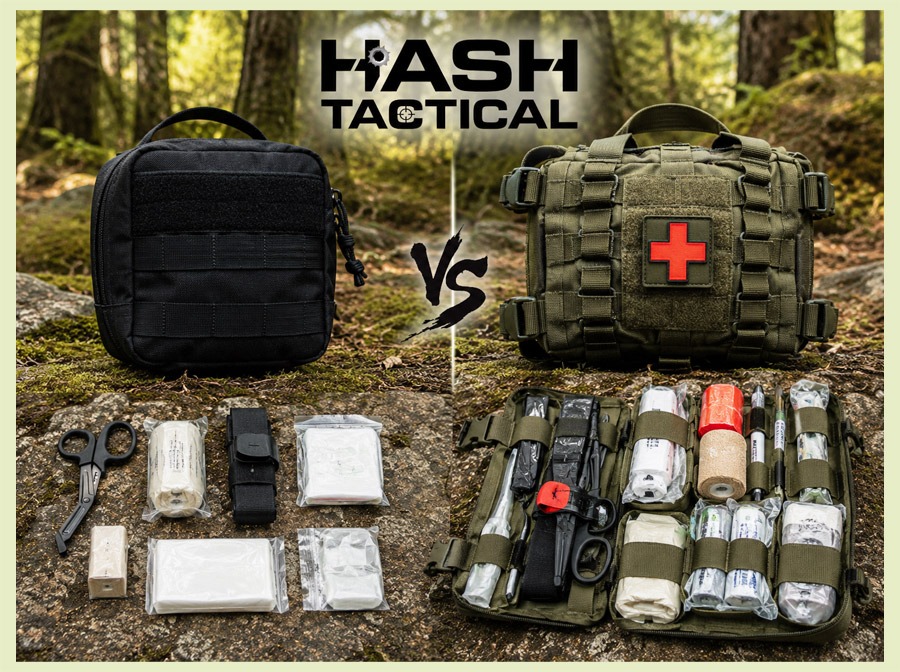
Custom vs. Stock IFAK Pouches: A Side-by-Side Look
Stock pouches work fine for casual use. But if your job depends on your kit, the differences add up fast.
| Feature | Stock IFAK Pouch | Custom IFAK Pouch |
|---|---|---|
| Sizing | Fixed, one-size-fits-all | Built to your exact gear list |
| Internal layout | Basic loops, may not fit your tools | Custom elastic tool dividers sized for what you carry |
| Deployment speed | Standard zipper or flap | Red pull-tab quick deployment option |
| Material | Often lower-grade nylon | Choice of Cordura weight and grade |
| Mounting | Basic MOLLE straps | Custom MOLLE, belt, or drop-leg mounting |
| Branding/ID | None or generic | Team patches, name tape, color coding |
| Durability | Varies by brand | Built for your specific environment (brush, rock, water) |
Stock pouches are fine as a starting point. But once you know what your kit actually needs, custom pays off in speed and reliability.
Why Wilderness Guides Need Something Different Than Military Buyers
Most trauma pouches on the market were designed for military or law enforcement use. That’s not a bad thing, but it means the shapes, sizes, and layouts assume a certain kind of mission.
Wilderness guides and backcountry hunters have different needs:
Weight matters more. You’re carrying this kit for eight, ten, twelve hours a day. Bulk adds up.
Weather exposure is constant. Rain, mud, snow, and UV exposure happen daily, not occasionally.
Tools are different. You may carry snake bite kits, altitude sickness meds, or gear for treating hypothermia instead of gunshot wound supplies.
Access differs by activity. A guide on horseback needs different pouch placement than a hunter crawling through brush.
This is where a custom medical breakaway pouch earns its price. You choose the shape, size, and internal layout based on your actual work, not someone else’s checklist.
Key Features to Look For in the Custom IFAK Pouches
1. Red Pull-Tab Quick Deployment
In an emergency, you don’t want to fumble with a zipper or a hook-and-loop flap. A red pull-tab system lets you rip the pouch open in one motion. The bright color also makes it easy for a teammate to spot and grab your kit if you’re the one who’s hurt.
This feature matters most for:
- Solo guides who may need to self-treat
- Team responders who need to grab a teammate’s kit fast
- Cold-weather use, when gloved hands struggle with small zippers
2. Internal Elastic Tool Dividers
Loose gear inside a pouch is a problem. It shifts, rattles, and takes longer to find under stress. Internal elastic tool dividers hold each item in its own spot.
Good dividers should:
- Hold tourniquets snug but easy to pull
- Separate gauze, shears, and gloves into their own sections
- Stretch to fit slightly different tool sizes over time
- Stay quiet during movement (important for hunters)
Custom dividers mean you’re not stuck with slots sized for gear you don’t carry.
3. Field Medic Pouch Shapes
Not every trauma kit needs to be the same shape. Field medic pouch shapes vary based on where and how you’ll wear the pouch.
Common shapes include:
- Slim vertical pouches for belt or vest mounting, low profile
- Horizontal pouches for drop-leg or pack-strap mounting
- Clamshell pouches that open flat for full visibility of all tools
- Blowout-style pouches built for one-handed access
Your activity should drive your shape choice. A horseback guide and a whitetail hunter in a tree stand don’t need the same pouch geometry.
4. Durable, Weather-Ready Material
Wilderness gear takes a beating. Look for:
- 500D or 1000D Cordura nylon
- Water-resistant coating or laminate backing
- Reinforced stitching at stress points
- UV-resistant thread and zippers (if used)
Cheaper materials fail faster in brush, rain, and constant sun exposure.
5. Mounting Flexibility
Your pouch should mount the way you work:
- MOLLE/PALS webbing for vests and packs
- Belt clip or drop-leg strap for hands-free access
- Quick-detach buckles for fast pouch swaps between gear setups
Building a Custom IFAK: What Wilderness Guides Should Include
Every kit is different, but most solid wilderness trauma pouches include a version of the list below.
Bleeding control:
- Tourniquet
- Compressed gauze or hemostatic gauze
- Pressure bandage
Airway and breathing:
- Chest seal
- Nasopharyngeal airway (if trained to use one)
Wound care:
- Trauma shears
- Nitrile gloves (two pairs minimum)
- Adhesive bandages, various sizes
Environment-specific additions:
- Snake bite extractor or wrap (desert/brush regions)
- Hand warmers or emergency blanket (alpine/cold regions)
- Electrolyte packets (heat/altitude regions)
- Tick removal tool (forest/grassland regions)
Once you know your list, you can size your pouch and dividers around it instead of forcing your gear into a generic layout.
Team Emergency Responders: Building for Consistency
If you run a team of guides, hunters, or field staff, consistency across kits matters. Everyone should be able to grab any teammate’s pouch and know exactly where things are.
Custom builds let you standardize:
- Same pull-tab color across all team kits
- Same internal layout, so muscle memory transfers between pouches
- Team name or role patches for fast identification
- Color-coded pouches by role (medic, guide, lead)
This reduces confusion during high-stress moments, when every second matters.
How Hash Tactical Approaches Custom Builds
Hash Tactical works directly with guides, hunters, and response teams to design pouches around real use cases, not generic templates. That means choosing your shape, your divider layout, your pull-tab style, and your mounting system before the pouch is ever built.
The goal is simple: a pouch that matches your job, not the other way around. Hash Tactical builds these as a shell first, so you can load it with the exact gear your certification and environment call for.
Common Mistakes to Avoid When Choosing a Trauma Pouch
Buying based on looks alone. A pouch that looks tactical isn’t automatically functional.
Ignoring glove compatibility. If you’ll ever use this kit in winter, test pull-tabs and zippers with gloves on.
Overpacking the pouch. More gear isn’t always better if it slows down access.
Skipping a trial run. Practice opening your pouch and finding tools with your eyes closed. If you can’t do it fast, redesign the layout.
Choosing the wrong mount point. A pouch mounted where you can’t reach it one-handed defeats its purpose.
Field Gear Comparison
Custom IFAK Pouches vs. Stock: Built For Your Mission
Bottom line: A custom pouch fits your gear, your terrain, and your speed. A stock pouch fits no one exactly.
Stock vs. Custom
Stock Pouch
- ✕ One-size, fixed layout
- ✕ Generic loops, wrong fit
- ✕ Standard zipper only
- ✕ Basic MOLLE mount
Custom Pouch — Hash Tactical
- ✓ Built to your gear list
- ✓ Elastic dividers, sized to fit
- ✓ Red pull-tab quick deploy
- ✓ MOLLE, belt, or drop-leg mount
The Features That Matter
Red Pull-Tab
One motion opens it. Easy to spot for a teammate too.
Elastic Tool Dividers
Each tool in its own slot. No shifting, no digging.
Field Medic Shapes
Slim, drop-leg, or clamshell — matched to your activity.
What Goes Inside
Ready to Build Yours?
Hash Tactical builds the shell around your mission — you load the gear.
Build an Emergency Trauma Bag ShellSource: Hash Tactical Field Guide — Custom MOLLE Medical Pouches
FAQ: Custom MOLLE Medical IFAK Pouches
An IFAK is built for one person’s immediate self-care or buddy care. A full trauma kit is larger and often carried by a designated medic for team use.
Yes. Most custom pouches use standard MOLLE/PALS webbing, so they attach to existing vests, packs, and belts without modification.
Timelines vary by order size and design complexity. Contact the builder directly for current lead times.
Yes. Basic wilderness first aid or Stop the Bleed training is strongly recommended before carrying trauma gear in the field.
It’s functional. High-visibility color helps both you and teammates find and deploy the pouch faster under stress.
Final Thoughts: Build Around Your Mission, Not a Template
A stock IFAK pouch is better than nothing. But a custom one is built around how you actually work, what you actually carry, and where you actually go. For wilderness guides, backcountry hunters, and team responders, that difference can save critical time when it matters most.
Start with your gear list. Pick your shape. Choose your deployment style. Then build a shell designed for that exact setup.
Ready to build your own? Build an Emergency Trauma Bag Shell with Hash Tactical and design a pouch that matches your mission, not someone else’s.
👉 For more helpful guidance regarding custom IFAK pouches, contact our expert team now!