Listen up. If you think knee pads are for skateboards or gardening, you’ve never had to drop into a prone position on a bed of jagged gravel or broken glass. In the field, your joints are your mobility. If you blow out a knee hitting the deck or shatter an elbow on a concrete corner, you aren’t just out of the fight—you’re a liability to your team. I’ve seen guys try to “tough it out” without protection. By the second day of a multi-day op, they are crawling like infants because their knees look like raw hamburger meat. Today, we’re talking about tactical protective pads. We’re diving into the difference between external armor and integrated inserts, and why your choice determines how long you stay in the fight.
Guide to Tactical Protective Pads for Knees & Elbows
The Drop That Stayed With Me
I remember a dynamic entry in an industrial sector. We had to move fast. I went to take a knee behind a steel crate, and I didn’t see the pile of rusted scrap metal on the floor. I hit it hard. If I hadn’t been wearing high-impact pads, that metal would have gone straight through my patella.
Instead, I heard a loud crack of plastic hitting steel. I felt the vibration, but no pain. I stayed mobile and finished the mission. At Hash Tactical, we don’t build gear for the shooting range; we build it for that split second when your body hits the earth, and the earth hits back.
The Philosophy of Joint Protection
Your knees and elbows are “hinge points.” They are vulnerable. They have very little meat over the bone. A minor impact in the wrong spot can cause a “funny bone” nerve shock that numbs your hand or a knee bruise that stops you from walking.
A professional pair of tactical protective pads serves two masters: impact absorption and comfort. If they protect but slip down to your ankles every ten minutes, they are garbage. If they stay put but offer no cushion, they are useless. We look for the “High-Speed” balance where the gear disappears until you need it.
The Two Main Types: External vs. Integrated
1. External “Hard Shell” Pads
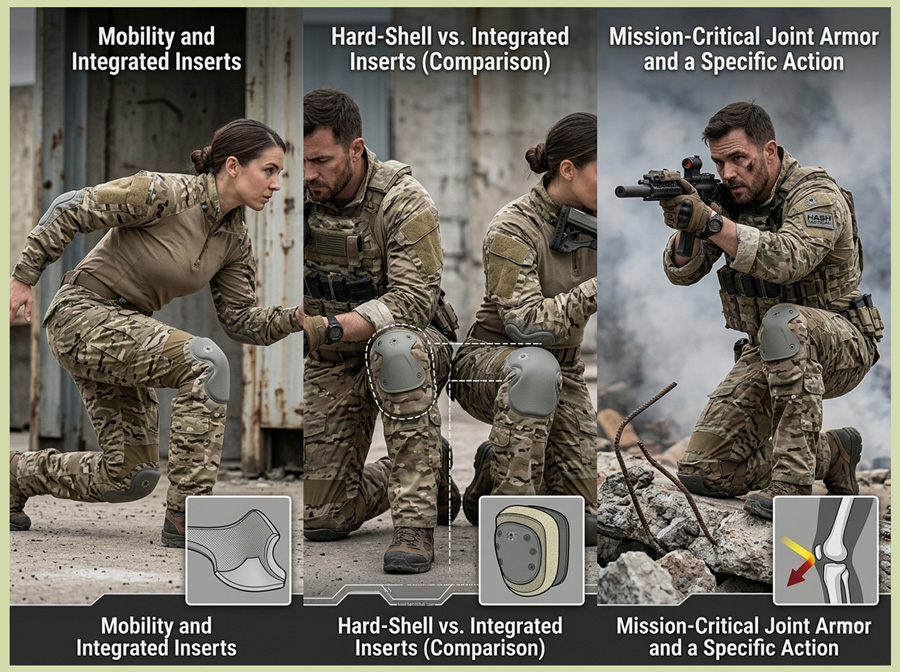
These are the classic “Cap” style pads. They strap over your pants or shirt. They are rugged and feature a hard plastic or polymer shell backed by foam. These are best for short-term, high-intensity work where you’re constantly hitting hard surfaces like concrete or asphalt.
2. Integrated “Combat” Inserts
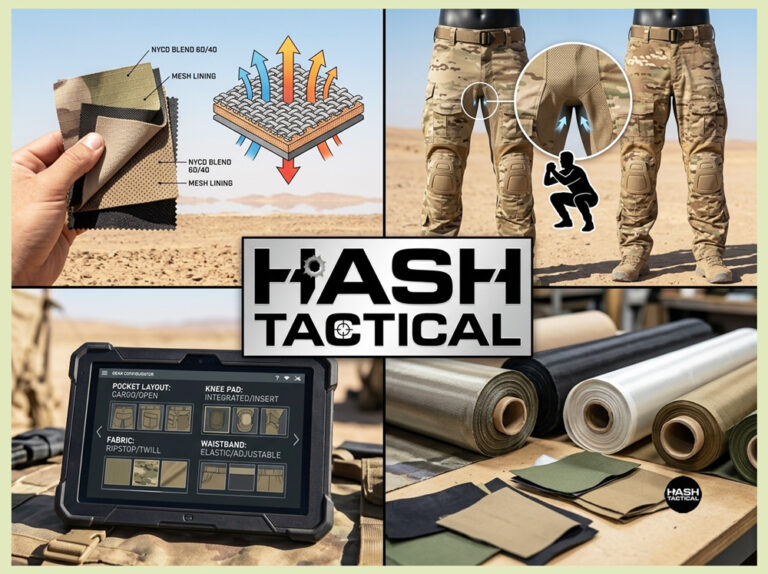
Modern combat uniforms, like the ones we engineer, feature dedicated pockets for inserts. These are the “silent” heroes. They don’t have straps that pinch your blood flow. They stay perfectly aligned with your joints because they are built into the garment.
Materials: The Science of the “Thud”
| Component | Material Type | Performance Benefit |
| Outer Shell | Thermoplastic Rubber (TPR) | Deflects sharp objects and resists cracking. |
| Inner Core | EVA or Closed-Cell Foam | Absorbs the shock energy so your bone doesn’t. |
| Backing | Breathable Neoprene | Prevents slipping and manages sweat. |
| Straps | Elastic with Hook-and-Loop | Allows for adjustable tension during movement. |
EVA Foam: The Silent Cushion
Ethylene-vinyl acetate (EVA) is the gold standard for internal padding. It’s lightweight. It doesn’t soak up water like a sponge. Most importantly, it has “memory.” It bounces back after every impact. When we “Cut & Sew” our internal pad pockets, we size them specifically for high-density EVA.
Non-Slip Technology
There is nothing more frustrating than a knee pad that rotates to the side of your leg. We use rubberized “Grip” strips on the interior of our external pads. This friction keeps the pad centered over your kneecap, even when you’re sprinting or climbing.
Elbow Pads: The Forgotten Armor
Crawling and Bracing
Everyone talks about knees, but your elbows take a beating during low-crawls. They also act as your “pivot” point when you’re shooting from a prone position. If your elbows are hurting, your shot groups will open up.
Low-Profile Designs
Unlike knee pads, elbow pads should be low-profile. You don’t want a massive plastic “turtle shell” on your arm that catches on your gear or your sling. We design our tactical protective pads for elbows to be streamlined. They provide a “cradle” for the joint without adding unnecessary bulk.
Thermal and Chemical Resistance
In a tactical environment, the ground isn’t just hard; it can be hot. If you’re kneeling on a sun-baked rooftop or near a hot vehicle engine, cheap plastic will melt. Our pads are tested for thermal stability.
We also ensure our materials are resistant to common oils and fuels. If you drop into a puddle of diesel in a garage, your pads shouldn’t dissolve or become dangerously slick. Tactical gear has to be chemically “inert” to keep you safe in industrial zones.
The Manufacturing Difference at Hash Tactical
We are a tactical gear manufacturer that understands the human form and doesn’t just “stitch pads.” We map the movement of the human knee. Our “Cut & Sew” team ensures that the curvature of the pad matches the natural bend of your leg.
Through our sublimation capabilities, we can even offer pads that match your specific camouflage patterns, ensuring your “signature” remains low. We use industrial-strength thread and reinforced bonding because we know these pads are going to be dragged, dropped, and abused.
Field Tips: How to Wear Your Pads
- Don’t Over-Tighten: If you cut off the circulation, your legs will cramp. Tighten the top strap and leave the bottom one slightly looser.
- Cross the Straps: For external pads, try crossing the straps in an “X” pattern behind your knee. This often prevents them from sliding down.
- Insert Alignment: If using internal pads, make sure they are seated deep in the pocket. If they sit too high, they won’t protect the lower part of your joint.
- The “Silent” Mod: If your plastic shells are clicking against the floor, apply a small strip of “Sniper Tape” or cloth tape to the front to dampen the sound.
Maintenance: Keeping Your Protection Prime
- Remove the Inserts: Before washing your combat pants, take the pads out. Soap can degrade the foam over time.
- Sanitize: Knees and elbows sweat a lot. Use an antimicrobial spray to keep the pads from smelling like an old gym locker.
- Inspect the Rivets: On external pads, check the metal or plastic rivets holding the shell to the foam. If they get loose, the pad can snag.
- Sun Dry: Let them dry in the sun to kill bacteria, but don’t leave them out for days, or the UV will weaken the elastic straps.
Frequently Asked Questions (FAQ)
A: Hard shells are better for impact on rocks and concrete. Soft pads (D3O or foam) are better for “stealth” and long-term comfort where weight is the main concern.
A: Hand wash the external shells with warm water and mild soap. Air dry only. Never put them in a dryer, as the heat can warp the plastic shell.
A: It’s usually a sizing issue or the straps are worn out. Look for pads with a “Contoured” shape that fits the top of the calf muscle—this helps “lock” the pad in place.
Mission Complete. Save your joints today so you can walk tomorrow. Get the gear that stands between you and the hard truth of the ground.